A good record player does one simple job: it lets you play your records without fuss, without a rack of separate boxes, and without quietly ruining the records you love. The best record players of 2026 do exactly that. They have a proper turntable mechanism inside a friendly-looking box, speakers built in, and controls a first-timer can understand in five minutes.
That sounds obvious, but the market is full of traps. The cheapest players look charming and sound dreadful, and some wear records out far faster than they should. The most expensive ones are component turntables in disguise, needing an amplifier and speakers you may not own. This guide is about the middle ground: the all-in-one players that are genuinely pleasant to live with, how to tell them from the traps, and when to step up to a separates system instead.
Key Takeaways
- A record player is an all-in-one: turntable, amplifier and speakers in one box, while a turntable is one component that needs the rest of the system.
- Buy a player with a replaceable stylus and a counterweighted tonearm; a fixed needle and a heavy arm wear records out.
- Suitcase players suit gifts and small bedrooms, wooden consoles suit living rooms, and Bluetooth-out models suit listeners who already own a speaker.
- Built-in speakers are convenient but small, so check for an output that lets you connect better speakers later.
- Spend for the mechanism, not the extras: USB recording and flashing lights never make a record sound better.
Record Player vs Turntable: The Difference That Decides Everything
The confusion starts with the words. A turntable is a single component: a platter, a tonearm and a cartridge that spins a record and reads the groove. On its own it makes no sound at all. It needs a phono stage, an amplifier and speakers before you hear a note. A record player has all of that built in. You plug it into the wall, put a record on, and it plays.
That difference decides who each one is for. A turntable suits someone building a hi-fi system piece by piece, who enjoys choosing a cartridge and matching an amplifier. A record player suits someone who wants music in the room tonight: a first vinyl collection, a bedroom, a gift for a parent rediscovering old records, or a living room where a rack of black boxes would never be welcome. Our guide to the turntables that make vinyl sound its best in 2026 covers the component route in full. This guide covers the other route, and it is honest about what that route gives up: a little sound quality, in exchange for a lot of simplicity.
One more distinction matters. The cheapest suitcase players are built around the weakest possible mechanism: a light plastic platter, a fixed ceramic cartridge, and a tonearm with no counterweight. They press down on the groove with three or four times the force a record is designed to take, so a record played often on one sounds worse within a year. The players worth buying keep the convenience but use a real mechanism, and you can tell them apart by two features: a stylus you can replace, and a tonearm you can balance.
The Four Kinds of Record Player in 2026
1. The Suitcase Player
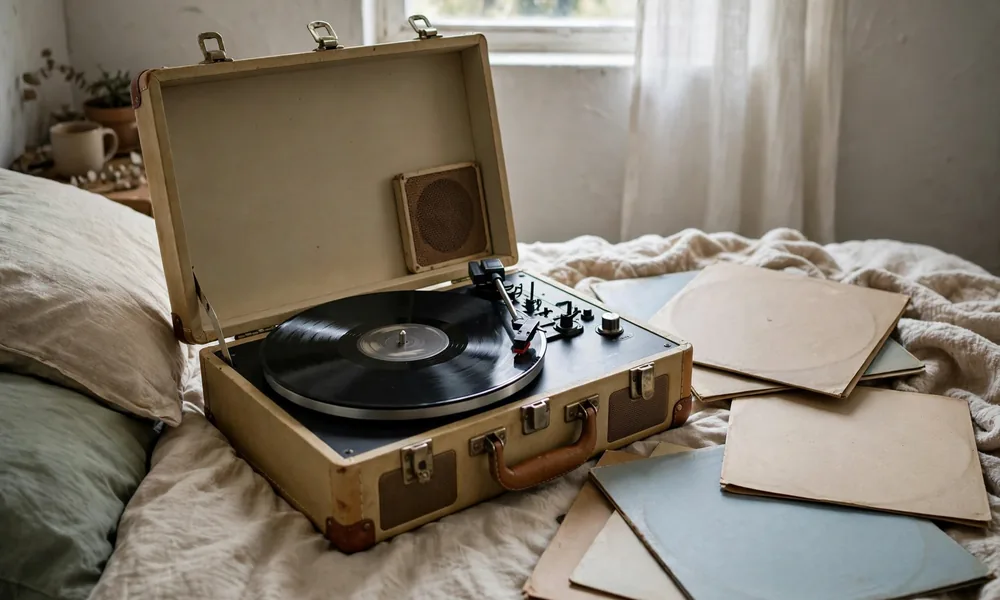
The suitcase player is the one everyone recognises: a latching case with a handle, a turntable inside the lid, and small speakers in the base. It is the best gift record player and the best choice for a bedroom or a student flat. The good ones have a replaceable stylus, a belt-drive platter and a headphone socket. Expect honest, small-room sound rather than room-filling bass, and buy it for charm and portability rather than fidelity.
2. The Wooden Console Player
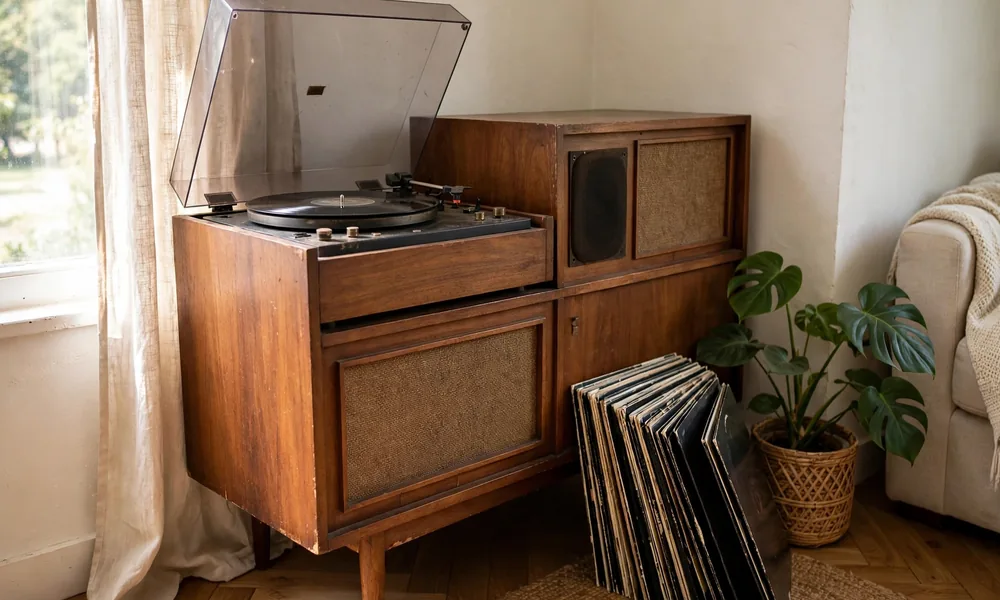
The wooden console is the living-room record player: a walnut or oak cabinet that sits on a sideboard and looks like furniture rather than a gadget. Inside is a proper belt-drive deck with a moving-magnet cartridge, front-facing speakers, and usually a radio and Bluetooth as well. It is the best all-round choice for most buyers, because the bigger cabinet fits bigger speakers and a heavier platter, and that weight keeps speed steady and vibration down.
3. The All-in-One With Detachable Speakers
Some all-in-ones split the difference: the turntable and amplifier live in one unit, and the speakers sit beside it on short cables. You get a wider stereo image than a single box can manage. This is the best type for a small flat where a full hi-fi is too much but a single box sounds too narrow. Check the speaker cables are long enough for your shelf, because small speakers driven hard distort quickly.
4. The Bluetooth-Out Player
A Bluetooth-out player is for people who already own a good speaker. It plays records through its own small speakers, but it can also send the sound wirelessly to a Bluetooth speaker or headphones. Check that the player also has a wired output, because Bluetooth adds a small delay and a little compression, and a cable always sounds a touch cleaner. Our guide to the best Bluetooth speakers in 2026 will help if you need a speaker to pair with one.
Record Players Compared at a Glance
| Type | Best for | Sound | Portability | Value |
|---|---|---|---|---|
| Suitcase player | Gifts, bedrooms, students | Small, charming, thin bass | Excellent | Good |
| Wooden console | Living rooms, first collections | Warm, full, room-filling | None | Excellent |
| Detachable speakers | Small flats, wider stereo | Clear, wider image | Fair | Very good |
| Bluetooth-out | Owners of a good speaker | As good as your speaker | Good | Good |
The wooden console wins on value for most buyers. The suitcase wins on charm and portability, and the Bluetooth-out model wins if you already own a speaker worth playing through.
What Actually Decides How a Record Player Sounds
Three things decide the sound, and none of them is the price tag. The first is speed stability: a record must spin at a rock-steady 33⅓ revolutions per minute, and a light, wobbly platter cannot hold that speed. Pianos sound seasick and voices wobble. A heavier platter and a belt drive fix most of this, which is why the wooden consoles sound steadier than the suitcase players.
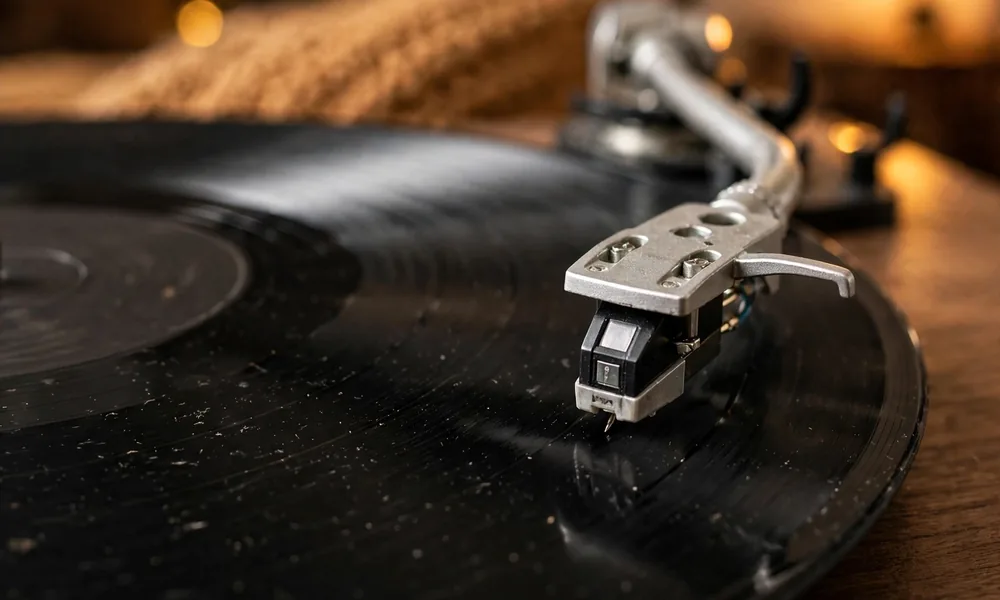
The second is the stylus, the tiny diamond tip that rides in the groove. A decent stylus pulls far more detail from a record than the ceramic needle fitted to the cheapest players, and it treats the groove far more kindly. A diamond stylus lasts roughly 500 to 1,000 hours of playing, and then it needs replacing. That is normal, like changing the tyres on a car, and it is why a replaceable stylus is the single most important feature on any record player you buy.
The third is the speakers. Built-in speakers are small by necessity, so bass is always the first thing to go. That is fine for a bedroom, but if you want the low end to land properly, you need an output: a line-out or Bluetooth-out that lets you bypass the built-in speakers. If you want to build a bigger system later, our guide to the best speakers in 2026 shows what a separates speaker can add.
Protecting Your Records: The Part Nobody Talks About
A record player either looks after your records or slowly damages them, and the difference is measured in grams. The tracking force, the weight pressing the stylus into the groove, should sit around 1.5 to 2 grams. The cheapest suitcase players press down with three or four times that, because their tonearms have no counterweight. Play a favourite album a dozen times on one and the high notes start to go fuzzy; play it a hundred times and the damage is permanent.
So check two things before you buy: can the stylus be replaced, and does the tonearm have an adjustable counterweight or a properly balanced arm? If the answer to both is yes, your records are safe. Then look after them yourself: brush each side before playing, store records upright out of sunlight, never stack them flat, and keep the player on a level surface away from the speakers, because speaker vibration feeds back through the needle and muddies the sound.
What to Avoid When Buying a Record Player
The worst record players share the same flaws. The first is a non-replaceable stylus: a wear item that needs replacing after hundreds of hours, fitted to a player that cannot take a new one. That player is disposable, however pretty it looks. The second is a platter so light it feels like a toy; if it wobbles when you spin it with a fingertip, walk away. The third is a player that sells features rather than fundamentals. Bluetooth, USB recording and flashing lights are fine extras, but none makes a record sound better, and a player that leads with its feature list is usually hiding a weak mechanism.
Before You Buy: A Quick Checklist
- Confirm the stylus is replaceable and that spares are easy to buy for that model.
- Check the tonearm has an adjustable counterweight or is properly balanced.
- Lift the platter: it should feel heavy, flat and true, not light and wobbly.
- Check for an output, line-out or Bluetooth-out, so you can use better speakers later.
- Match the type to the room: suitcase for a bedroom, console for a living room.
- Put the player on a level, solid surface away from the speakers before you judge the sound.
Frequently Asked Questions
Do I need a separate amplifier or speakers?
No. An amplifier and speakers are built in, which is the whole point of one. You only need separate speakers for bigger sound, and then you need a player with an output.
Will a record player damage my records?
A good one will not; a bad one will. The damage comes from a heavy, unbalanced tonearm and a fixed ceramic needle pressing too hard on the groove. Buy a player with a replaceable stylus and a balanced arm, keep your records clean, and they will last for decades.
How long does a stylus last?
A diamond stylus typically lasts 500 to 1,000 hours. If the sound distorts or high notes turn fuzzy, replace it. A worn stylus damages records, so do not put it off once you hear the change.
Is Bluetooth on a record player worth it?
Bluetooth-out is worth having if you already own a good speaker or headphones, because it lets the player sound far better than its built-in speakers. Bluetooth-in is a nice extra, not a reason to choose one player over another.
Can I play 45s and 78s on a record player?
Most play 33⅓ and 45 rpm, and many include the adaptor for the large centre hole on 7-inch singles. Few play 78s, which need a different stylus, so check the speeds first if you have old shellac records.
When should I buy a turntable instead?
Buy a turntable when you want better sound within a year and are happy to add an amplifier and speakers. If you want music in the room tonight with no extra boxes, a record player is the right call.
The Bottom Line
The best record player in 2026 respects your records and fits your room: a real mechanism with a replaceable stylus, a platter with some weight behind it, speakers that suit the space, and an output for the day you want more. Buy a suitcase for a bedroom or a gift, a wooden console for the living room, and a Bluetooth-out model if you already own a speaker you love. Skip the cheapest players, skip the gimmicks, and spend your money on the mechanism.