
The Worst Shuttles to Send Packing: The Worst Sports Shuttles of 2026
The worst sports shuttles of 2026 are not the ones with the oldest buses or the plainest paint. The worst sports shuttles fail in much more basic ways: they turn up once an hour, or not at all, they pack fans in until the doors will not close, they drop you a long walk from the gates, or they leave for home before the final whistle. This guide ranks the worst types of sports shuttle in 2026 by the damage they do to a fan’s day.
Key takeaways
- The worst sports shuttles are service types, not operators: the same seven failures turn up at grounds in every sport and every city.
- Frequency is everything: a shuttle that runs once an hour is barely a service, and a queue that never moves is a missed kick-off.
- A shuttle that drops you far from the gates has already failed: the walk, the weather and the dark all count against it.
- The return journey matters as much as the ride in: a shuttle with no buses after the match strands the crowd it brought.
- Check the timetable, the drop-off point and the last bus home before you rely on a shuttle, and walk away from any service that hides them.
How the worst sports shuttles were ranked
Every type below was scored on five measures. Frequency comes first: how often does a bus actually turn up, and does the service match the crowd or leave fans standing in a queue that never moves? Capacity is second, judged on whether fans get a seat or a safe place to stand, or a door that will not close. The drop-off is third: how far the bus stops from the gates, and whether the walk is paved, lit and safe. The return service is fourth, because a shuttle that gets fans there and forgets to get them home is only half a service. Clarity is fifth: does the service publish real times and real stops, or do fans have to guess?
Two notes before the list. First, no real operator is named here, because the same seven shuttle types turn up everywhere. Second, this is about the shuttle service itself, not the building it serves: our guides to the worst sports stadiums of 2026 and the worst sports tickets of 2026 cover the venue and the ticket that fail in their own ways.

Comparison table: the worst sports shuttles of 2026
| Rank | Shuttle type | Main fault | Worst moment |
|---|---|---|---|
| 1 | The once-an-hour shuttle | One bus an hour, if it comes | Hearing kick-off from the queue |
| 2 | The crush-load shuttle | Packed past the safe limit | Doors that will not close |
| 3 | The far drop-off shuttle | Stops a long walk from the gates | Forty minutes in the rain |
| 4 | The no-return shuttle | Last bus leaves before full time | No way home after the whistle |
| 5 | The mystery-timetable shuttle | No times, no stops, no answers | Waiting at the wrong stop |
| 6 | The single-door shuffle | One narrow door for everyone | Boarding that takes an hour |
| 7 | The step-too-high shuttle | No step-free boarding at all | Watching your bus drive past |
The worst sports shuttles of 2026
1. The once-an-hour shuttle: the worst shuttle of all
The once-an-hour shuttle is the worst type of sports shuttle, because it fails at the one job a shuttle has. A shuttle exists to move a crowd quickly, in a steady stream, from the station or the car park to the gates, and a service that runs once an hour cannot do that for a crowd of thousands. The first bus fills before it leaves, the second is an hour away, and the fans at the back are still standing there when the match starts. Count the buses in the hour before kick-off, not the buses on the poster, and if the answer is one, make another plan.
2. The crush-load shuttle: packed past the safe limit
The crush-load shuttle looks like a success until you try to get on it. The bus arrives, the doors open, and the crowd pushes forward, and the driver waves more people in long after every seat is taken and every handrail is held. Fans stand in the aisle, pressed against the doors, with bags on their laps and elbows in their ribs, and the bus pulls away with the door alarm still sounding. A sudden stop throws the standing crowd forward, and nobody can reach a handrail. If the aisle is already full, wait for the next one.
3. The far drop-off shuttle: a walk, not a ride
The far drop-off shuttle keeps its promise in the narrowest way: it takes you toward the ground, but it drops you off so far away that the ride barely matters. You step off into a car park, a trading estate or a field on the edge of town, and the ground is a distant shape on the horizon. The walk takes forty minutes in the rain, over unpaved ground, past fences and roundabouts, with no signs and no lights, and by the time you arrive your shoes are ruined and your temper is gone. A good drop-off is under fifteen minutes on a paved, lit route: ask where the bus actually stops.
4. The no-return shuttle: home is your problem now
The no-return shuttle is the service that gets you there and forgets to get you home. The buses run well before the match, every few minutes, with stewards and signs and a proper queue, and the ride in feels like a service that knows what it is doing. Then the match ends, the crowd pours out of the gates, and the stop is empty. The last bus left before full time, or the service simply stops when the match starts, and nobody told the fans. Get the last bus home in writing before you board, with a time and a stop, and have a backup plan.
5. The mystery-timetable shuttle: no times, no stops, no answers
The mystery-timetable shuttle is the service that expects fans to guess. There is no timetable at the stop, no times on the website, and no announcements at the station, just a bus stop with a faded sign and a queue of people who all look as lost as you are. The buses turn up when they turn up, or they do not, and nobody can say which stop is the right one, because the stops have no names, no numbers and no maps. A good shuttle publishes real times and real stops, and sticks to them: if nobody can say when the next bus comes, do not rely on it.
6. The single-door shuffle: one narrow door for everyone
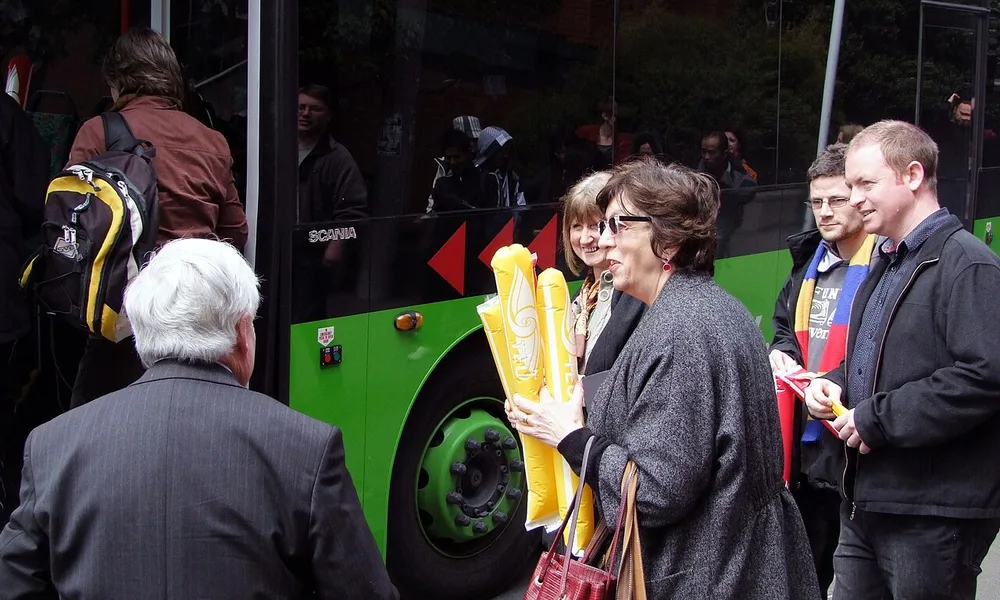
The single-door shuffle is the shuttle that moves at the speed of its narrowest point. The bus has one door, or one door that works, and every fan must file through it, one at a time, with bags, coats, scarves and children, while the queue behind them stretches back around the corner. Boarding takes an hour for a bus that holds fifty people, because each person must climb the step, find the fare, stow the bag and find a seat, and the driver cannot leave until the last one is in. A bus with two wide doors and a flat floor boards in minutes: look at the door before you queue.
7. The step-too-high shuttle: no way on board
The step-too-high shuttle is the service that leaves some fans behind before it even starts. The bus has a steep step, a narrow doorway and no ramp, no kneeling suspension and no space for a wheelchair, a pushchair or a fan with a bad knee. The driver cannot lower the bus, the step is too high to climb safely, and the fan watches their bus drive past, full of people who could climb aboard, while they wait for the next one, which will be exactly the same. Step-free boarding is standard on any modern bus: check the bus itself, not the poster, before you queue.
What to avoid when relying on a sports shuttle
The most common shuttle regret is not a bad bus but a wrong assumption: that the shuttle runs often, stops close and comes back after the match, when it does none of those things. Avoid the trap by checking three things before you rely on it: the timetable, the drop-off point and the last bus home, in that order. Count the buses in the hour before kick-off, find the stop on a map, and get the return time in writing. The same checks work for the rest of matchday too, and our guide to the worst stadium parking of 2026 makes the same point about checking the walk, the payment and the exit first.
Checklist: using a sports shuttle
- Count the buses in the hour before kick-off, not the buses on the poster.
- Look at the bus before you board: if the aisle is full and the doors will not close, wait.
- Find the drop-off point on a map: if the walk is over fifteen minutes on an unlit route, make another plan.
- Get the last bus home in writing, with a time and a stop, and check extra time.
- Look for a real timetable with named stops and real times: if nobody can say when the next bus comes, do not rely on it.
- Check the boarding before you queue: a low floor, a ramp and two wide doors mean a fast, safe ride for everyone.
Frequently asked questions
How often should a matchday shuttle run?
Every few minutes when the crowd is moving, with buses staged and ready before the gates open. A service that runs once an hour cannot move a crowd of thousands, and the queue will still be standing there when the match starts.
How far should the shuttle drop me from the gates?
Close enough to walk in under fifteen minutes on a paved, lit route, with signs from the stop to the gates. Anything further needs a proper stop and a lit path.
What should I do if there is no bus after the match?
Do not rely on the shuttle in the first place. Get the last bus home in writing before you board, with a time and a stop, and have a backup plan: a train time, a taxi number, or a walk you are willing to make. A shuttle with no return is a one-way ride.
Is a packed shuttle safe to ride?
No, not past the safe limit. A bus with a full aisle, fogged windows and doors that will not close is slow, hot and frightening, and a sudden stop throws the standing crowd forward. If the bus is already full before you step on, wait for the next one.
Can I take a wheelchair or pushchair on a matchday shuttle?
Only if the bus has a low floor, a working ramp and a marked space inside. Check the bus itself before you queue, not the promise on the poster, and ask staff whether the service is step-free. If it is not, the shuttle is not a service for everyone.
Why do shuttle queues move so slowly?
Usually because the bus has one narrow door, a steep step and a fare box blocking the aisle, so every fan must file through one at a time. A bus with two wide doors and a flat floor boards in minutes. Look at the door before you join the queue.
Bottom line
The worst sports shuttles of 2026 fail at the basics: buses that run once an hour, pack fans past the safe limit, drop you far from the gates, or never come back after the match. Check the timetable, the drop-off and the last bus home before you rely on one, and the shuttle will make matchday easier instead of getting in its way.


