
Why Napkin Rings Still Belong on a Dressed Table in 2026
Napkin rings are the smallest item on a dressed table, and the easiest to dismiss as old-fashioned. Yet napkin rings still belong on a dressed table in 2026, because no other detail does so much for so little money: a simple ring turns a folded napkin into a deliberate place setting, gives the table a finished look before a single plate of food arrives, and tells guests that the evening has been thought about. In a year when home entertaining is more relaxed than ever, that small signal matters more, not less. A dressed table does not have to be formal to be cared for.
Key takeaways
- Napkin rings turn a folded napkin into a finished place setting for very little cost.
- They work best when they match the mood of the meal, not when they try to outshine it.
- Metal suits formal evenings; wood, rattan and linen suit relaxed, everyday hosting.
- Buy rings in sets of eight or twelve so you are never short a place at the table.
- A ring should hold the napkin firmly without crushing it or leaving a crease.
What a napkin ring actually does
It is worth being honest about what a napkin ring is for. It does not keep a napkin clean, and a meal served without one is not a failure. What it does is visual: it gathers a napkin into a shape, adds a point of colour or texture at every place, and creates rhythm across the table. A table that looks considered makes guests relax, because it signals that the host has everything in hand.
There is a practical side too. A ring keeps a napkin folded neatly between setting the table and sitting down, and it gives each guest an obvious place to return the napkin afterwards. Rings also store neatly: napkins threaded through them stack in a drawer and stay crease-free. For a full guide to the napkins themselves, see our roundup of napkins that make everyday meals feel finished.

Why they fell out of fashion — and why they came back
Napkin rings faded for understandable reasons. Formal dining made them feel stuffy, paper napkins took over weeknight meals, and minimalist styling in the 2010s left no room for a small brass circle. For a while, rings survived only in wedding hire catalogues and grandmother’s sideboards — until relaxed home entertaining brought them back as the cheapest way to make a table feel like an occasion.
Choosing a material that fits your table
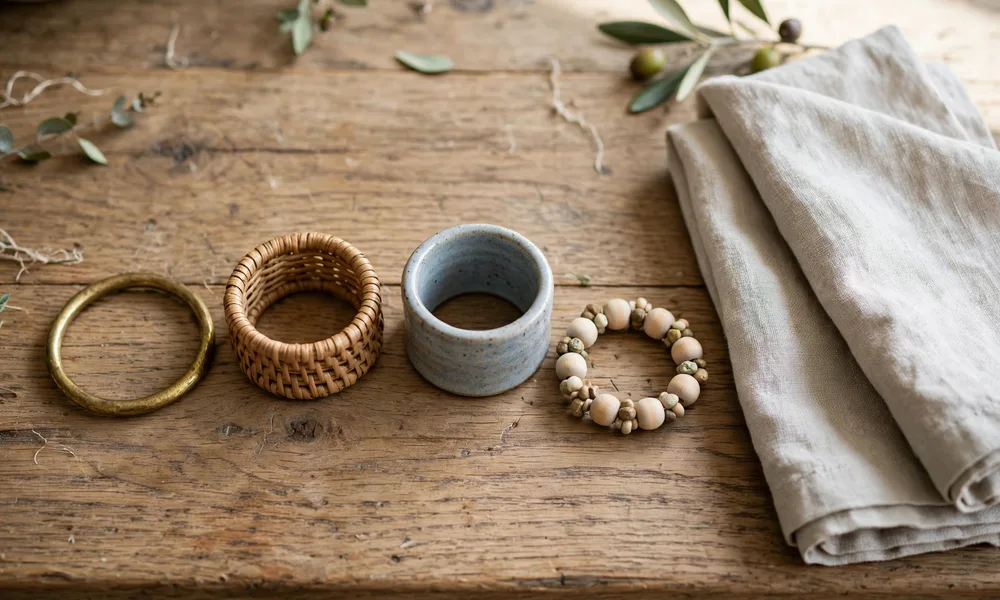
Material is the first decision, and it sets the tone of the whole table. Metal rings — brass, gold-toned, silver or pewter — are the most formal and durable, and brass in particular has had a strong revival. Wood and rattan are the relaxed alternative: warm, honest and almost impossible to get wrong. Ceramic rings come in the widest range of colours but are the most fragile, while beaded and fabric rings are softer and more playful, though they stain more easily.
Wood and rattan are the relaxed alternative. A wooden ring in oak or walnut feels warm and honest, works with linen and stoneware, and is almost impossible to get wrong. Rattan and woven rings bring texture and a slightly rustic feel that suits summer lunches and outdoor tables. Ceramic rings are the most decorative option and come in the widest range of colours, from plain white to deep glaze blues, but they are the most fragile and the least forgiving if dropped on a hard floor. Beaded and fabric-covered rings are softer and more playful, good for festive tables and children’s places, though they stain more easily. Leather rings, usually a loop with a stud or knot, look smart and modern, but they need to be kept dry. As a rule, match the ring to the plates rather than to the cutlery: a rustic ring with fine china looks confused, while a polished ring with stoneware looks like it wandered in from another dinner.
Size, shape and the napkin itself
A napkin ring that is too tight is worse than no ring at all. The standard inner diameter of about four to five centimetres suits a folded linen or cotton napkin, but thick linen, double-folded napkins and larger dinner napkins need more room. Before buying a set, test one ring with the actual napkins you use: the napkin should slide through with gentle pressure and sit with a soft, full shape, not squeezed into a thin cord. If you have to force it, the ring is too small, and the napkin will come out creased and reluctant. If the napkin slides straight through and flops, the ring is too big.
Shape matters more than most people expect. A plain round ring is the most versatile and suits almost any fold, while an oval ring holds a flat fold well and looks elegant on a plate. Sculptural rings make a stronger statement but can be awkward with thicker napkins. The rest of the table matters too, so consider how the ring sits with the runner and mats, as in our guide to table runners worth dressing the table with.
How to fold and place a napkin with a ring
The simplest fold is also the most reliable. Lay the napkin flat, fold it into a long rectangle, then roll or fold it loosely and slide the ring to the middle. Place it on the plate, or to the left of the fork if the plate needs to stay clear for a starter. Avoid tight, complicated folds: they look fussy, they crush linen, and they come undone the moment a guest picks the napkin up.
Comparing napkin ring styles
| Style | Best for | Watch out for | Price |
|---|---|---|---|
| Brass or gold-toned metal | Formal evenings, festive tables | Cheap versions look brash; can tarnish | Mid-range |
| Silver or pewter | Classic settings, white linen | Needs polishing; cool tone | Mid to high |
| Wood | Everyday hosting, rustic tables | Can stain if left damp | Low to mid |
| Rattan or woven | Summer lunches, outdoor dining | Can fray; not for formal meals | Low |
| Ceramic | Colour and decoration | Fragile; chips on hard floors | Mid-range |
| Beaded or fabric | Festive tables, playful settings | Stains easily; harder to clean | Low to mid |
Styling rings for different occasions
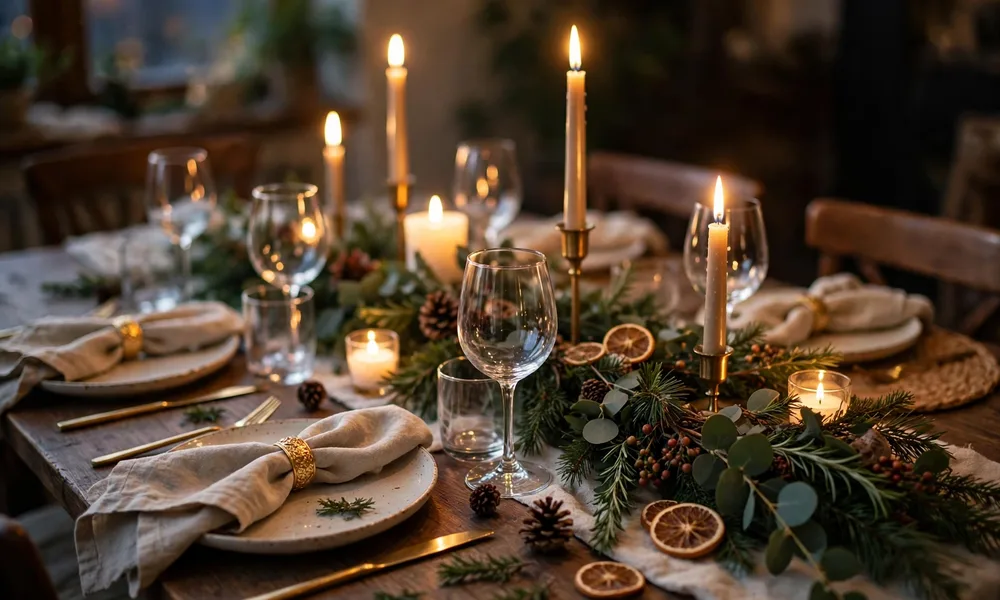
For a weeknight supper, keep it simple: wooden or plain metal rings, a folded linen napkin, nothing else. For a Sunday lunch, add a sprig of rosemary tucked through the ring. For a festive table, bring out the decorative set, and for a summer lunch outdoors, rattan rings and lighter linen keep the table from feeling heavy.
Colour is worth a thought. A ring does not have to match anything exactly — a brass ring against grey-blue linen, or a wooden ring against white linen on a dark wood table, creates contrast that makes both stand out. If your plates are patterned, choose a plain ring; if they are plain, a textured ring adds interest. If your mats need attention too, our guide to placemats that protect the table and dress it up covers the options that sit best beneath a ringed napkin.
Buying, caring and storing
Buy in sets of eight or twelve, even if you usually host six. Rings go missing, and a set that is one short cannot dress a full table. When buying, check that every ring in the set is the same size — handmade rings, especially ceramic and rattan, can vary — and read the measurements rather than trusting the photograph if you buy online.
Care is straightforward. Metal rings wipe clean with a soft cloth and, for brass and silver, an occasional polish. Wooden rings need to be kept dry and can be refreshed with a drop of food-safe oil if they look pale. Rattan rings should be brushed free of dust and kept out of damp. Ceramic rings go in the dishwasher only if the maker says so — many glazes do not like the heat. Store rings threaded onto a spare napkin or in a small cloth bag so they do not scratch each other, and keep metal and ceramic apart. A drawer divider or a small box is enough; rings are small, and a tidy store is what keeps a set complete.
Common mistakes to avoid
The first mistake is buying rings that are too small for your napkins, which leaves every napkin creased. The second is mixing too many styles on one table: one set, one material, every place the same. The third is over-decorating, and the fourth is using rings with paper napkins, where they tear the paper and look like a joke. Match the ring to the evening, and the table will look right without trying too hard.
Napkin ring checklist
- Test one ring with your actual napkins before buying a full set.
- Buy eight or twelve so you are never a ring short at a full table.
- Match the ring material to your plates and the mood of the meal.
- Keep the fold simple: a loose roll or rectangle, ring at the middle.
- Place every setting the same way, on the plate or left of the fork.
- Remove rings before washing napkins, and store rings so they cannot scratch each other.
Frequently asked questions
Are napkin rings old-fashioned?
They were out of fashion for a while, but they are back because relaxed, thoughtful home entertaining is back. A simple ring in wood, brass or rattan reads as considered rather than formal, and it suits the way most people host now: often, casually, and with care.
What size napkin ring do I need?
Most rings have an inner diameter of about four to five centimetres, which suits a folded linen or cotton dinner napkin. Test with your own napkins first: the napkin should slide through with gentle pressure and hold a soft, full shape without being squeezed thin.
Do napkin rings go on the plate or beside it?
Either is fine. On the plate is the classic position and the most visible. To the left of the fork is practical when a starter plate is already in place or the table is crowded. Keep every place setting the same whichever you choose.
Can I use napkin rings with paper napkins?
It is best not to. Paper napkins tear, crease and look wrong in a ring, and the ring itself can look like a joke. Save rings for cloth napkins, even inexpensive cotton ones, which are what make the effect work.
How do I keep brass napkin rings from tarnishing?
Wipe them with a soft dry cloth after use and store them in a cloth bag or lined box away from damp. An occasional polish with a gentle brass cleaner restores the shine, and many hosts like the soft patina that develops if they are left unpolished.
How many napkin rings should I buy?
Buy a set of eight or twelve, even if you usually host fewer people. Rings get lost or borrowed, and a set that is one short cannot dress a full table. Twelve covers most gatherings and leaves you with spares.
The bottom line
Napkin rings still belong on a dressed table in 2026 because they do the smallest job with the biggest return: they make a table look considered, they keep napkins tidy, and they cost less than almost anything else on the table. Choose a simple ring in a material that suits your plates, buy enough for the whole table, and keep the fold relaxed. The table will look finished before the food arrives, and your guests will feel it the moment they sit down.


