The best pet trackers in 2026 can tell you where your dog or cat is within a few metres, almost anywhere they roam, from a device smaller than a matchbox clipped to a collar. If your dog has ever slipped the lead at the park, or your cat has vanished overnight, you know the worry a tracker is built to end. This guide explains how to choose one: how tracking works, what the accuracy numbers mean, what the subscription really costs, and which features matter most.
A pet tracker is not the small disc that finds your keys. Key finders borrow nearby phones to report a location and go quiet where there are no phones around. A real pet tracker carries its own GPS receiver and mobile connection, so it reports your pet’s position from an empty field or a country lane — exactly the situation you bought it for.
Key Takeaways
- A real pet tracker uses GPS plus a mobile connection, so it works far from home — unlike a Bluetooth key finder.
- Live tracking updates every few seconds on the best models; budget trackers may update only every minute or two.
- Check the subscription first: most GPS trackers charge monthly, and it can cost more than the tracker over two years.
- Weight matters most for cats and small dogs: a tracker should be under five percent of your pet’s body weight.
- Safe zones and escape alerts are the features owners use most — test how fast the alert arrives.
How a Pet Tracker Actually Works
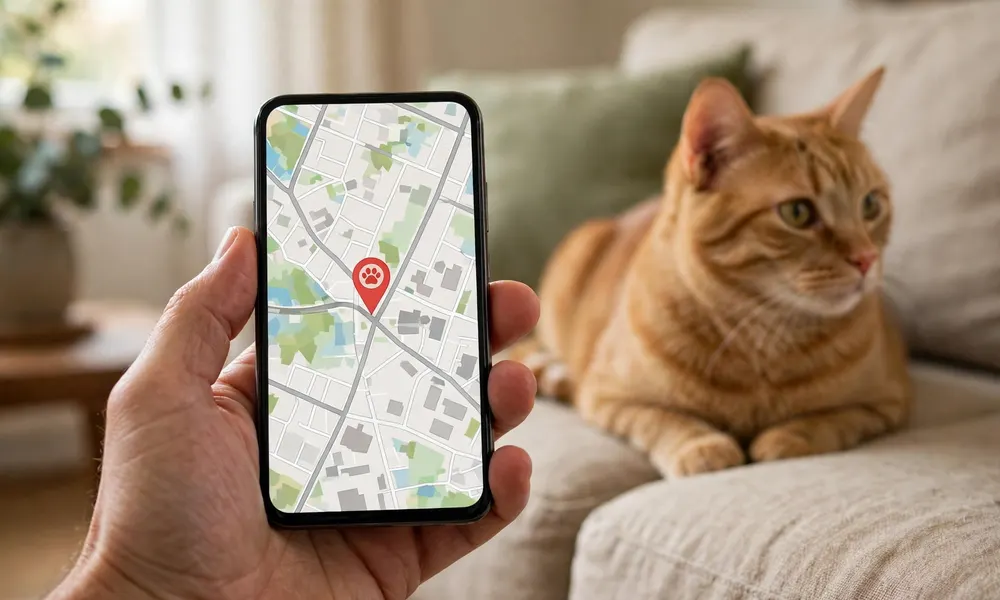
A pet tracker is a GPS receiver, a mobile modem, and a battery in a waterproof case that clips to a collar or harness. The GPS receiver works out its position from satellites, usually to within five to ten metres outdoors, and the modem sends it over the mobile network to an app on your phone, where it appears as a dot on a map.
That mobile connection is why most GPS trackers need a subscription: the tracker is effectively a tiny mobile phone, and somebody pays the network for its data. Some brands include the first year in the price; others charge from day one. A few models use a radio link to a handheld receiver instead, with no subscription, but those only work within a few kilometres and give direction and distance rather than a map pin.
GPS, Bluetooth and Radio: Three Different Tools
GPS trackers suit pets that roam: they cover the country wherever there is mobile signal and show an exact position on a map. Bluetooth trackers, the kind our guide to the best Bluetooth trackers of 2026 covers, are made for keys, wallets and bags — they have no GPS of their own and only report a position when another phone passes nearby. Radio trackers sit in between, pointing you towards your pet like a compass with no phone and no subscription, but you must go out searching yourself.
The Best Pet Trackers of 2026 Compared
| Tracker Type | Best For | Standout Strength | Typical Price |
|---|---|---|---|
| GPS collar tracker | Dogs that roam | Live map tracking anywhere | $40–$100 plus subscription |
| Lightweight GPS tag | Cats and small dogs | Under 25 grams | $35–$80 plus subscription |
| GPS tracker with activity monitoring | Older or unwell pets | Activity reports for the vet | $50–$120 plus subscription |
| Radio tracker with handheld receiver | Rural homes, no signal | No subscription, off-grid | $150–$300, no monthly fee |
| Bluetooth tracker | Pets that stay near home | Cheap, tiny, long battery | $25–$35, no subscription |
| GPS tracker with virtual fencing | Escape artists | Instant safe-zone alerts | $45–$110 plus subscription |
GPS Accuracy: What the Numbers Really Mean
Manufacturers quote accuracy of five to ten metres, and outdoors in open sky that is roughly what you get. Under thick tree cover, between tall buildings, or inside a garage, the signal weakens and the position can jump by twenty or thirty metres, or freeze on the last good reading.
Update speed matters just as much. The best trackers send a new position every two to three seconds, so the dot follows your pet in real time. Budget models may update only every sixty seconds, so a running dog can cover a hundred metres between updates. If your dog is a runner, pay for faster updates; if your cat strolls, a slower rate saves battery.
Battery Life: Days, Not Weeks
A GPS tracker is a radio that is always working, so its battery lasts days, not the year you get from a Bluetooth tag. Most run for two to five days on a charge, and heavy live tracking can drain one in a single day — the trade-off for a live map is charging it like your phone.
Look for a battery that lasts at least three days, charging under two hours, and a low-battery warning that arrives in time to act on. Some models offer a power-saving mode that checks in every few minutes, stretching the battery to a week or more at home.
Size, Weight and Comfort for Dogs and Cats
A tracker only works if your pet wears it. Vets use a simple rule: a collar attachment should weigh less than five percent of the animal’s body weight. That is no problem for a thirty-kilo dog, but for a four-kilo cat anything over about twenty-five grams will be noticed and pawed at, so the lightest trackers are the only sensible choice for cats.
Shape matters as much as weight: a flat tracker that sits against the collar beats a bulky box that swings and catches on bushes, and the attachment must be secure. For cats, use a breakaway collar, which releases if it snags.

Subscriptions: The Hidden Monthly Cost
The subscription surprises most buyers: a fifty-dollar tracker can cost eight dollars a month, nearly two hundred dollars over two years — four times the price of the device. Before you buy, add up the total cost over the time you expect to use it, and compare trackers on that total, not the box price.
Subscriptions come in monthly, yearly, and two-year plans, with longer plans cheaper per month, sometimes by half. Only take a two-year plan once you know the tracker suits your pet. Live tracking, location history, safe zones, and alerts should all be included — be wary of any brand that charges extra for them. Also check coverage: a tracker on one network may have no signal in your area.
Safe Zones and Escape Alerts
Safe zones are the feature owners end up using most. You draw a circle around your home or garden in the app, and the tracker alerts you the moment your pet leaves it. Test the speed: walk the tracker to the end of the street and time the notification. The best systems alert within a minute; the worst can take ten, by which time a fast dog is long gone.
A good alert shows the direction your pet went, how fast they are moving, and whether they have settled. Some apps let you share a live tracking link with family or a neighbour, so someone closer can collect the pet — also useful on holiday, when a pet sitter can watch the same map.
Water, Mud and Real Life
A pet tracker lives a harder life than a phone: rain, puddles, mud, and chewing. Check the waterproof rating: IP67 survives a dunk in shallow water for half an hour, while anything rated only splash-proof will not survive a dog that jumps in the river.
Check the case too: a rugged, rubberised case survives knocks against fences far better than glossy plastic, and a replaceable collar clip means one broken clip does not end the tracker’s life. Dry the tracker and its charging contacts after wet days, because damp charging pins corrode quietly and then refuse to charge.

Pet Trackers and Home Monitoring Together
A tracker tells you where your pet is when they are out; a camera tells you what they are doing when they are in. Our guide to the best pet cameras of 2026 covers cameras that let you talk to your pet and get an alert when barking starts. If you travel with your pet, our guide to the best luggage trackers of 2026 covers trackers that watch suitcases the way a pet tracker watches your dog.
What to Avoid
Avoid any tracker that only works with one phone brand and cannot share locations with the family — the person who finds the dog is rarely the buyer. Avoid trackers with no waterproof rating, and any subscription that hides its price behind a free trial that converts silently. Be cautious of trackers promising one-metre accuracy: GPS does not work that precisely on a device this size.
Finally, avoid buying on size alone: the smallest tracker is not the best if its battery lasts a day and its updates arrive once a minute. Choose the lightest tracker that still gives live updates, a battery of at least two days, and a safe-zone alert within a minute — that combination is what makes a tracker useful on the day your pet goes missing.
Checklist: Before You Buy a Pet Tracker
- Check the total cost: device price plus the subscription over two years, not the box price alone.
- Weigh your pet: the tracker must be under five percent of body weight, and under 25 grams for a cat.
- Confirm the tracker uses a mobile network with signal where you live and where your pet roams.
- Test the safe-zone alert speed: it should arrive within a minute of the tracker leaving the zone.
- Check the waterproof rating is at least IP67 if your dog swims or your cat hunts in wet weather.
- Make sure the app shares live location with family, so whoever is nearest can collect your pet.
Frequently Asked Questions
Do pet trackers need a subscription?
Most GPS pet trackers do, because they use the mobile network to report their position. Bluetooth and radio trackers usually do not, but they only work at short range. Always check the monthly price first.
How accurate are pet trackers?
Outdoors in open sky, most GPS pet trackers are accurate to within five to ten metres. Under trees, between buildings, or indoors, the position may be twenty or thirty metres out.
Will a tracker work for a cat?
Yes, if it is light enough: choose a tracker under 25 grams on a breakaway collar, and expect a smaller battery, so charge it more often. Cats hide better than dogs, so a precise last-known position matters most.
Can I track my pet without mobile signal?
A GPS tracker can work out its position without signal, but it cannot send it to your phone until it reconnects. Where there is no signal, a radio tracker with a handheld receiver is better.
How long does a pet tracker battery last?
Most GPS pet trackers last two to five days on a charge, and less than a day with constant live tracking. Power-saving modes can stretch that to a week or more at home.
Is a Bluetooth tracker enough for a pet?
Only if your pet never leaves the neighbourhood and stays near people with compatible phones. A Bluetooth tracker has no GPS of its own, so it cannot report a position from an empty field or a wood.
The Bottom Line
The best pet trackers in 2026 balance live updates, a battery of at least two or three days, a weight your pet forgets, and a subscription you can afford for years, not months. Buy for your pet’s habits: a light GPS tag with fast alerts for a roaming cat, a rugged collar tracker with a big battery for a dog that runs, and a radio tracker if you live beyond mobile signal. Test the safe-zone alert on day one, charge it on a routine, and share the live map with your family — the tracker that finds your pet is the one that is charged, attached, and watched.