
The best SUVs for city driving in 2026 are not the biggest or most powerful. They fit into a standard parking bay, turn around on a narrow street in one move, and sip fuel while the traffic barely moves. A city rewards short length, a tight turning circle, light weight and a clear view, and the SUVs that win here are built around those qualities, not motorway speed or towing muscle.
City driving is a very different job from the one most SUVs are advertised for. The average urban trip is short, slow and full of stops: school runs, supermarket car parks, multi-storey ramps and streets with cars parked on both sides. An SUV that feels superb on an open road can be a daily punishment here, while a smaller, lighter one slips through the same streets without a second thought.
This guide ranks the SUV types that cope best with city life, judged on length, width, turning circle, weight, visibility, ride and fuel or energy use in stop-start traffic. Every pick scores well on at least five of those seven measures, and the table below compares them at a glance.
Key Takeaways
- A turning circle under 10.5 metres is the biggest advantage in a city, turning U-turns and tight car-park exits into one smooth move.
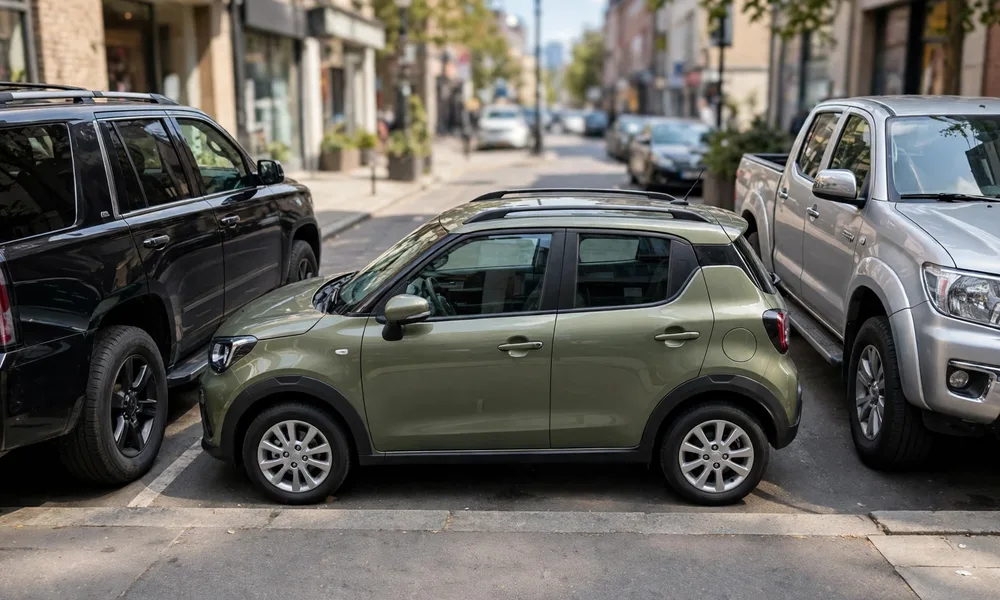
- SUVs shorter than 4.4 metres fit standard 4.8-metre parking bays comfortably, leaving room to open the doors and unload.
- Light SUVs use far less fuel in stop-start traffic, where every pull-away is paid for.
- Hybrid and electric SUVs shine in town because they recover energy every time you brake and use almost nothing while waiting at lights.
- Good visibility matters more than cameras alone: a high seat, slim pillars and a large rear window beat a bigger car with more sensors.
How We Judged the Best SUVs for City Driving
Every type here was judged on city life first. We started with length and width, because they decide whether a car fits the parking spaces a city provides, then looked at turning circle, weight, visibility, low-speed ride and fuel or energy use in walking-pace traffic.
We also weighed the things that make daily driving less tiring: light steering at parking speeds, a smooth automatic gearbox, quiet running at low speed, and driver aids that help in town, such as a 360-degree camera. A type that scored badly on three or more measures did not make the list, however good on a motorway.
The Best SUVs for City Driving at a Glance
| SUV type | Length | Turning circle | Best for | City score |
|---|---|---|---|---|
| Compact hybrid SUV | About 4.2 m | About 10.2 m | Low fuel bills | 9/10 |
| Small electric SUV | About 4.2 m | About 10.4 m | Silent in traffic | 9/10 |
| Subcompact crossover | About 4.1 m | About 10.0 m | Tightest parking | 9/10 |
| Mid-size hybrid SUV | About 4.6 m | About 11.0 m | For families | 8/10 |
| Compact plug-in hybrid SUV | About 4.5 m | About 10.8 m | Short electric trips | 8/10 |
| Small diesel SUV | About 4.3 m | About 10.6 m | Mixed journeys | 7/10 |
1. Compact Hybrid SUV — Best Overall
The compact hybrid SUV is the best all-round city SUV in 2026 because it turns the city’s worst feature, constant stopping and starting, into a strength. Every time you brake, the electric motor recovers energy a petrol-only car would waste, and at low speed the car often runs on electric power alone. The result is fuel use in town up to a third lower than a comparable petrol SUV. At around 4.2 metres long and under 1.85 metres wide, it fits standard bays with room to spare, turns in roughly 10.2 metres and gives a high, clear view at junctions. For one car that does the school run, the weekly shop and the occasional longer trip, start here.
2. Small Electric SUV — Best for Stop-Start Traffic
A small electric SUV is almost unfairly well suited to the city. It uses no energy while waiting at a red light, accelerates instantly and silently from every stop, and one-pedal driving lets you slow with the accelerator alone in traffic. With no gearbox hunting for gears and no engine vibration at idle, it feels calmer than any combustion car in traffic. Charging at home overnight costs a fraction of a petrol fill-up, and short city journeys are the ones an electric car does cheapest. Before buying, check home charging and boot space: the battery can eat into boot room, so measure it against your pram or weekly shop first.
3. Subcompact Crossover — Best for Tight Parking
If your daily life is tight parking spaces, narrow residential streets and multi-storey car parks, the subcompact crossover will make the least fuss. At around 4.1 metres it is the shortest type here: it slides into gaps other SUVs must pass by, turns in about 10 metres, and steering feels easy at parking speed while fuel bills stay low. The trade-off is space: rear legroom and boot room are modest, so a family of five with a large pram will find it tight, and the ride can be firmer over bumps. For couples, single drivers and small families who value parking anywhere over carrying everything at once, it is the most stress-free SUV in the city, and usually the cheapest to run.
4. Mid-Size Hybrid SUV — Best for Families
Families often assume they need the biggest SUV they can afford, but the mid-size hybrid is the sweet spot: five seats and a full boot without growing into the class that struggles in town. At around 4.6 metres it still fits most standard bays, and its hybrid system keeps fuel use reasonable when fully loaded. The cabin is roomy, the rear doors open wide for child seats, and children get a good view out. Its turning circle of about 11 metres is wider than a compact’s, so three-point turns are more common on narrow streets, and the wider body needs more care around car-park pillars. If you regularly carry four or five people, the extra room is worth those small compromises.
5. Compact Plug-In Hybrid SUV — Best for Short Electric Commutes
The compact plug-in hybrid suits drivers whose daily journeys are short but who still want to drive further without planning charging stops. Its battery covers most urban trips, often 40 to 60 kilometres, on electricity alone, so the school run and commute can be silent and almost free, while the petrol engine covers weekend trips. The catch is weight and price: battery plus engine make it heavier than a regular hybrid, blunting fuel savings once the battery runs out, and it costs more to buy. It only makes sense if you can charge at home or at work: without regular charging it becomes a heavy petrol SUV carrying a battery it never uses.
6. Small Diesel SUV — Best for Longer Mixed Journeys
Diesel has lost ground in cities: short trips from cold never suit a diesel, and many cities now charge older diesels extra to enter. But a small, modern diesel SUV still suits drivers mixing city streets with long motorway runs: economical over distance, relaxed at cruising speed and strong when fully loaded. Buy one only if it fits your pattern and your city’s rules: check the emissions standard and clean-air charges where you drive most, and be honest about how many trips are short, since a diesel that rarely gets warm costs more to maintain and run. If your driving is almost entirely urban, the hybrid types above will serve you better, as our guide to the best hybrid cars for city driving explains.
What Makes an SUV Good in a City
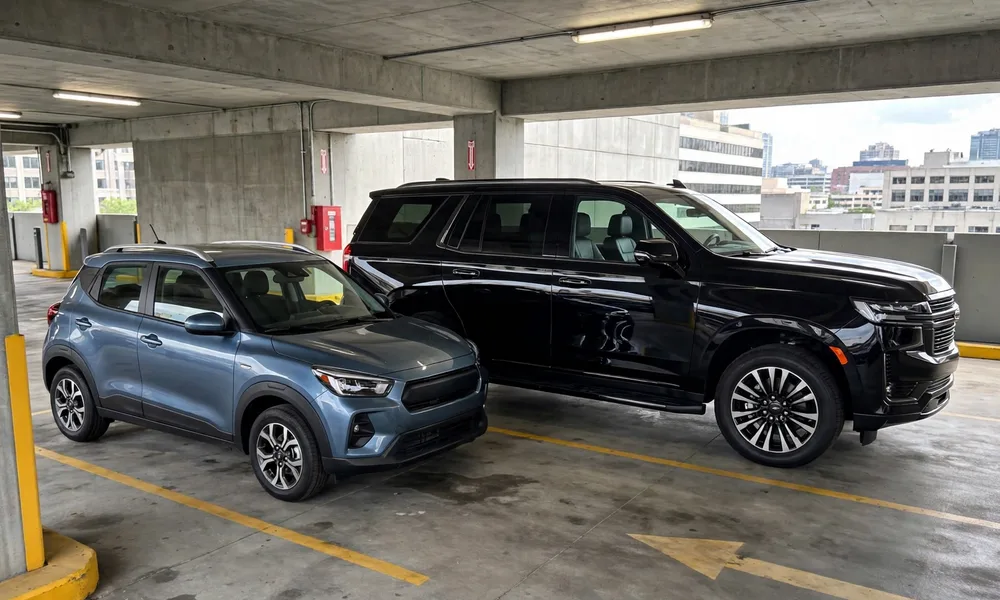
The numbers that matter most are smaller than most buyers expect. A standard bay is about 4.8 metres long and 2.4 metres wide, so an SUV longer than 4.9 metres will overhang it, and one wider than 2 metres including mirrors leaves almost no room to open the doors. A turning circle under 10.5 metres turns a U-turn into one move; anything over 12 metres turns it into a three-point shuffle with traffic building up behind you.
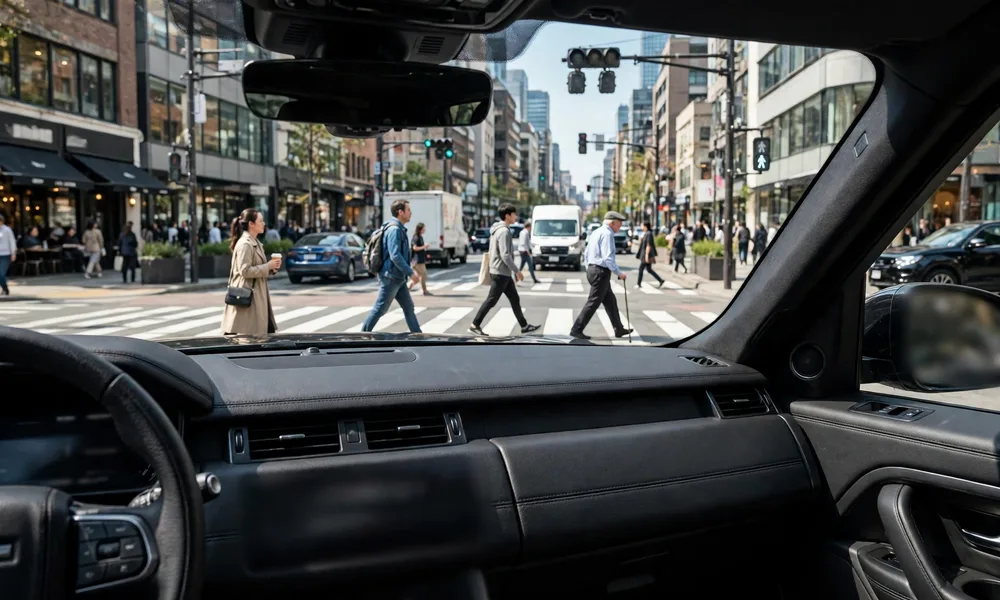
Weight is the hidden cost: a 1,500-kilogram SUV uses noticeably less fuel pulling away from every light than a 2,200-kilogram one, and over a year that difference can add up to hundreds of pounds or dollars. Visibility matters too: a high seat with slim pillars lets you spot a cyclist or a child at a junction, and a large rear window plus a clear reversing camera makes parking far less stressful than a sloping roofline that blocks the view. A 360-degree camera is worth more in a city than anywhere else, and automatic emergency braking that recognises pedestrians is a genuine safety net, while towing capacity and off-road tyres only add weight and cost for a city driver.
City SUV Buying Checklist
- Measure your parking space and garage, then buy an SUV at least 20 centimetres shorter than the space.
- Check the turning circle and test a U-turn on a narrow street.
- Sit in the driver’s seat and check the view at junctions and the blind spots over your shoulder.
- Add up your real weekly journeys and work out whether hybrid, electric or plug-in hybrid running costs fit best.
- Check your city’s clean-air charges and parking rules for the fuel type and size.
- Take the test drive through a multi-storey car park, over speed bumps and into a tight bay.
Frequently Asked Questions
What is the best SUV size for city driving?
Around 4.1 to 4.4 metres long is the sweet spot: SUVs in that range fit standard bays comfortably, turn tightly and keep fuel bills low, while still giving you the high driving position and boot space that make an SUV useful.
Are SUVs good for city driving at all?
Yes, if you choose the right size: a compact or subcompact SUV is easy to park, simple to see out of and comfortable in traffic. The problems start with full-size SUVs over 4.9 metres long, which struggle with parking, narrow streets and fuel use.
Is a hybrid or electric SUV better in a city?
Both are excellent; the choice depends on charging. An electric SUV is cheapest and quietest if you can charge at home, while a hybrid needs no charging and still saves a great deal of fuel in traffic. Drivers who cannot charge at home will find the hybrid simpler.
What turning circle should I look for in a city SUV?
Under 10.5 metres is ideal; under 11 metres is still good. Anything over 12 metres will make U-turns and tight car-park exits a regular chore, so treat a wide turning circle as a warning sign.
Do small SUVs feel safe in city traffic?
Yes. Modern small SUVs carry the same safety equipment as larger ones, including automatic emergency braking, blind-spot monitoring and multiple airbags, and lighter weight means shorter stopping distances. Size alone does not make a car safe.
Should I buy a big SUV if I only drive in the city occasionally?
Probably not: a big SUV’s extra space is rarely used, while its parking and fuel penalties apply every single day. A mid-size hybrid gives most families all the room they need, and hiring a larger car for the rare big trip is usually cheaper than owning one all year. For a different body shape, see the best wagons for city driving and the best sedans for city driving before you decide.
The Bottom Line
The best SUVs for city driving in 2026 are the compact hybrid, the small electric SUV and the subcompact crossover: short, light, easy to park and cheap to run in the traffic a city actually produces. Choose the hybrid for simplicity, the electric if you can charge at home, and the subcompact crossover if parking is your biggest headache. Measure your parking space, test the turning circle on a narrow street, and buy the smallest SUV that genuinely fits your life: in a city, smaller is the advantage.


