
A towel ladder is the simplest fix for a bathroom where towels never quite dry. It is a tall frame of horizontal rungs that leans against the wall or stands on its own feet, giving every bath towel its own rung, with air on both sides. No drilling, no brackets, and a wet towel spread flat over a rung dries in a few hours instead of staying damp until morning.
This guide covers the three kinds of towel ladder worth buying, the sizes that fit real bath towels, the materials that survive steam, and the small details that separate a sturdy ladder from one that slides across the tiles. A ladder that looks good but leaves towels bunched and musty has failed at its only job.
Key Takeaways
- A towel ladder dries towels by spreading them flat over a rung with air on both sides, which beats hooks every time.
- Leaning ladders suit renters and small bathrooms, A-frames suit larger rooms, and wall-mounted ladders suit families.
- Rungs should sit 25 to 30 centimetres apart so a folded bath towel hangs without bunching.
- Stainless steel and powder-coated metal handle steam best, while sealed wood adds warmth but needs care in a damp room.
- Check stability before you buy: wide feet, a gentle lean angle and rubber pads stop a ladder slipping.

What a Towel Ladder Actually Does
A bathroom without a proper place to dry towels is a bathroom where towels end up everywhere: draped over the shower screen, hung from the door, or heaped on the floor. None of those spots lets a towel dry properly, so it turns musty, gets washed more often, and wears out faster. A ladder solves the problem by giving towels air: a bath towel spread flat over a rung dries in a few hours, while the same towel folded over a hook can stay damp until the next morning. That difference matters most in a small bathroom, where steam lingers.
A towel ladder is not the same thing as a towel rack, though the two get confused. A rack is a whole system of bars, rings and hooks fixed to the wall, and our guide to towel racks covers that system in full, including one short section on ladder racks. A towel ladder is one fitting only: a ladder-shaped frame that holds three to five towels, one per rung, each with its own air and space. It is also not a blanket ladder, which holds throws in a living room: our guide to blanket ladders covers that use, while a towel ladder holds wet, heavy bath towels in steam, a harder job that needs different materials.
The size is the first thing to get right. Most towel ladders stand 150 to 180 centimetres tall and 45 to 60 centimetres wide, enough for four or five bath towels without blocking a whole wall. Measure the wall and the towels before you buy: a standard bath towel is about 70 by 140 centimetres, folded in half it needs a rung at least 45 centimetres wide, and a narrower ladder folds the towel into a damp bundle. Check the ceiling as well, because a tall ladder under a low shelf will not lean at the right angle.
Towel Ladder Types Compared
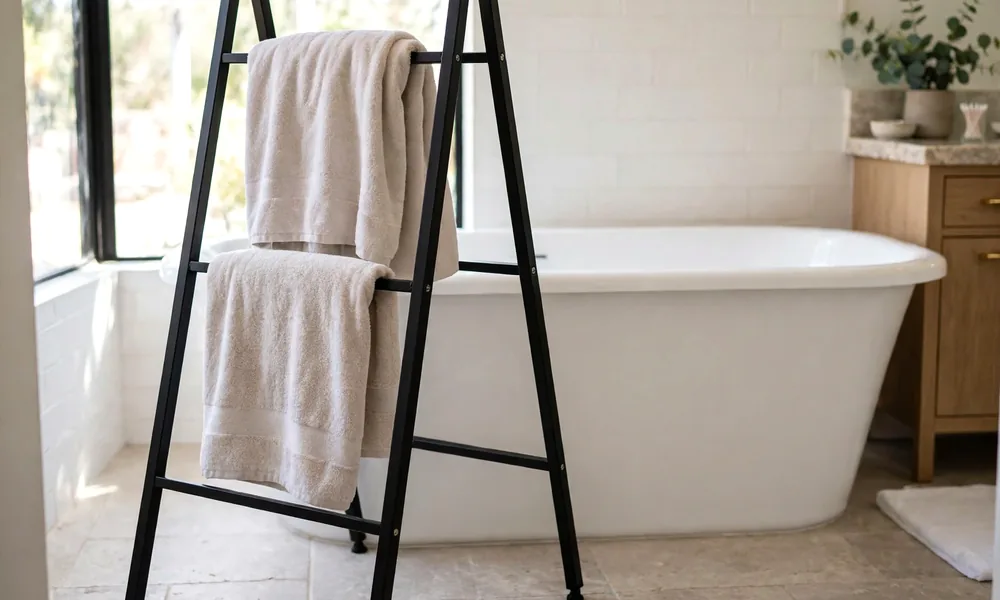
Towel ladders come in three distinct forms, and the form decides whether you drill, how much floor it takes, and how many towels it holds.
| Type | Towels Held | Best For | Needs Drilling | Watch Out For |
|---|---|---|---|---|
| Leaning ladder | 3 to 5 | Renters, small bathrooms | No | Slides on wet tiles |
| Freestanding A-frame | 2 to 4 | Larger rooms, beside the bath | No | Takes floor space |
| Wall-mounted ladder | 3 to 4 | Family bathrooms | Yes | Fixed in one place |
| Folding ladder | 2 to 3 | Guest bathrooms, small flats | No | Less sturdy when open |
If you only buy one towel ladder, make it a leaning ladder. It needs no drilling, it moves in seconds, and it holds the most towels for the wall it takes. A family bathroom is the one exception: a wall-mounted ladder holds up better when four people grab towels off it every morning.
How to Choose the Best Towel Ladder
Start with stability, because a ladder that slides is worse than no ladder at all. A leaning ladder should rest at about 75 degrees to the floor, with its feet flat on the tiles and its top touching the wall. Check the feet first: wide feet spread the load, and rubber pads grip wet tiles where bare wood slides. Press the ladder sideways as soon as it arrives: if it wobbles with two towels on it, it will fall with four wet ones.
Rung spacing matters more than most buyers realise. Rungs should sit 25 to 30 centimetres apart, so a folded bath towel hangs without bunching against the rung below and without dragging on the floor. Rungs closer together look tidy in the shop and dry towels slowly at home, because the fabric bunches up and the air cannot move between the layers. Rungs further apart waste the ladder: a ladder with only three rungs holds three towels, however tall it is. Round rungs dry towels faster than flat rungs, because less fabric touches the wood, but flat rungs hold a folded towel more neatly.
Materials decide how long the ladder lasts in steam. Stainless steel is the safest choice: it resists rust, wipes clean in seconds, and brushed finishes hide water marks better than polished chrome. Powder-coated metal is almost as durable and comes in black, white and brass. Solid wood adds warmth but needs a sealed finish, and unsealed pine in a steamy bathroom will warp, stain and grow mould within a year. Bamboo is the lightest option, but it suits lighter towels rather than heavy wet bath towels. Check the joints whatever the material: rungs fixed with dowels or screws last, while rungs held by glue alone work loose in steam.
Capacity is a matter of counting people, not rungs. Give each person their own rung, because towels bunched together on one rung stay damp and start to smell. A couple needs three rungs, one each plus one spare for a hand towel, and a family of four needs four or five. A single towel bar is the better buy if you only ever dry one bath towel at a time, and our guide to towel bars covers the length, clearance and fixings that make a single bar work. A ladder earns its place when two or more towels need drying at once.
Using a Towel Ladder in a Small Bathroom
A towel ladder suits a small bathroom better than almost any other fitting, because it uses vertical space that would otherwise be empty wall. Put it on the wall beside the bath or the shower, where wet hands can reach it without dripping across the floor, and leave at least 10 centimetres between the ladder and the wall so air moves behind the towels. Do not put it behind the door, where it gets knocked every time the door opens, or above the radiator, where the heat dries the wood out and cracks it.
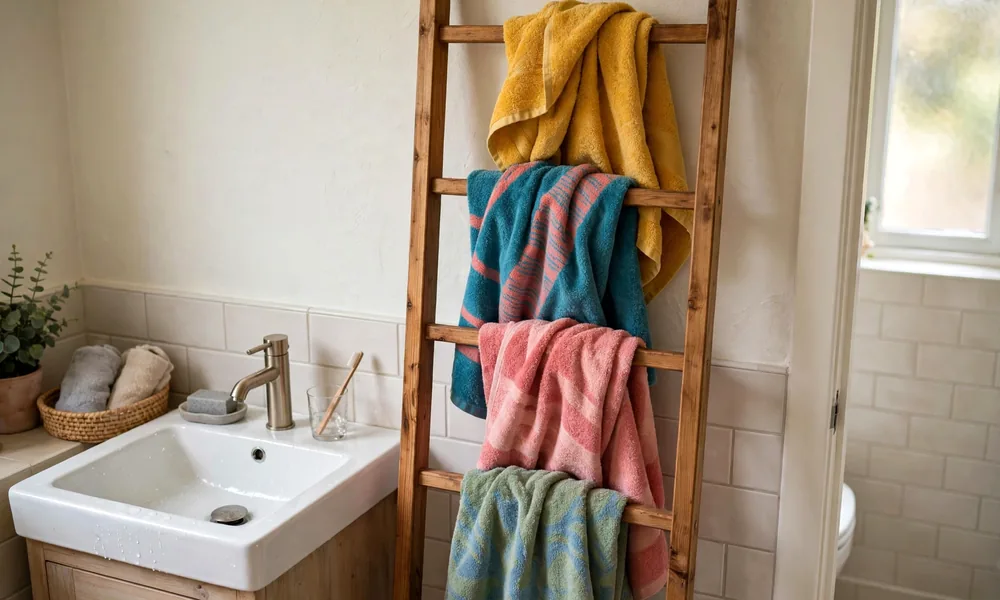
Hang towels the right way and they dry twice as fast. Spread each towel flat over its rung, unfolded, with the same amount of fabric on each side, so the weight balances. Do not fold a wet towel in half over a rung and then fold it again, because the inner layers never see air. Leave a gap between towels on neighbouring rungs: if the hem of one towel touches the towel below, both stay damp. In a bathroom with no window, leave the door open after a shower, because a ladder in still, steamy air dries towels no faster than a hook.
Keep the ladder itself clean. Wipe the rungs monthly with hot water, and wash the feet and pads, where soap scum and dust collect. Wooden ladders need their finish checked every few months: if water no longer beads on the surface, the seal has worn off and the wood needs resealing before it stains. A ladder that smells musty is telling you the towels are not drying, so check the spacing and the ventilation before you blame the towels.
Mistakes That Ruin a Good Towel Ladder
The first mistake is buying a ladder that is too narrow. A ladder 35 centimetres wide looks neat against the wall, but a bath towel folded over its rungs bunches into a damp bundle, and a bundle dries no faster than a towel on a hook. Measure the towels first, and buy a ladder at least 45 centimetres wide. The second mistake is ignoring the floor: a leaning ladder on polished tiles with bare wooden feet will slide the first time someone pulls a wet towel off it, so rubber pads are not optional.
The third mistake is overloading it. A ladder rated for four towels will hold six if you squeeze them on, but the towels will bunch, the air will stop moving, and the ladder will lean further from the wall until it slides. The fourth mistake is buying unsealed wood for a steamy bathroom: it looks beautiful for a month, then it warps, stains and smells. The fifth mistake is putting the ladder where it cannot dry anything, behind a door or in a corner with no air. A ladder needs air more than it needs a good spot.
Your Towel Ladder Checklist
- Measure the wall and the towels first: the ladder should be 45 to 60 centimetres wide.
- Check the rung spacing: 25 to 30 centimetres apart, so a folded bath towel hangs without bunching or dragging.
- Test stability: wide feet, rubber pads, a gentle lean angle, and no wobble when you press it sideways.
- Choose steam-proof materials: stainless steel or powder-coated metal first, sealed wood second, never unsealed pine.
- Give each person their own rung.
- Leave a gap behind the towels for air, and wipe the rungs clean once a month.
Frequently Asked Questions
Do towel ladders actually dry towels faster?
Yes. A towel spread flat over a rung has air on both sides, so it dries in a few hours in a ventilated room. The same towel folded over a hook bunches up and can stay damp until the next morning.
Will a leaning towel ladder slide on tiles?
It can, if the feet are bare wood on polished tiles. Rubber pads on the feet and a gentle lean angle of about 75 degrees stop it sliding. Test it with wet towels on before you trust it.
What size towel ladder do I need?
Most bathrooms suit a ladder 150 to 180 centimetres tall and 45 to 60 centimetres wide, with four or five rungs. A standard bath towel folded in half needs a rung at least 45 centimetres wide.
Are wooden towel ladders OK in a steamy bathroom?
Yes, if the wood is sealed. A sealed finish stops steam soaking in, while unsealed pine warps, stains and grows mould within a year. Check every few months that water still beads on the surface.
Can I use a towel ladder if I rent?
Yes, that is their best use. A leaning or freestanding ladder needs no drilling at all, and it moves in seconds when you rearrange the room. Wall-mounted ladders are the only kind a renter should avoid.
How many towels can a towel ladder hold?
One towel per rung, so a four-rung ladder holds four towels. Do not squeeze two towels onto one rung: they bunch and both stay damp. Count people, not rungs.
The Bottom Line
The best towel ladder is the one that dries every towel on it by morning: wide enough for a folded bath towel, rungs 25 to 30 centimetres apart, rubber pads on its feet, and a material that laughs at steam. Leaning suits renters, wall-mounted suits families, and either beats a hook every time. Measure first, give each person a rung, and hang towels flat.


