How to Spot the Worst Sports Journalists of 2026: Seven Reporting Habits That Mislead Readers
The worst sports journalists of 2026 are not the reporters who get one score wrong or misspell a name once. They are the writers whose habits mislead readers week after week: invented transfer rumours, headlines that contradict their own stories, match reports written without attending the match, and opinions dressed up as facts. This guide ranks the worst types by pattern, not by person, so you can spot unreliable reporting before you share it or believe it.
Key takeaways
- Bad sports journalism is a habit, not a single error: the same fault appears in every story.
- A headline that the story itself does not support is the fastest warning sign.
- Unnamed sources are only useful when the reporter explains why they cannot be named.
- Match reports written from television and social media are not the same as being there.
- Good reporting corrects its mistakes openly; bad reporting deletes them quietly or never admits them.
How the worst sports journalists of 2026 were judged
Every type below was scored on five measures. Accuracy comes first: do the facts, the quotes, the scores and the context check out, or does the story need constant silent correction? Sourcing is second, judged on whether claims can be traced to a real source or rest on vague phrases like insiders say. Originality is third, because a journalist who only rewrites other outlets adds nothing to what readers already know. Fairness is fourth: does every club, player and side of a dispute get the same treatment, or does one side get a free pass? Finally, accountability is fifth, measured by whether mistakes are corrected openly and quickly, or buried. A journalist who fails on three of these five is failing at the job.
Two notes before the list. First, this article is about written sports journalism, the reporters who write match reports, transfer stories and investigations for print and online outlets. Broadcast commentary is a different job, with different failures, and our guide to the worst commentators of 2026 ranks the broadcast habits that ruin a good game. Second, no individual journalist is named as the worst anywhere in this article, because the same seven types turn up in every newsroom, and what matters is learning to recognise them. The same pattern-first approach works for audio as well as print, and our guide to the worst news podcasts of 2026 shows how a repeated weakness matters far more than one bad episode.

Comparison table: the worst sports journalists 2026
| Rank | Journalist type | Main fault | First warning sign |
|---|---|---|---|
| 1 | The Rumour Inventor | Transfer stories made from nothing | Every story says a deal is close |
| 2 | The Headline-Only Journalist | Headline contradicts the story | The third paragraph quietly disagrees |
| 3 | The Copy-Paste Reporter | Rewrites other outlets and press releases | No original quote anywhere in the piece |
| 4 | The Agenda Journalist | One club always right, one always wrong | The same villain in every story |
| 5 | The Stats Cherry-Picker | Numbers chosen to prove a fixed point | The stat stops at a convenient season |
| 6 | The Hot-Take Merchant | Outrage replaces reporting | The verdict arrives before the evidence |
| 7 | The Never-There Reporter | Reports from television and social media | No detail only someone present would know |
The worst sports journalists of 2026
1. The Rumour Inventor: transfer stories made from nothing
The Rumour Inventor is the worst type of all, because the damage spreads before anyone can check it. Every transfer window brings the same stories: a star is close to signing, a club has made an offer, a deal is done bar the paperwork. The sources are always unnamed, the details always vague, and the story falls apart quietly a week later, with no correction and no apology. Readers remember the rumour, and the journalist has already moved on to the next invented exclusive. A real transfer story names what is known, what is not, and who is saying it. If a reporter claims ten exclusives and none happens, they were never real.
2. The Headline-Only Journalist: headline contradicts the story
The Headline-Only Journalist writes a headline designed to be shared, then a story that says something much smaller. The headline claims a manager has been sacked; the third paragraph admits the club is merely considering its options. The headline claims a player demanded a transfer; the story quotes a vague comment about wanting to win trophies. Most readers never get past the headline, so the false version is the one that travels and shapes the mood around a club. A good headline is the story in short, not a different story altogether. If the headline and the article disagree, believe the article.

3. The Copy-Paste Reporter: rewrites other outlets and press releases
The Copy-Paste Reporter never breaks a story, never interviews anyone and never attends anything, yet publishes all day. The method is simple: read another outlet’s report, change the order of the paragraphs, add a new first line, and publish it as your own. Press releases get the same treatment, turned into news stories with no questions asked and no independent check. Readers end up reading the same story five times under five bylines, and the original reporting that made it possible gets no credit. The tell is the absence of anything original: no fresh quote, no new fact, no detail only a reporter on the scene would know.
4. The Agenda Journalist: one club always right, one always wrong
The Agenda Journalist has decided the story before the season starts, and every match, decision and quote gets bent to fit it. One club can do no wrong and the other can do no right, whatever actually happens on the pitch. A fair decision for the favoured club is proof of justice; the same decision for the other club is proof of a conspiracy. Readers notice the pattern quickly, because the villain never changes and the praise never moves. This is not analysis, which follows the evidence, but campaigning, which starts with the conclusion and works backwards. A journalist who cannot write fairly about a team they dislike, or critically about one they love, has stopped reporting.
5. The Stats Cherry-Picker: numbers chosen to prove a fixed point
The Stats Cherry-Picker uses numbers the way a lawyer uses evidence: only the ones that help the case. A player is judged on goals but never on assists, on one good season but never on the three poor ones around it, on home form but never on away form. The numbers themselves are usually correct, which is what makes the trick work; the deception is in what is left out. A fair argument shows the full picture, including the numbers that weaken the case. If a stat stops at a suspiciously convenient season, the journalist is not informing you.
6. The Hot-Take Merchant: outrage replaces reporting
The Hot-Take Merchant publishes a verdict within minutes of the final whistle, before the replay has been watched, the quotes have been gathered or the facts have been checked. The opinion is always extreme: a manager must go, a player is finished, a season is over. Extreme views get shared and quoted, which is the point; the reporting that would support or contradict them never arrives. This habit rewards speed and certainty over accuracy and patience. A good journalist waits, checks and then judges. If the verdict arrives before the evidence, the verdict is the product.
7. The Never-There Reporter: reports from television and social media
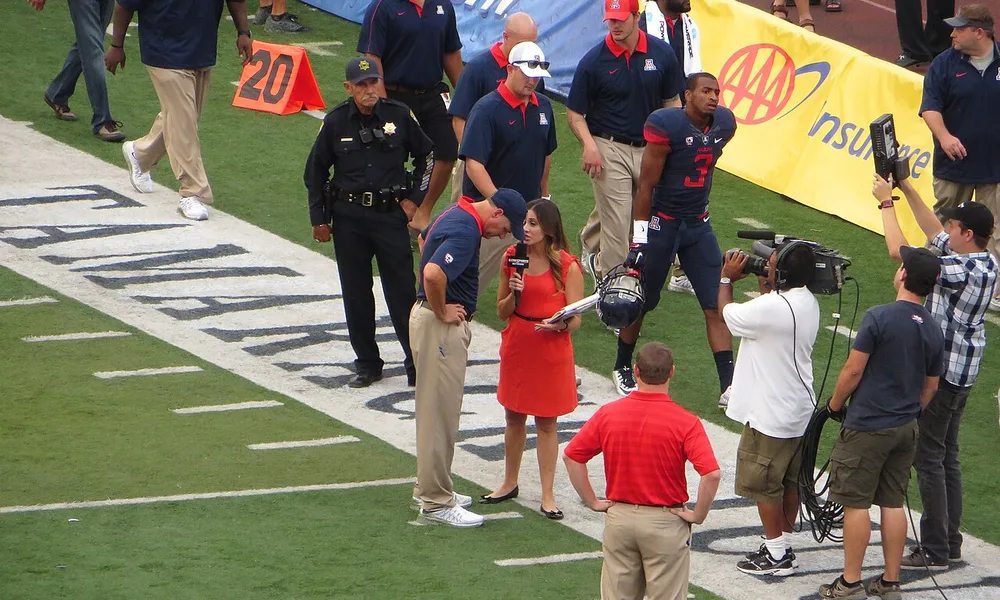
The Never-There Reporter writes match reports, press-conference stories and dressing-room analysis without ever leaving the desk. The match is watched on television, the quotes are taken from other outlets, and the atmosphere is guessed from social media. What is lost is everything that only being there provides: the mood in the ground, the player who limped off out of camera shot, the question that was asked but never answered, the detail that changes the meaning of a quote. Readers can feel the gap even when they cannot name it: the report reads like a summary of the broadcast, because that is what it is. Journalism that never goes anywhere is not journalism at all. It is commentary on other people’s work, sold as reporting.
What to avoid when trusting a sports journalist
The most common mistake is trusting a reporter because they are loud, confident or widely shared, none of which says anything about whether they are right. The second mistake is reading only the outlets that agree with you, which turns a journalist’s agenda into your own. Check the record instead: did their last ten exclusives happen, do their headlines match their stories, and do they correct mistakes openly? The same honest-pattern approach applies on screen as well as in print, and our guide to the worst documentaries about sports of 2026 ranks the films that disappoint for the same reasons. Finally, trust reporters who show their working: named sources where possible, clear limits on what is unknown, and corrections when they get it wrong.
Checklist: spotting the worst sports journalists
- Check whether the headline matches the story, or whether the third paragraph quietly disagrees.
- Count how many of their last ten transfer exclusives actually happened.
- Look for original quotes and details only someone present would know.
- Watch whether one club is always praised and another always blamed, whatever happens.
- Ask whether the statistics show the full picture or stop at a convenient season.
- Check whether mistakes are corrected openly or quietly deleted without a note.
Frequently asked questions
What makes a journalist one of the worst sports journalists of 2026?
A repeated pattern, not one wrong story: invented rumours, misleading headlines, copied reporting and no corrections. Every reporter makes mistakes; the worst ones make the same mistakes every week and never admit them.
How can I tell if a transfer rumour is real?
Look for specifics: a named source, a figure, a stage of talks, and a reporter with a record of accurate exclusives. Vague claims from unnamed insiders, repeated by many outlets at once, usually trace back to a single invented story.
Is it wrong for a journalist to use unnamed sources?
No, unnamed sources are sometimes necessary, but a good reporter explains why the source cannot be named and gives enough detail for the claim to be judged. A story built entirely on unnamed sources with no verifiable detail is not worth trusting.
Why do headlines so often mislead readers?
Headlines are written to earn clicks, and the pressure to attract readers can push them beyond what the story supports. A trustworthy outlet keeps its headlines honest, and a reader should always check the story before sharing the headline.
Does attending a match really change the reporting?
Yes. Being present provides details television misses: injuries off camera, the mood in the ground, unanswered questions and the context behind a quote. Reporting from a desk can summarise a game, but it cannot report on it fully.
Can a biased journalist still be worth reading?
Sometimes, if the bias is open and the facts are sound, because opinion has a place in sport. The problem is bias hidden as neutral reporting, where the reader is misled about what is fact and what is the writer’s own agenda.
Bottom line
The worst sports journalists of 2026 share one trait above all: they do not report. The Rumour Inventor invents, the Headline-Only Journalist exaggerates, the Copy-Paste Reporter copies, the Agenda Journalist campaigns, the Stats Cherry-Picker selects, the Hot-Take Merchant shouts and the Never-There Reporter stays home. Judge a journalist on accuracy, sourcing and corrections, not on confidence or follower count, and the worst types are easy to spot before their stories shape what you believe about the game.


