A room that feels cold and unwelcoming rarely has a heating problem. More often, it is the light. The worst lighting mistakes that make a room feel cold have nothing to do with the furniture. They come from light that is too harsh, too blue, too flat, or simply in the wrong place, and the effect is immediate: a room that should feel like home instead feels like a waiting room.
Lighting shapes how every other choice in a room reads. Warm wood looks grey under a cold bulb, and a soft sofa looks hard under a single glaring ceiling light. Most of these mistakes are cheap to fix: a bulb swap, a lamp moved a few inches, or a dimmer switch can change the whole mood of a room in an afternoon.
This guide runs through the worst lighting mistakes that make a room feel cold, why each matters, and the simple fix for each. None requires rewiring the house or buying designer fittings.
Key takeaways
- One bare overhead light is the fastest way to make any room feel cold, flat, and unwelcoming.
- Bulbs above 4000K read as blue and clinical; warm white around 2700K feels far more inviting.
- Light should fall at several heights, so walls and corners are lit too.
- Mismatched bulbs and unlit corners break a room into cold patches.
- Dimmers and layered lamps give you control over mood that a single switch never can.
Why Lighting Decides Whether a Room Feels Warm or Cold
Human beings read warmth in a room long before they notice the thermostat. Our eyes evolved around firelight and sunset, so warm, low, uneven light feels safe, while cool, even, overhead light feels like a workplace. That is why two rooms with identical furniture can feel completely different.
Colour temperature is the biggest single factor. Bulbs are rated in kelvin: a 2700K bulb gives the soft yellow glow most people associate with home, while a 5000K or 6500K bulb gives a blue-white light that suits a garage and is terrible for a living room. Direction matters almost as much: light from several heights fills a room evenly, while light from one ceiling fitting flattens everything it touches.
Mistake 1: Relying on a Single Overhead Light
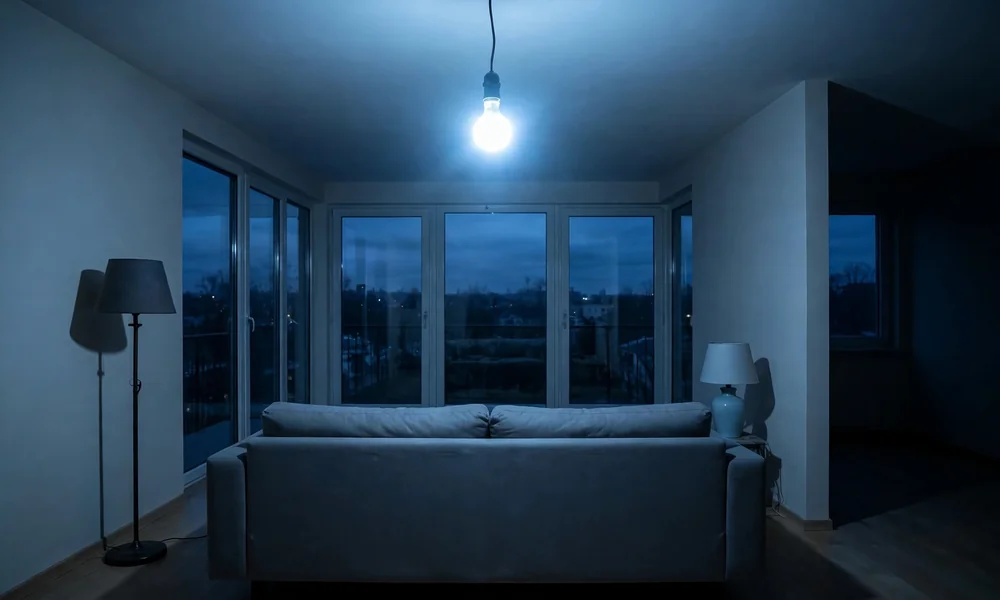
The single ceiling light is the most common lighting mistake in any home, and also the most damaging. One bright ceiling source creates a pool of harsh light underneath it and leaves the corners, the reading chair, and the far wall in darkness. The room ends up with one overlit spot and a ring of gloom, which the eye reads as cold and empty. It is the same problem you find in hotel rooms that look beautiful in photos but feel impossible to relax in, because the photograph hides what the light does to a real person sitting in the room.
Why One Light Is Never Enough
A room needs light at more than one height to feel finished. Overhead light handles general brightness, but it cannot do the work of a lamp beside a chair or a light that washes a wall. Without those layers, the ceiling becomes the brightest surface, making the space feel taller, emptier, and colder than it is.
The Fix: Add Two More Light Sources
Every room you spend time in needs at least three light sources at different heights: one overhead, one at sitting height such as a table or floor lamp, and one low accent light on a shelf or wall. A floor lamp in a dark corner and a small lamp on a side table will transform a room that depends on a single ceiling bulb.
Mistake 2: Choosing the Wrong Colour Temperature
Colour temperature is invisible on the shelf and obvious in the room. A bulb labelled daylight or cool white, usually 5000K or higher, throws a blue-white light that makes skin look pale, wood look grey, and white walls look almost blue. It is the light of offices and supermarkets. The mistake usually happens by accident: someone replaces a dead bulb with whatever is in the drawer. The fix is simple. Choose warm white, around 2700K, for living rooms and bedrooms, and reserve cooler light for kitchens and workspaces.
How to Check What You Already Have
Look at the base or the box of each bulb. The kelvin rating is usually printed there, as a number or as a word such as warm white or daylight. If the bulbs in one room do not match, replace the odd ones out: the eye notices a clash between warm and cool light immediately.
Mistake 3: Lighting Only the Ceiling, Never the Walls
Walls are the largest surfaces in a room, and when they are left dark, the room feels like a box with a bright lid. Many people light the middle of the room and forget the edges, so the walls fall into shadow. The fix is to put some light on the walls themselves: a lamp placed near a wall throws a soft wash of light across it, and a sconce or a floor lamp angled toward a wall will lift the whole room. It takes little brightness; the goal is to remove the darkness, not flood the wall.
Mistake 4: Ignoring Shadows and Dark Corners
Every room has a corner the main light never reaches, and left alone it becomes a black hole that drags the whole room down. Dark corners make a room feel unfinished, especially in the evening, when the contrast between the lit centre and the dark edges is at its worst. The solution is a small light in each dark corner: a floor lamp, a table lamp, or a battery-powered accent light. The point is not to make the corner bright, but to remove the patch of total darkness.
Mistake 5: Mismatched Bulbs Across the Room
Walk into a room where one lamp glows warm yellow, another throws cold white, and the ceiling light is somewhere in between, and the effect is instantly uncomfortable. The eye keeps adjusting between colour temperatures and never settles, which makes the room feel restless and cold. Mismatched bulbs accumulate gradually, one replacement at a time, but the fix takes ten minutes: check every bulb, standardise them on warm white, and match brightness too, since one very bright bulb among dim ones creates the same uneasy effect.
Mistake 6: Forgetting Dimmers and Layered Control
A room with only on and off has only two moods, and neither is quite right. Full brightness feels harsh and clinical in the evening, while darkness is not an option at all. Without a dimmer, the only way to soften the light is to switch lamps off one by one, which leaves the room unevenly lit. Dimmer switches are inexpensive and make the biggest difference to how a room feels after dark, letting you lower the overhead light while the lamps do the real work. The same thinking applies to smart bulbs and the smart home devices that cause more problems than they solve when they are bought for novelty rather than for a real lighting plan.
Layering Light Through the Evening
Think of lighting as something that changes through the day: bright in the morning, softer in the afternoon, low and warm in the evening. That shift is the difference between a house full of lights and a home that works quietly in the background, and a dimmer gives you that control without any new technology.
Mistake 7: Blocking Daylight and Fighting the Windows
Bad lighting is not only about bulbs. Heavy curtains that never open, tall furniture parked in front of windows, and dark blinds kept half-closed all starve a room of daylight, and no amount of artificial light fully replaces it. A room that gets little natural light will feel cold even with the lamps on, because the eye expects the brightest light to come from the window. Keep coverings light and easy to open, move tall furniture away from windows, and clean the glass twice a year: dirty windows cut incoming light by a surprising amount.
Mistake 8: Overlighting the Room
More light is not always better. A room crammed with bright downlights feels like a retail space: even, shadowless, flat light strips the room of atmosphere. Overlit rooms are tiring to sit in, because the eye has nowhere to rest. The cure is subtraction. Turn off half the downlights, or replace some with lower-wattage bulbs, and let the lamps take over. A room should have pools of light and gentle shadow, not uniform brightness from wall to wall.
The Worst Lighting Mistakes at a Glance
Most cold-feeling rooms suffer from more than one of these mistakes at once. Here is each one, what it does, and the quickest fix.
| Mistake | What it does | Quickest fix |
|---|---|---|
| Single overhead light | Harsh centre, dark edges | Add two lamps |
| Wrong colour temperature | Blue, clinical glow | Switch to warm white, 2700K |
| Dark walls | Box-with-a-lid feeling | Wash a wall with a lamp |
| Unlit corners | Shrinks the room | Small light in each dark corner |
| Mismatched bulbs | Restless, clashing light | Standardise bulbs |
| No dimmers | Only harsh or dark | Fit a dimmer switch |
| Blocked daylight | Flat, gloomy daylight | Open windows fully, move furniture |
| Overlighting | Flat, tiring brightness | Switch off half the downlights |
A Room-by-Room Lighting Checklist
Use this checklist the next time you walk through your home in the evening.
- Every room you relax in has at least three light sources at different heights.
- All bulbs in one room share the same warm colour temperature, 2700K.
- No wall is completely dark, and no corner is a patch of total blackness.
- Overhead lights are on a dimmer, or switch off while lamps stay on.
- Windows are clear of tall furniture and curtains open fully during the day.
- Each lamp has a purpose: reading, relaxing, or washing a wall.
Frequently Asked Questions
What colour temperature makes a room feel warm?
Warm white, around 2700K, is the safest choice for living rooms and bedrooms: the soft yellow glow most people associate with home. 3000K is slightly cooler but still warm enough; above 4000K reads as blue and clinical.
How many lights does a living room need?
At least three sources at different heights: an overhead light, a lamp at sitting height, and an accent or wall light. Larger rooms need more, but one light source, however bright, always leaves a living room feeling flat and cold.
Why does my room feel cold even with the heating on?
Because your eyes tell your brain the room is cold. Blue-white light, harsh glare, and dark corners signal coldness, and that impression can overpower the actual temperature. Warm, layered light changes how it feels without touching the thermostat.
Are LED bulbs worse for warm lighting?
No. Modern LEDs come in every colour temperature, including warm 2700K, and dim well with a compatible dimmer. The problem is the bulb chosen: a daylight LED is just as cold as a daylight fluorescent tube.
Should I use smart bulbs to fix my lighting?
They can help if you use their dimming and colour controls, but they are not necessary. A dimmer switch and warm bulbs achieve the same result more simply, and everyone can use them without an app.
What is the cheapest way to warm up a cold-feeling room?
Swap the bulbs to warm white 2700K, move a lamp into the darkest corner, and fit a dimmer on the main light. Those three cheap changes usually transform the room that evening.
The Bottom Line
A cold-feeling room is almost never a decorating failure. It is a lighting failure, and lighting is the cheapest thing in the room to change. Replace the cold bulbs with warm ones, add lamps at different heights, light the walls and corners, and fit a dimmer. Do those four things and the same room will feel like a different place. Warmth in a room is not bought, it is lit.