The best sports bottles of 2026 are the ones you can drink from without breaking stride. A good sports bottle opens with one hand, seals tight in a kit bag, and gives you a proper drink at the moment you need it, whether you are halfway up a climb, ten miles into a run, or waiting on the sideline. The wrong one leaks into your bag, needs two hands and a full stop, or forces you to unscrew a lid while the game moves on without you. This guide ranks them by how they perform in use, so you can pick one bottle for your sport and stop thinking about it.
Key Takeaways
- Buy the sports bottle for your sport first: cycling, running, team sports and the gym all point to different bottles.
- A squeeze bottle with a bite valve is the best all-rounder for drinking on the move, because it is fast, light and cheap to replace.
- Check the cage fit before you buy: most bike cages take a bottle about 74 millimetres across, and a bottle a few millimetres too wide will not seat.
- Soft flasks suit runners best, because they collapse as you drink, weigh almost nothing, and never slosh in a vest pocket.
- Clean the valve and cap after every use, because mould starts in the parts you cannot see.
Best Sports Bottles of 2026 at a Glance
| Type | Best For | Capacity | Why It Wins | Watch Out For |
|---|---|---|---|---|
| Squeeze bottle | Cycling, team sports | 500 ml to 1 litre | Fast one-handed drinking, light, cheap | No insulation, valve wears out |
| Soft flask | Running, trail | 250 to 500 ml | Collapses as you drink, no sloshing | Small capacity, fiddly to fill |
| Insulated steel | Hot days, long sessions | 500 ml to 1 litre | Keeps water cold for hours, tough | Heavy, may not fit a cage |
| Handheld bottle | Running, gym classes | 350 to 600 ml | Strap frees your fingers, easy to grab | You carry the weight in one hand |
| Team squeeze bottle | Football, rugby, hockey | 750 ml to 1 litre | Tough, wide mouth, fast to refill | Bulky for solo training |
| Shaker sports bottle | Gym, protein shakes | 600 to 800 ml | Mixes shakes smooth, stands steady | Extra parts to wash, can leak if open |
Best Squeeze Bottle for Cycling
The squeeze bottle is still the standard on a bike, and nothing has beaten it for speed. You pull it from the cage, bite or pull the valve, squeeze, and drink, all with one hand, without ever stopping. A good one is light, cheap and easy to replace, which is why most cyclists own several. Look for a soft body that squeezes easily even when nearly full: a stiff bottle needs two hands and defeats the point.

Cage fit is the detail that catches people out. Most cages are built for a bottle about 74 millimetres across, so measure your cage or take the bike to the shop and test the fit before you buy. A bottle a few millimetres too wide will not seat, and one too narrow rattles out on the first pothole. A 750-millilitre bottle is the standard for road riding.
The valve is where cheap squeeze bottles fail. A bite valve opens when you bite it and seals when you let go, which makes it the fastest option at speed, but it wears out over a season and starts to dribble. A pull-top valve lasts longer and seals more firmly, at the cost of a slightly slower drink. Buy a bottle whose valve comes apart for washing, and replace the valve rather than the whole bottle when it leaks.
Best Soft Flask for Running
A soft flask is a flexible pouch, usually 250 to 500 millilitres, that collapses as you drink from it. It weighs almost nothing, fits in a running vest pocket or a belt, and never sloshes, because there is no air inside it to slosh around. For trail runners and anyone training for a half marathon or longer, it is the best sports bottle of 2026 by a clear margin.
The trade-off is capacity and filling. A 500-millilitre flask covers about an hour of running in cool weather, but on a hot day you will want two flasks or a vest with a larger bladder, and filling a soft flask from a tap or a fountain takes more patience than filling a rigid bottle. Look for a wide mouth and a bite valve you can lock shut, because a flask that leaks inside a vest pocket soaks everything you are carrying.
For anything longer, or any run in the heat, carry water and drink little and often rather than waiting until you are thirsty. Our guide to the best running shoes of 2026 covers the rest of the kit that belongs beside your flask on race day.
Best Insulated Steel Sports Bottle
An insulated steel sports bottle is the heavyweight of the family: double-wall vacuum insulation, a powder-coated grip, and a sports cap that flips or twists open. It keeps water cold for hours, survives being knocked off a bench onto concrete, and does not hold flavours from yesterday’s energy drink. For long sessions in the heat, or for anyone who hates warm water, it is the most comfortable bottle to drink from,

The weight is the honest trade-off. A full one-litre steel bottle is heavy, and it will not fit every bike cage, so check the diameter before you buy and do not assume it will ride where a plastic bottle rides. For cycling and running, steel is usually the wrong call unless your ride or run is short and the heat is extreme.
Look for a sports cap rather than a standard screw lid: a flip-top or twist cap you can open with one sweaty hand is essential, because a steel bottle with a fiddly lid is just a heavy desk bottle. If you want a bottle for everyday life as well as sport, our guide to the best water bottles of 2026 compares the insulated steel bottles that work best at a desk, in a car, and on a commute.
Best Handheld Bottle for Running and the Gym
A handheld bottle with a strap sits between the soft flask and the rigid bottle. The strap leaves your fingers free instead of forcing you to grip all the way round, which matters on a long run when your hands start to cramp, and the rigid body is easier to fill and clean than a flask.
The weakness is that you carry the weight in one hand, and on a long run that imbalance adds up. Swap hands every mile or so, or accept that handhelds are a short-to-medium distance tool and move to a vest with flasks for anything longer. A bottle that stands steady on the floor matters in the gym too: one that rolls away the moment you set it down will be kicked across the room before your set is finished.
Best Team Sports Bottle
Football, rugby and hockey need volume and toughness. A 750-millilitre to one-litre squeeze bottle per player, with a pull-top that opens with a tug and a body that survives being dropped on tarmac, is the right call. Numbered caps or coloured bottles stop arguments about whose is whose, and a wide mouth lets a coach refill a dozen bottles from a jug in a couple of minutes.
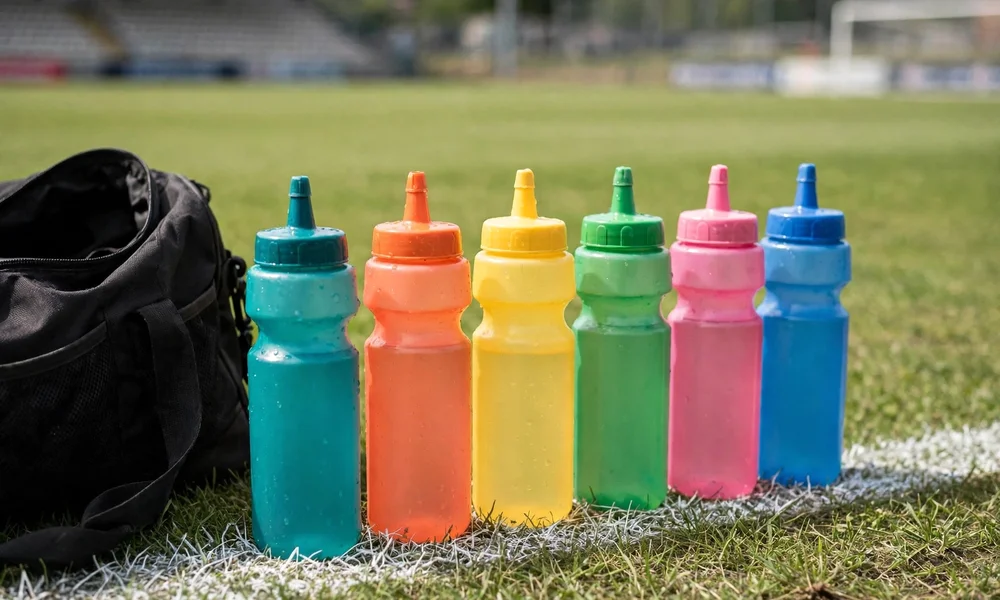
For team use, buy the same bottle for everyone and buy them in bulk. Mixing shapes means mixing caps and valves, and the one bottle with the odd cap is the one that leaks in the bag. Wash them all after every session, valves included, and check the seals at the start of the season rather than discovering a leak on the first match day.
Best Shaker Bottle for the Gym
If your sport is the gym, your bottle has a second job: mixing a protein shake without lumps. A shaker bottle with a mixing ball or a built-in grid does that well, and a wide mouth takes powder and ice without a funnel. The best gym bottles stand steady on the floor, open with one sweaty hand between sets, and survive being knocked off a bench, Our guide to the best gym bags of 2026 covers the rest of the kit that belongs beside your bottle on the gym floor.
The extra parts are the catch. A shaker has more pieces to wash, and a bottle left closed with a half-finished shake inside will smell by the next morning in a way a water bottle never does. Rinse it the moment you finish, wash it properly at home, and leave the lid off to dry.
What to Check Before You Buy
Size and cage fit
Start with where the bottle has to go: a bike cage, a vest pocket, a car cup holder, or a kit bag. Measure first, because a bottle that does not fit its home is useless no matter how good it is.
Valve and lid
The valve is the part you touch most, and it is where cheap bottles fail first. Bite valves are fastest, pull-tops last longer, flip-tops suit steel bottles, and straw lids suit sipping in the car.
Material
Soft plastic squeeze bottles are light and cheap. Tritan plastic is the best of the plastics: shatter-resistant, BPA-free, and clear enough to see how much is left. Stainless steel insulates and lasts for years but is heavy. Silicone flasks are light and collapsible but hold less.
Cleaning
A sports bottle you cannot clean is a bottle you will throw away. Wide mouths take a brush and a hand, valves that come apart can be scrubbed, and bottles that go in the dishwasher get washed more often.
Before You Buy Checklist
- Match the bottle to your sport first, then to your bag, cage or vest pocket.
- Test the valve with one hand, wet hands included, before you commit.
- Check the diameter against your bike cage or car cup holder.
- Make sure the valve and lid come apart for washing.
- Pick a size you will actually carry full, not the biggest bottle on the shelf.
- Buy a spare valve or a second bottle, because the one you lose is always the good one.
Frequently Asked Questions
What is the best sports bottle for cycling?
A 750-millilitre squeeze bottle with a bite valve or pull-top, about 74 millimetres across so it fits a standard cage. It is light, fast to drink from one-handed, and cheap to replace.
Are soft flasks better than rigid bottles for running?
For runs over an hour, yes: it collapses as you drink and never sloshes. For short runs, a small handheld bottle is simpler.
Do insulated sports bottles keep water cold all day?
A good vacuum steel bottle keeps water cold for most of a day, and for several hours in real heat. Opening it often lets the cold out faster.
How often should I wash a sports bottle?
After every use: hot soapy water, wash the valve and cap, and dry open. Replace the valve when it dribbles or smells.
Can I put a sports bottle in the dishwasher?
Many are, but valves and seals often are not, so check the label. Hand-washing the valve still gets it cleaner.
What size sports bottle do I need?
Most adults need 500 millilitres to one litre: runners 250 to 500, cyclists 750, team players 750 to one litre. Bigger is not better if you will not carry it full.
Bottom Line
The best sports bottle of 2026 is a squeeze bottle with a bite valve for most people, because it is fast, light and cheap, and it works in every sport where you drink on the move. Runners training for distance should choose a soft flask, anyone training in real heat should choose insulated steel, and team players should buy tough 750-millilitre squeeze bottles in bulk. Whatever you choose, check the fit, test the valve one-handed, and wash it after every use.