The best travel umbrellas for rain in 2026 are small enough to disappear into a daypack yet strong enough to survive a proper downpour on a windy city street. The difference between a great one and a cheap one is rarely obvious in a shop: both look similar folded, but only one stays open when the wind turns.
Rain is the most common weather surprise in travel, and the most avoidable misery. A good travel umbrella turns a washed-out afternoon into a pleasant walk, while a bad one inverts at the first gust and soaks your bag. It is the one piece of kit you only notice when it fails.
This guide compares the best travel umbrellas for rain on the features that matter: wind resistance, canopy size, folded length, weight and fabric quality, judged on real travel use from city streets to coastal paths.
Key takeaways
- A double-canopy vented design is the single best defence against wind inversion.
- Look for a folded length under 30 centimetres and a weight under 350 grams for easy packing.
- Teflon-coated pongee or high-density polyester sheds water fastest and dries quickest.
- A canopy of at least 95 centimetres across keeps both you and your bag dry.
- Always shake your umbrella out and let it dry open before packing it away.

What Makes a Great Travel Umbrella for Rain
A travel umbrella has a harder job than a full-size one. It must fold small, weigh almost nothing, open in seconds, and still stand up to weather that would defeat a cheap model.
Windproof Frames That Resist Inversion
Wind is what kills most travel umbrellas. A gust catches the canopy from underneath, the ribs bend backwards, and the umbrella inverts with a snap that often breaks a rib or tears the fabric. The best use flexible fibreglass ribs that bend rather than snap, with a vented double canopy that lets wind pass through instead of lifting it.
When you shop, look for frames described as windproof or storm-proof, and check the number of ribs. Eight ribs is the standard for a good compact umbrella, while six ribs usually means a lighter but weaker frame.
Canopy Fabric That Sheds Water
The canopy fabric decides how dry you stay and how wet your bag gets. Pongee, a tightly woven polyester with a soft finish, is the standard for good travel umbrellas because it sheds water quickly and dries fast. Higher-density weaves, often listed as 190T or above, hold up better in heavy rain.
A Teflon or similar water-repellent coating makes a real difference too. On a coated canopy, rain beads up and rolls off instead of soaking in, so a quick shake leaves the umbrella almost dry. The close-up below shows how good canopy fabric beads water instead of absorbing it.

Size and Weight for Real Packing
A travel umbrella only helps if you actually carry it, and you will only carry it if it packs small and light. The best folding umbrellas collapse to between 25 and 30 centimetres and weigh between 250 and 350 grams, roughly the weight of a paperback. Longer than 32 centimetres, it pokes out of smaller daypacks; heavier than 400 grams, it feels like a burden by the end of the day.
Canopy size matters just as much. Under 90 centimetres, your shoulders and bag stay exposed; at 95 to 105 centimetres, you get proper cover without turning the umbrella into a sail.
Opening Mechanisms and Handles
Automatic open and close is the most useful convenience feature on a travel umbrella. One press opens the canopy when the rain starts, and another collapses it when you step indoors, which matters when your other hand holds a phone, a ticket or a coffee. Manual umbrellas are lighter and have fewer parts to fail.
Handle design deserves more attention than it usually gets. A rubberised grip stays secure when wet, while a smooth plastic handle can slip in a downpour. A wrist strap lets you hang the umbrella from your wrist while you take a photograph or pay for a ticket.
The Best Travel Umbrellas for Rain 2026
The umbrellas below are grouped by what they do best, because no single model suits every traveller. Pick the category that matches your trips, and you will get the best umbrella for the way you actually travel.
Best Overall: The Double-Canopy Windproof Compact
The best all-round travel umbrella for rain is a vented double-canopy compact with a fibreglass frame and a pongee canopy of around 100 centimetres. It folds to about 28 centimetres, weighs around 320 grams, and survives gusts that destroy ordinary umbrellas.
This is the pick for travellers who want one umbrella for everything: city breaks, coastal walks, business trips and holidays. It opens automatically, has a rubberised grip, and comes with a sleeve that keeps the rest of your bag dry.
Best Ultralight: The Featherweight Packing Pick
For travellers who count every gram, the best ultralight travel umbrella weighs under 200 grams and folds to about 25 centimetres. Its slim six-rib frame and thinner canopy trade some wind resistance for a size that disappears into a jacket pocket. It suits summer trips where rain is possible but unlikely to be severe.
The trade-off is honest: an ultralight umbrella will not survive a coastal storm. What it does brilliantly is guarantee you always have cover, because it is so small you never leave it behind. For light packers, that is worth more than storm-proofing you will rarely need.
Best for Storms: The Heavy-Duty Windproof Model
Some trips demand a stronger umbrella. If you are heading to a windy coast, a northern city in autumn, or anywhere with sideways rain, choose a heavy-duty windproof model with a nine or ten-rib fibreglass frame and a reinforced double canopy. These weigh more, usually 400 to 450 grams, but they stay open in gusts that would flatten anything lighter.
Look for reinforced joints at the rib tips and a thicker shaft. The extra weight is noticeable, but it is a small price for staying dry when the weather turns genuinely rough.
Best Budget: The Reliable Everyday Folding Umbrella
You do not need to spend a fortune to stay dry. The best budget travel umbrella costs little, folds to about 30 centimetres, and uses a simple eight-rib steel and fibreglass frame with a standard polyester canopy. It will not match a premium model in a storm, but it handles ordinary rain well.
With a budget umbrella, avoid the very cheapest models, which use thin fabric and weak joints that fail in the first strong wind. Spend slightly more than the bottom of the range and choose a model with a proper sleeve and a wrist strap.
| Umbrella type | Folded length | Weight | Canopy size | Best for |
|---|---|---|---|---|
| Double-canopy windproof compact | 28 cm | 320 g | 100 cm | All-round travel |
| Ultralight packing pick | 25 cm | 190 g | 95 cm | Light packers |
| Heavy-duty windproof model | 30 cm | 430 g | 105 cm | Storms and coasts |
| Reliable budget folding umbrella | 30 cm | 340 g | 98 cm | Everyday rain |
How to Choose the Right Travel Umbrella
Choosing well comes down to matching the umbrella to your trips rather than chasing the most expensive model.
Match the Umbrella to Your Destination
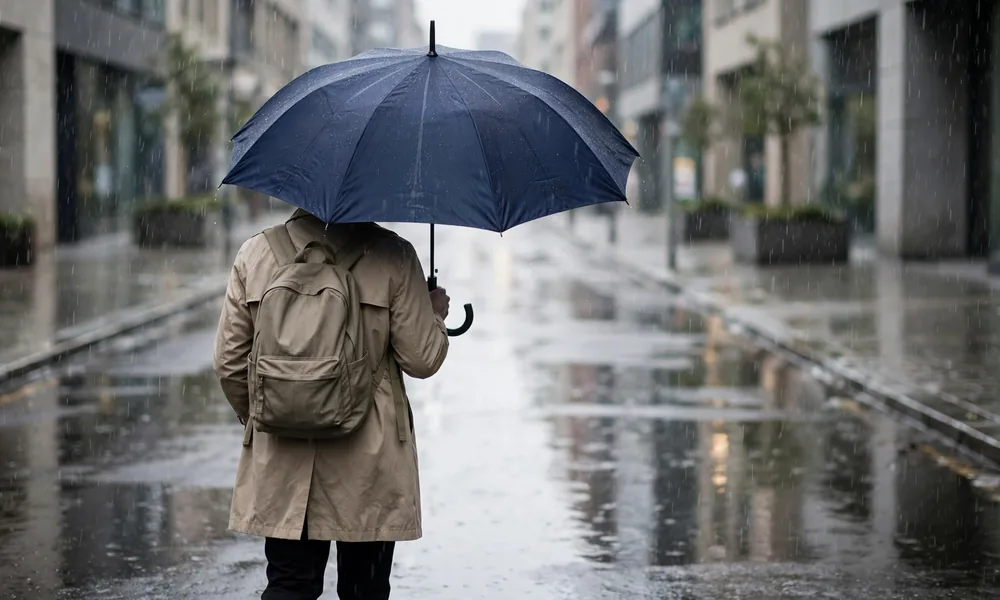
Think about where you are going and when. A summer trip to the Mediterranean calls for an ultralight model, while an autumn trip to a northern city calls for a proper windproof compact. Coastal and mountain destinations deserve the heavy-duty option, because wind there is stronger and less predictable.
Season matters too. Spring and autumn bring the heaviest rain in most of Europe, so those trips justify a better umbrella, while in summer a light model is usually enough. Check typical rainfall for your destination before you pack, not just the temperature.
Check the Details Before You Buy
Small details separate good umbrellas from frustrating ones. Open and close it a few times before you travel: the mechanism should feel smooth, not stiff or gritty. Check the canopy sits evenly when open, with no sagging panels or loose stitching, and that the rib tips are capped.
The sleeve matters more than most people think. A good sleeve is waterproof, fits snugly, and has a drawstring or Velcro closure that keeps a wet umbrella contained. A loose sleeve defeats the purpose, because a damp umbrella will soak everything it touches.
Think About the Rest of Your Kit
An umbrella works best as part of a rain-ready kit. A good rain jacket, waterproof shoes and a dry bag for electronics all work together: the umbrella keeps rain off your head and shoulders, the jacket handles the rest, and dry footwear keeps you comfortable. The best walking shoes for travel make a bigger difference on a rainy day than most travellers expect, because wet feet end a walk faster than a wet head.
Packing matters too. A compact umbrella slides neatly beside best travel packing cubes in a carry-on, and a quick-dry towel is useful for drying off after a downpour, which is why the best travel towels are worth packing alongside it. When your whole kit is chosen for wet weather, rain becomes a minor inconvenience.
Packing and Caring for Your Umbrella
A travel umbrella lasts far longer with a little care. Always shake it out before folding, and let it dry fully open when you get back to your room. Folding a wet umbrella and leaving it closed for days invites mildew.
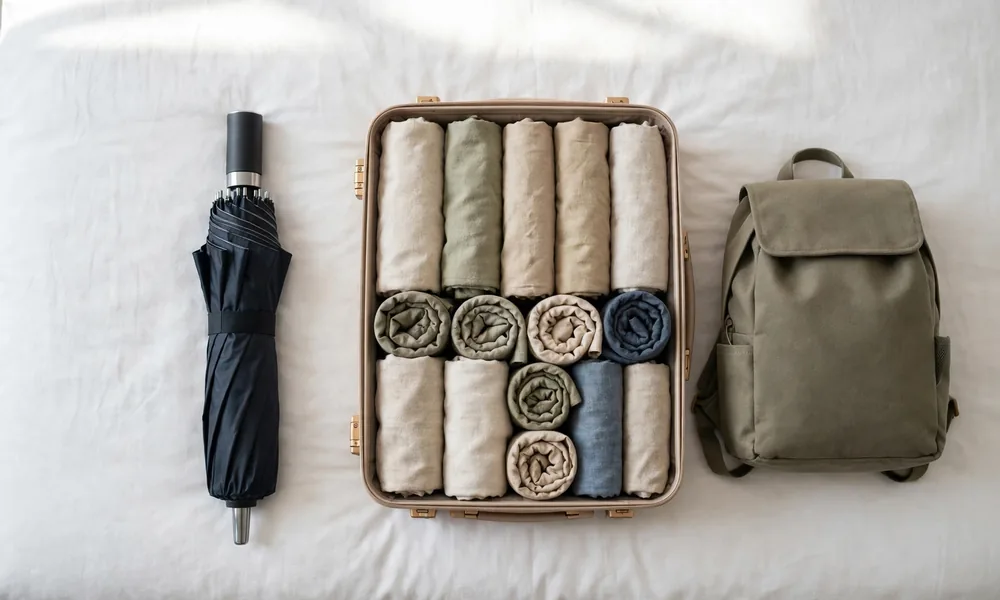
For packing, keep the umbrella in its sleeve in an outside pocket or a separate compartment, away from electronics and clothing. The flat-lay below shows how little space a good folding umbrella takes next to a packed suitcase.
Check the ribs and joints every few trips. If a rib feels loose or a joint sticks, a drop of silicone lubricant usually fixes it. Replace the umbrella when the fabric lets water through or the frame no longer opens evenly.
Travel Umbrella Checklist
- Folded length under 30 centimetres so it fits any daypack.
- Weight under 350 grams unless you need heavy-duty storm protection.
- At least eight ribs, preferably fibreglass, for wind resistance.
- Vented double canopy to stop inversion in gusts.
- Water-repellent pongee or high-density polyester fabric.
- Canopy of 95 centimetres or more for real coverage.
Frequently Asked Questions
What is the best travel umbrella for rain?
A vented double-canopy compact with a fibreglass frame, a water-repellent pongee canopy of around 100 centimetres, and a folded length under 30 centimetres.
Can I take a travel umbrella in hand luggage?
Yes, folding travel umbrellas are allowed in hand luggage on almost all airlines. Some budget airlines ask you to pack full-size umbrellas inside your bag, so check before you fly.
How do I stop my umbrella inverting in the wind?
Choose a vented double-canopy model with flexible fibreglass ribs, and tilt the canopy slightly into the wind rather than holding it flat. If a gust inverts it, most windproof models can be pushed back into shape.
How do I dry a travel umbrella quickly?
Shake it vigorously, then open it fully in a ventilated space for twenty to thirty minutes. A water-repellent canopy dries much faster than untreated fabric.
Are expensive travel umbrellas worth it?
A mid-range windproof umbrella is worth the extra cost if you travel often or visit windy places. For occasional light rain, a budget model does the job well.
What size travel umbrella should I buy?
Look for a canopy of 95 to 105 centimetres. Folded, it should be under 30 centimetres long and under 350 grams.
The Bottom Line
The best travel umbrellas for rain are the ones you actually carry: compact, light, windproof and quick to dry. Choose a vented double-canopy model for all-round use, go ultralight for summer trips, and pick a heavy-duty frame for windy coasts and autumn cities. Pack it every day, and rain will never spoil a trip again.