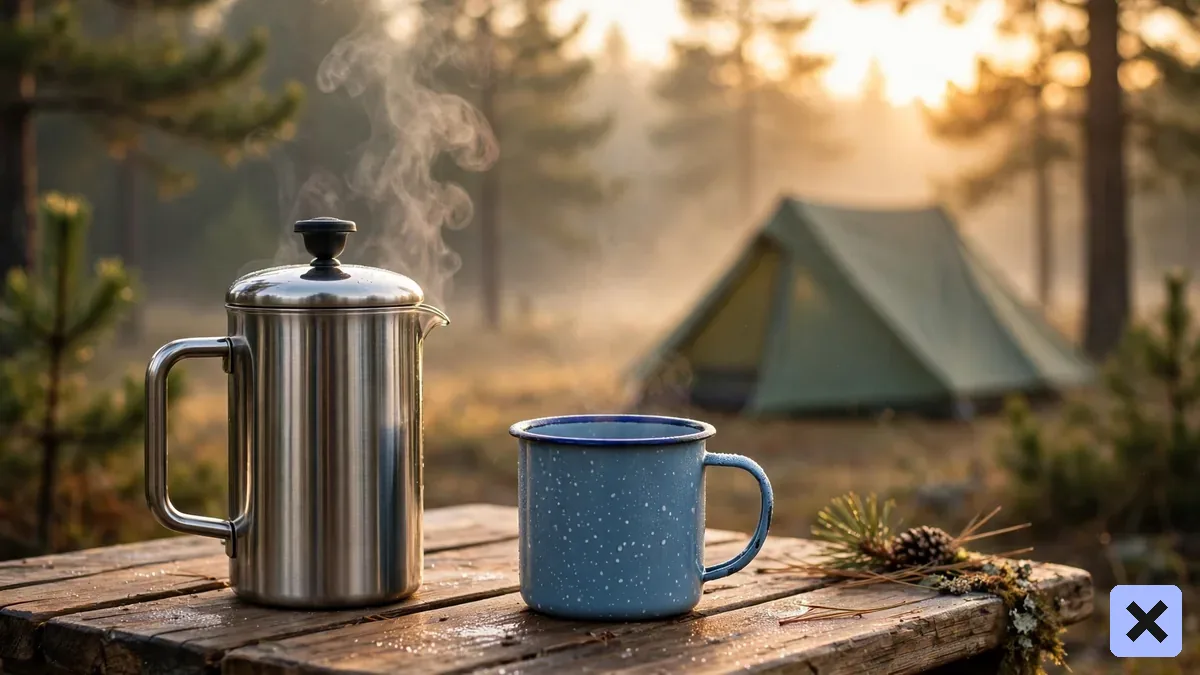
There is a particular kind of morning that only camping delivers: cold air, birdsong, a tent glowing in the first light, and the slow realisation that coffee is still ten minutes away. The best French press coffee makers for camping 2026 turn that wait into one of the best parts of the trip, brewing rich coffee with nothing more than hot water, coarse grounds, and four quiet minutes.
A French press asks almost nothing of you: no power, no paper filters, no pods, and no delicate parts that shatter in a stuff sack. You boil water, you pour, you press, and you drink. That simplicity is why it has become the go-to brewer for car campers and backpackers alike.
This guide compares the presses that hold up outdoors, judging unbreakable materials, sensible sizes, grit-free filters, and designs that pack well.
Key takeaways
- Choose stainless steel or titanium, never glass, because a dropped glass beaker ends the trip’s coffee.
- A 32-ounce press serves two to three people; a 12 to 16-ounce travel press suits solo campers.
- Coarse grounds and a four-minute steep matter most for a clean, sweet cup.
- Double-wall insulation keeps coffee hot longer and doubles as a mug, saving pack space.
- A fine mesh filter plus a slow, steady press keeps sediment out of the last sip.
Why a French Press Wins at Camp
Camping rewards gear that does one job brilliantly and never complains. A French press has no electronics to fail and no disposable parts to run out of mid-trip. If you can boil water, you can make excellent coffee.
Immersion brewing lets the grounds sit in the water, pulling out the oils and body that paper filters strip away. The result is a fuller, rounder cup, even with ordinary supermarket beans.
Weight and bulk matter too. A travel press weighs about the same as a water bottle and often replaces your mug entirely, since you can drink straight from it. Group presses are heavier, but they still take up less room than a pour-over kit. For backpackers, that decides whether coffee gear comes along at all.
What to Look for in a Camping French Press
Not every French press survives the outdoors. A glass beaker is a liability on a rocky campsite, and a loose filter fills your cup with sludge. These features separate a genuine camping press from a kitchen press taken outside.
Material: Steel and Titanium Beat Glass
Stainless steel is the default choice for camp: it shrugs off drops, keeps coffee hot, and cleans up with a rinse and a wipe. Titanium is lighter still and just as tough, which is why it dominates the ultralight market, though it costs more. Insulated double-wall steel is the sweet spot for most campers: it holds heat through a slow morning and stays comfortable to hold. Check that the lid seals well, since a leaking press makes a mess in a pack.
Size: Match the Press to Your Party
Size is the easiest mistake to make. A press that is too small means brewing twice before breakfast, and one that is too big means carrying dead weight and drinking coffee that has gone cold. Solo campers should look at 12 to 16 ounces, couples do well with 20 to 24 ounces, and groups of three or four need a 32-ounce press. When unsure, size up: a half-full press still brews well.
Filter Quality and Ease of Cleaning
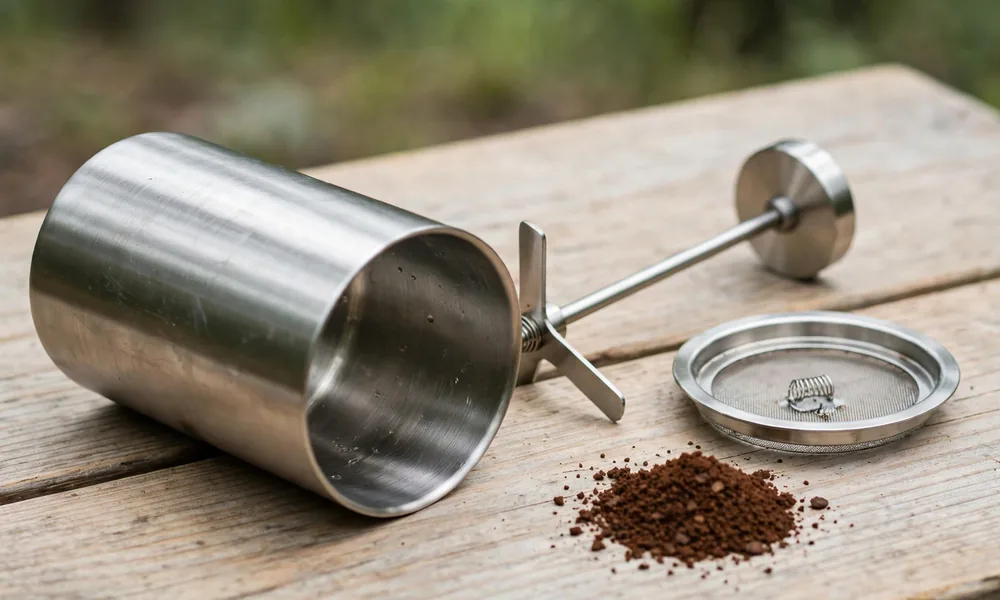
The filter is where cheap presses give themselves away. A good mesh filter is fine, even, and held flat against the plunger, so grounds stay below it and the cup stays clean. Look for a two-stage or double-mesh design if you hate sediment, and check that the plunger moves smoothly without wobbling. A press that comes apart easily rinses out in a stream or wipes clean. Our guide to the best French press coffee makers covers the full-size models in detail.
Weight, Packability, and Durability
A camping press earns its place by being easy to carry and hard to break. Travel presses that double as a drinking vessel are the most efficient, because they replace another item in your kit. A tall, narrow press slides into a pack side pocket; a wide one may not. Handles should fold or sit flush and lids should lock. The simplest test: if you would hesitate to toss it into a bag full of hard gear, it is not a camping press.
The Best French Press Coffee Makers for Camping 2026
These five presses cover every style of camping, from ultralight solo trips to family basecamps.
1. Stanley Classic Travel Press
The Stanley Classic Travel Press is the press most campers end up buying. Its double-wall vacuum-insulated steel body keeps coffee hot for hours, the press mechanism is built into the lid, and you drink straight from the vessel, so it replaces both brewer and mug. At 16 ounces it is a true one-person system, and the steel construction survives drops that would destroy a glass press instantly. It is heavy for ultralight trips, but close to perfect for car camping and van life.
2. GSI Outdoors JavaPress
The GSI Outdoors JavaPress is the group brewer of this list. The 30-ounce version makes enough for three people, the insulated steel body holds heat well, and the fine mesh plunger keeps the cup noticeably cleaner than cheaper presses. The whole assembly comes apart and rinses out in seconds, which matters when water is scarce. It suits car campers and basecamps far better than backpackers, but for a family morning at camp it is hard to beat.
3. Espro Travel Press P1
The Espro Travel Press P1 is the pick for campers who hate sediment. Its double micro-filter stops grounds far more effectively than a standard mesh, so the last sip tastes as clean as the first. The insulated steel body keeps coffee hot, the 12-ounce size is ideal for solo use, and the whole thing doubles as a travel mug with a sip-through lid. It costs more and the filter has more parts, but if gritty coffee ruins your morning, this press solves it.
4. Snow Peak Titanium French Press
The Snow Peak Titanium French Press is the ultralight dream. Titanium is feather-light, completely rust-proof, and tough enough to survive years of hard use, and this press weighs noticeably less than any steel rival of the same size. The mesh filter is fine and well made, and the whole press packs down neatly for a backpack. The price is steep, and titanium does not insulate, so coffee cools faster than in a double-wall press. For gram-counting hikers, nothing else here comes close.
5. Planetary Design BruTrek BaseCamp French Press
The BruTrek BaseCamp French Press is designed for groups who want great coffee without a complicated routine. Its large capacity brews enough for a crowd, the double-wall steel keeps it hot through a long breakfast, and the Bru-Stop mechanism presses the grounds down and seals them off, so the coffee stops steeping and never turns bitter. That matters at camp, where the press often sits while people wander off. It is bulky and best for car camping, but the most forgiving brewer here for big groups.
Comparison Table
| Press | Capacity | Material | Best For |
|---|---|---|---|
| Stanley Classic Travel Press | 16 oz | Insulated steel | Solo campers and van life |
| GSI Outdoors JavaPress | 30 oz | Insulated steel | Groups and basecamps |
| Espro Travel Press P1 | 12 oz | Insulated steel | Cleanest cup, no sediment |
| Snow Peak Titanium French Press | 24 oz | Titanium | Ultralight backpacking |
| Planetary Design BruTrek BaseCamp | 48 oz | Insulated steel | Large groups |
How to Brew Great French Press Coffee at Camp
Good camp coffee is a method, not a mystery. Start with water just off the boil, letting it sit for about thirty seconds, since water that is too hot scorches the grounds and makes the cup bitter. Use coarse grounds, about the texture of breadcrumbs, because fine grounds slip through the filter and turn the coffee muddy.
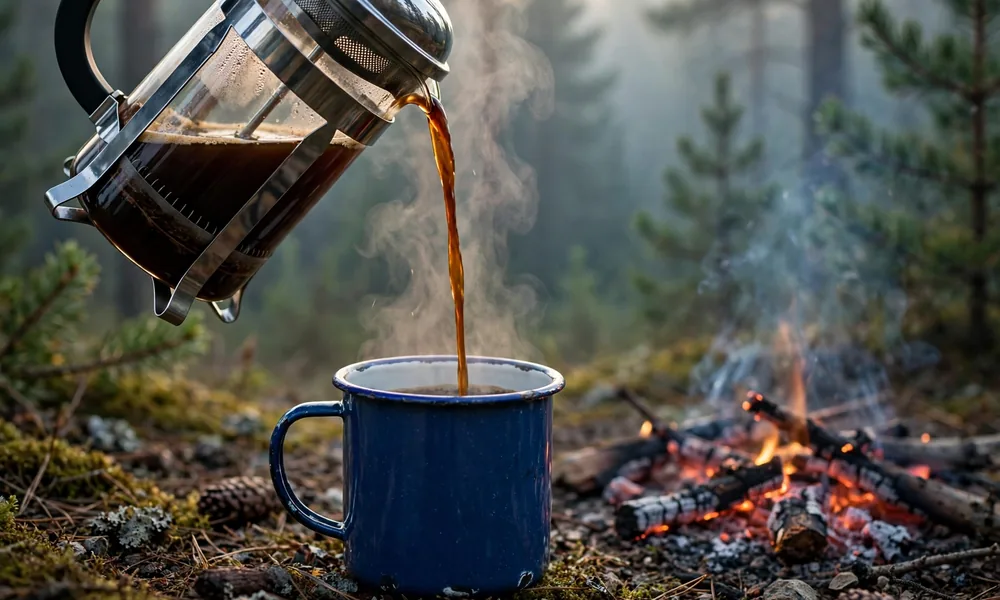
Use roughly one generous tablespoon of coffee per four ounces of water. Pour half the water, stir gently to wet all the grounds, then add the rest and put the lid on with the plunger up. Wait four minutes, press down slowly, and pour straight away so the coffee stops steeping. If the press is hard to push, your grind is too fine; if the coffee tastes thin, steep for another minute next time.
If local water tastes of minerals or chlorine, your coffee will too, so filter it or bring water from home. At altitude, water boils cooler, so steep an extra minute. The best camping stoves make this routine easier, since a steady, controllable flame brings water to a boil fast and holds it there without fuss.
Camping Coffee Packing Checklist
A little preparation turns camp coffee from a chore into a ritual. Clean water matters as much as good beans, so check our guide to the best insulated water bottles before you pack. These six things cover the rest.
- Coarse-ground coffee in a sealed container, measured out for each morning.
- A camping kettle or pot that pours cleanly, plus a reliable stove.
- Your French press, with the plunger and filter checked before you leave.
- Mugs for everyone, or a travel press that doubles as your cup.
- A small towel or bandana for wiping the press dry before packing.
- Airtight storage for used grounds, so you leave no trace.
Frequently Asked Questions
Can you use a glass French press while camping?
You can, but it is a poor idea. Glass breaks easily on rocks and in packs, and a broken beaker ends your coffee for the whole trip. Steel or titanium costs more but survives drops and keeps coffee hotter. Save glass for the kitchen.
How much coffee should I bring per person per day?
Plan on about 30 to 40 grams per person per day, which covers two generous mugs. Bring a little extra for the first morning, and store it sealed so it stays fresh and dry. Pre-measuring each morning into small bags saves time at dawn.
What grind size works best in a French press?
Coarse is the answer, roughly the size of breadcrumbs or coarse sea salt. Fine grounds pass through the mesh, make the coffee cloudy and bitter, and turn the plunger hard to press. Use the coarsest grinder setting at home, or buy beans labelled for French press.
Do I need a special stove to boil water for a French press?
No special stove is needed. Any camp stove, campfire kettle, or pot over a fire will do, as long as you can bring water to a boil. A stove with good flame control helps, but the press itself does the brewing work.
How do I clean a French press without running water?
Scrape the grounds into a bag, wipe the inside with a bandana, and rinse with a little drinking water if you have it to spare. Wash properly with soap when you get home, and never leave wet grounds in the press overnight.
Is a French press better than pour-over for camping?
For most campers, yes. A French press needs no paper filters, no extra dripper, and no precise pouring technique, and it brews a fuller cup with less gear. Pour-over makes a cleaner, lighter cup but adds weight, waste, and fiddliness. For the simplest great coffee outdoors, the press wins.
The Bottom Line
The best French press coffee makers for camping 2026 prove that great coffee outdoors needs no power, pods, or fragile glass. Pick a steel or titanium press in the right size, pack coarse grounds and a way to boil water, and the four-minute steep takes care of the rest. For most campers, the Stanley Classic Travel Press is the sweet spot; groups should look at the GSI JavaPress, and ultralight hikers at the Snow Peak titanium press. Whichever you choose, the reward is the same: a proper cup of coffee in the best seat in the house.