The best solar chargers for travel in 2026 turn sunlight into usable power for your phone, camera, and earbuds, no wall outlet required. Whether you are hiking a mountain trail, island-hopping by ferry, or stuck in a long airport layover, a good solar charger keeps your devices alive far from the grid.
Choosing the right one is not just about wattage. Panel efficiency, weight, portability, battery capacity, and weather resistance all matter, and the wrong pick can leave you with a heavy panel that barely charges a phone.
This guide compares the strongest solar chargers for travel in 2026, explains how solar charging works on the move, and shows you how to get the most from every hour of sun. Every pick balances charging speed with packability, durability, and value.
Key takeaways
- A 20 to 28 watt foldable panel is the sweet spot between speed and pack weight.
- Charge a power bank from the panel, then your phone from the bank.
- Look for monocrystalline panels, USB-C output, and at least IPX4 water resistance.
- Solar charging works in bright overcast too, at roughly a third to half of full-sun speed.
- A solar charger is a backup, not a replacement for a fully charged power bank before you leave.

How We Picked the Best Solar Chargers for Travel
We judged every charger on the factors that matter most on the road. Charging speed came first: we looked at rated wattage, panel efficiency, and real charging times in direct sun, partial shade, and overcast skies.
Durability mattered too, as travel gear gets dropped, rained on, and stuffed into overhead bins, so water resistance and scratch-resistant coatings counted. Finally, we considered versatility: the best models charge more than one device at once and include extras such as built-in stands and carabiner loops. Price was weighed against performance, so this list includes strong options at several budgets.
The Best Solar Chargers for Travel in 2026
These six stood out for travel use. Each suits a different kind of trip, so match the pick to how you actually travel.
1. Best Overall: 28W Foldable Solar Panel Charger
The 28 watt foldable panel is the best all-round solar charger for travel in 2026. It folds to roughly the size of a tablet, weighs under 600 grams, and charges a modern smartphone from empty in about two to three hours of strong sun. Two USB outputs, including USB-C, let you charge a phone and a power bank at once. Its monocrystalline cells reach around 23 percent efficiency.
2. Best for Hikers: 21W Ultralight Solar Charger
The 21 watt ultralight panel is built for backpackers who count every gram. At around 350 grams, it still tops up a phone during a lunch break on the trail. A fold-out kickstand angles it toward the sun, and its USB-A and USB-C ports charge a phone and a headlamp battery at once. The trade-off is speed: in full sun it charges about 25 percent slower than the 28 watt pick, but for multi-day hikes, that trade is worth making.
3. Best with Built-in Battery: 25,000mAh Solar Power Bank
A solar power bank combines a panel with a large internal battery to store sunshine for later. The best 25,000mAh models hold enough charge for four or five full phone charges, and the built-in panel trickle-charges the battery in the sun. Be realistic about the panel, though: it adds only a modest amount of charge per hour, so charge the bank fully from a wall outlet before you leave.
4. Best for Families: 40W Four-Panel Solar Charger
When several people need power, a 40 watt four-panel charger is the answer. It can charge two phones and a tablet simultaneously. It suits family beach trips, group camping, and road trips. The downside is size and weight: at over 900 grams, it is too bulky for ultralight hiking, but for car-based travel, nothing here charges more devices faster.
5. Best Budget Pick: 15W Compact Solar Charger
Budget travelers do not need to spend a fortune to keep a phone alive. A compact 15 watt charger costs far less than the premium picks while still delivering a useful charge in good sun. It folds to pocket size and weighs around 250 grams. Expect slower charging: a full phone charge takes three to four hours in strong sunlight, and its single USB output charges one device at a time. As a backup for city breaks, festivals, and short hikes, it is excellent value.
6. Best Premium Pick: 30W High-Efficiency Solar Charger
The premium 30 watt charger uses the newest high-efficiency cells to squeeze more power from the same sunlight, reaching conversion rates near 24 percent. It charges a phone noticeably faster than standard panels and holds up better in hazy weather, where cheaper panels fade quickly. A digital display shows live wattage, so you can angle it for maximum output. The price is higher, but for travelers who depend on their devices for navigation, work, or photography, the extra speed is worth it.
Solar Charger Comparison Table
| Charger | Wattage | Weight | Best For | Ports |
|---|---|---|---|---|
| 28W Foldable Panel | 28W | ~600 g | Most travelers | USB-C, USB-A |
| 21W Ultralight Panel | 21W | ~350 g | Hiking | USB-C, USB-A |
| 25,000mAh Solar Bank | 10W panel | ~500 g | All-in-one power | USB-C, USB-A |
| 40W Four-Panel Charger | 40W | ~900 g | Families, groups | USB-C, 2x USB-A |
| 15W Compact Charger | 15W | ~250 g | Budget trips | USB-A |
| 30W High-Efficiency Panel | 30W | ~650 g | Fast charging | USB-C, USB-A |

How Solar Charging Actually Works on the Move
A solar panel converts sunlight into electricity, and the amount of power depends on its size, efficiency, and how directly the sun hits it. Heat, haze, dust, and sun angle all reduce output, so expect 60 to 80 percent of rated wattage in good sun.
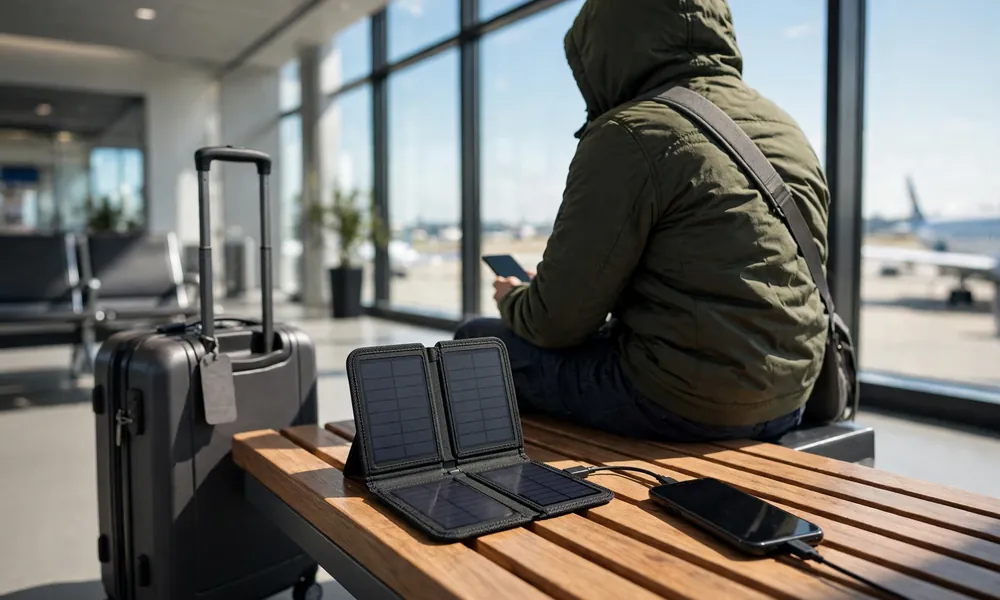
Direct sunlight is essential for fast charging: a panel in open shade can lose half its output or more, and charging through a window is far slower because glass blocks part of the spectrum the cells use. Most phones draw between 5 and 18 watts while charging, so a 20 watt panel charges a phone at a reasonable pace in good sun, while a 10 watt panel will feel slow. Charging a power bank from the panel first is the smartest approach, because power banks accept a steady trickle all day and then deliver fast, stable power to your phone at night. Pairing your panel with one of the best portable chargers for camping gives you a reliable buffer for cloudy stretches and evening use.
Solar Chargers vs Power Banks: Which Travels Better?
Solar chargers and power banks solve different problems, and many travelers carry both. A power bank is a finite reservoir that holds a fixed amount of energy and runs dry. A solar charger is a renewable source that produces energy whenever the sun shines, but stops when the sun sets or hides behind clouds. For short trips with reliable access to outlets, a power bank alone is enough.
For longer trips and outdoor adventures, the combination wins: charge the power bank from the panel during the day, then use the bank to charge your devices whenever you need power. This also protects your phone from stop-start charging when clouds pass over. Weight is the main trade-off, as carrying both adds roughly a kilogram to your bag.
What to Look for Before You Buy
Panel type matters more than brand names. Monocrystalline panels are the most efficient and the best choice for travel, while cheaper polycrystalline panels need more surface area for the same output. Thin-film panels are flexible and light but less efficient.
Check the ports carefully. USB-C is now standard on most new phones, tablets, and cameras, so a charger with a USB-C output is far more useful than one with USB-A alone. Weather resistance matters too: look for at least IPX4, which handles rain, and IP67 for beach or boat use. Finally, think about how you will carry it: foldable panels pack flat.
How to Get the Most Power from Your Solar Charger
Angle is everything. A panel lying flat at midday works well, but in the morning and afternoon, tilting it toward the sun can double the output. Use the kickstand, prop it against your bag, or hang it from a tree branch.
Keep the panel clean, since dust, sand, and sunscreen smears block light and cut efficiency. Charge during the middle of the day when the sun is strongest, roughly 10 a.m. to 3 p.m., topping up your power bank while you hike or relax, then charge your phone from the bank in the evening. Avoid charging a phone directly from the panel in patchy cloud.
Travel Checklist: Packing Your Solar Charger
- Choose 20 watts or more for phones, 30 watts or more for tablets.
- Pack a USB-C cable, a spare USB-A cable, and a short cable for the power bank.
- Charge your power bank fully from a wall outlet before departure.
- Test the panel at home in direct sun before you travel.
- Bring a microfiber cloth to keep the panel clean.
- Power banks go in carry-on luggage, never in checked bags.
Common Mistakes Travelers Make with Solar Chargers
The most common mistake is expecting a solar charger to work like a wall outlet. Solar charging is slower and depends on the weather, so travelers who arrive with a dead phone and expect a full charge in thirty minutes will be disappointed. Start early and treat charging as a background activity.
Another mistake is buying a panel that is too small: a 5 watt panel will take most of a day to add a meaningful charge to a modern phone. A panel strapped to a backpack also charges slowly while walking, because the angle changes constantly and your body shades it, so strap it on during rest stops instead. Finally, do not forget your other devices: cameras, smartwatches, earbuds, and headlamps all need power. If you travel with a smartwatch, check our guide to the best smart watches for travel, and our roundup of the best wireless earbuds for travel covers models with long battery life that pair nicely with solar charging.
Frequently Asked Questions
Do solar chargers work on cloudy days?
Yes, but more slowly. In bright overcast, a panel typically produces about a third to half of its full-sun output, so a two-hour charge may take four or five hours. In heavy rain or deep shade, output drops to a trickle.
How long does it take to charge a phone with a solar charger?
With a 20 to 28 watt panel in direct sun, most modern phones charge from empty in two to three hours. Smaller panels take longer, and charging through a power bank adds a little time but gives you more flexibility.
Can I take a solar charger on a plane?
Yes. Solar panels are allowed in both carry-on and checked luggage. Power banks, including solar power banks, must go in carry-on luggage and are limited to 100 watt-hours without airline approval.
Are solar chargers waterproof?
Most travel solar chargers are water-resistant rather than fully waterproof, typically rated IPX4 or IPX5, which means they handle rain and splashes. A few rugged models reach IP67.
Can a solar charger damage my phone battery?
No, when used normally. Reputable chargers regulate their voltage and current, and phones manage their own charging. The main risk is inconsistent power in patchy cloud, so charge a power bank first.
Is a solar charger worth it for a city trip?
For a typical city break with nightly access to outlets, a solar charger is optional. It earns its place on outdoor trips, road trips, festivals, beach holidays, and any journey where outlets are scarce.
The Bottom Line
The best solar chargers for travel in 2026 keep you powered anywhere the sun shines. For most travelers, the 28 watt foldable panel is the best balance of speed, weight, and price, while hikers will prefer the ultralight 21 watt model and families will get more from the 40 watt four-panel charger. Pair it with a fully charged power bank, keep the panel clean and angled toward the sun, and let it work in the background all day.