Nothing ends a camping trip faster than a dead phone. The map disappears, the camera goes dark, and the device you counted on becomes a brick. The best portable chargers for camping 2026 are built for exactly that moment.
Camping chargers must survive drops onto rock, dust, rain, and nights near freezing. They need capacity for several devices over several days, ports to charge a phone and a lantern at once, and a weight you will actually carry up a hill.
This guide ranks the nine best portable chargers for camping in 2026, from featherweight pocket banks for overnight hikes to power stations that can run a whole base camp. Every pick was judged on capacity, weight, ruggedness, and charging speed.
Key takeaways
- A 10,000mAh bank covers a phone-only weekend; a family or long trip needs 20,000mAh or more.
- Ruggedness beats raw capacity — look for drop protection and water resistance.
- USB-C Power Delivery is essential — it charges phones and headlamps far faster than USB-A.
- Solar helps on multi-day trips, but it tops a bank up slowly — treat it as a backup, not your main plan.
- Charge everything fully before you leave, and carry one short, tough cable per device.
Why Your Camping Charger Needs to Be Different
A charger that works at home can fail badly in the woods, and capacity is the first problem. At home you top up a phone once a day, so a small bank is fine. On a three-day trip, the same phone needs charging two or three times, a camera needs a top-up, and a headlamp needs power.
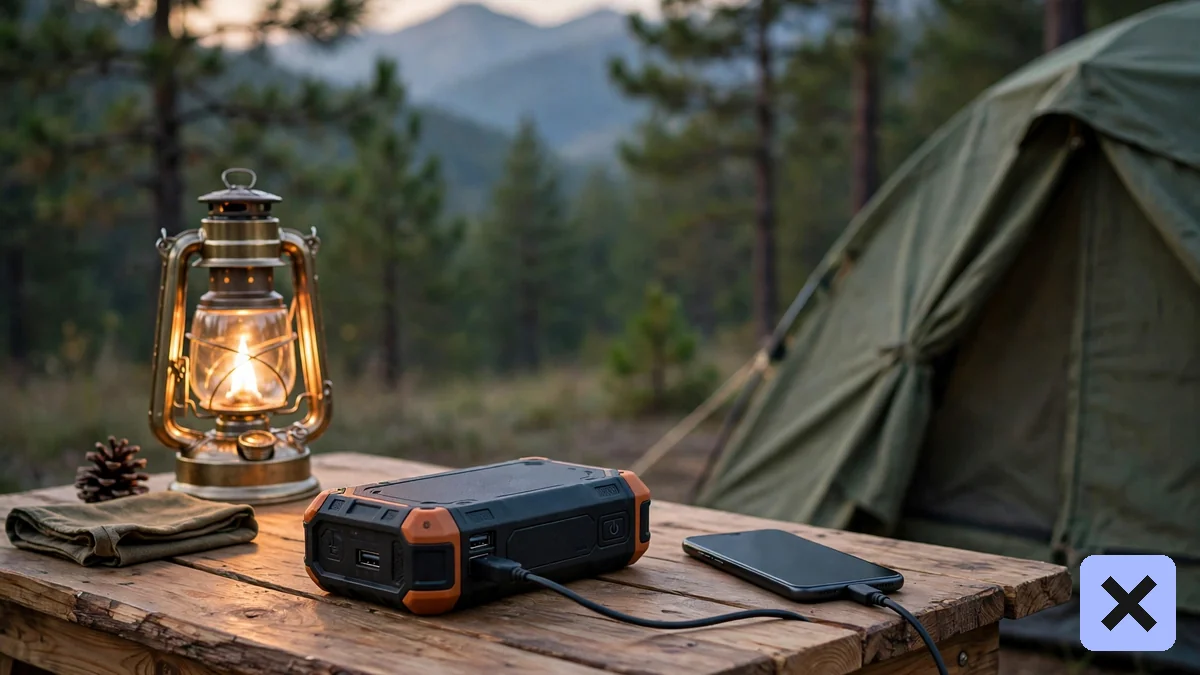
The second problem is the environment. Campsites are dusty, damp, and uneven. A charger gets tossed into a backpack, dropped onto a picnic table, and left in a tent baking in the sun. Cheap plastic banks crack and ports fill with grit, so the best camping chargers use toughened shells, recessed ports, and rubber bumpers.
The third problem is speed. With only an hour at a cafe before the trailhead, or a short window of sun on a solar panel, a slow charger wastes the opportunity — which is why every charger here supports USB-C Power Delivery. If you are starting from scratch, our guide to the best portable chargers for everyday use explains the basics.
How Much Power Do You Actually Need on a Camping Trip?
Capacity is measured in milliamp-hours, or mAh, and the box number is not the number you get. A 10,000mAh bank delivers about two full phone charges, a 20,000mAh bank gives you four or five, and a 26,800mAh bank stretches to six or seven.
Phone-Only Weekends
For one or two nights with a phone as your only device, 10,000mAh is the sweet spot. It weighs 150 to 200 grams, slips into a jacket pocket, and covers two full charges. Turn on battery saver, download maps offline, and switch to airplane mode at night.
Multi-Device Trips
Once a camera, a headlamp, and a second phone join the trip, the maths changes fast. A camera battery drinks roughly the same power as a phone charge. For two or three people on a three-night trip, 20,000mAh is the comfortable minimum, and two banks beat one big one because they charge devices in parallel.
Power-Hungry Base Camps
Family and car camping are a different game. Laptops, fans, lights, and a fridge cooler all want power, and no pocket bank can keep up. A power station in the 250 to 300 watt-hour range charges a laptop several times over and runs camp lights all evening.
The 9 Best Portable Chargers for Camping 2026
1. Nitecore NB10000 Gen 3 — Best Ultralight Charger
At around 150 grams, the Nitecore NB10000 Gen 3 is the lightest serious camping charger you can buy, and the one ultralight hikers actually carry. Its 10,000mAh capacity delivers two full phone charges, and its carbon-fibre shell shrugs off the scuffs of a crowded backpack.
2. Anker 737 Power Bank — Best All-Rounder
The Anker 737 is for campers who want one bank that does everything. Its 24,000mAh capacity handles four or five phone charges, its 140-watt USB-C output fast-charges a laptop, and its display shows exactly how much power is left. At 630 grams it is heavy for a pocket, but ideal for family weekends.
3. BioLite Charge 80 PD — Best for Cold Weather
Cold is the quiet killer of camping chargers, and the BioLite Charge 80 PD keeps working when the temperature drops. Its 20,000mAh capacity covers four phone charges, its 18-watt USB-C port handles phones and headlamps, and its slim design packs flat against a backpack.
4. Goal Zero Sherpa 100PD — Best Premium Power Bank
The Goal Zero Sherpa 100PD is the premium pick for campers who charge a lot of gear. Its 25,600mAh capacity and 100-watt USB-C output can charge a laptop, a camera, and a phone in one session, and its wireless pad handles earbuds without a cable.
5. Jackery Explorer 300 Plus — Best Portable Power Station
When a pocket bank is not enough, the Jackery Explorer 300 Plus steps in. With 288 watt-hours, it charges a phone more than twenty times, runs a laptop for a working day, and keeps camp lights glowing. It recharges from a wall socket, a car, or a solar panel.
6. EcoFlow River 2 — Best Fast-Recharging Station
The EcoFlow River 2 stands out because it recharges astonishingly fast. Its 256 watt-hour battery goes from empty to full in about an hour from a wall socket, so a lunch stop can reset your whole camp’s power. It offers USB-C, USB-A, and AC outputs in a tough, compact body.
7. Rugged Solar Power Bank 26,800mAh — Best Solar Backup
A rugged solar power bank with a built-in panel is the most honest solar option for short trips. Its 26,800mAh capacity covers five or six phone charges, its rubberised shell survives drops and rain, and its panel trickles power back in during the day.
8. Anker PowerCore 10000 Redux — Best Budget Charger
Not every camping trip needs a flagship bank, and the Anker PowerCore 10000 Redux proves the point. It packs 10,000mAh into a compact, pocket-friendly body and costs a fraction of the premium picks. For a weekend of phone top-ups, it is all most campers need.
9. Bluetti EB3A — Best for Gadget-Heavy Camps
The Bluetti EB3A is the power station for campers who bring everything: laptops, cameras, drones, lights, and a portable fridge. Its 268 watt-hour battery and 600-watt AC output handle gear smaller stations cannot, on sunny trips.
Best Portable Chargers for Camping 2026: Comparison Table
| Charger | Capacity | Weight | Best For |
|---|---|---|---|
| Nitecore NB10000 Gen 3 | 10,000mAh | ~150g | Ultralight hiking |
| Anker 737 Power Bank | 24,000mAh | ~630g | All-round use |
| BioLite Charge 80 PD | 20,000mAh | ~340g | Cold weather |
| Goal Zero Sherpa 100PD | 25,600mAh | ~600g | Premium performance |
| Jackery Explorer 300 Plus | 288Wh | ~3.5kg | Family base camps |
| EcoFlow River 2 | 256Wh | ~3.5kg | Fast recharging |
| Rugged Solar Power Bank | 26,800mAh | ~450g | Solar backup |
| Anker PowerCore 10000 Redux | 10,000mAh | ~190g | Budget weekends |
| Bluetti EB3A | 268Wh | ~4.6kg | Gadget-heavy camps |
Solar Charging on the Trail: What Actually Works
Solar charging sounds perfect, but the reality is modest. A small built-in panel produces only a few watts, adding roughly ten to fifteen percent of a phone charge per hour of strong sun — useful as a trickle, but it will not refill a dead bank before dinner.
A folding panel changes the equation. A 20-watt folding panel in direct sun can charge a phone in a couple of hours and refill a 10,000mAh bank over a full sunny day. Charge the bank by day and your devices at night.
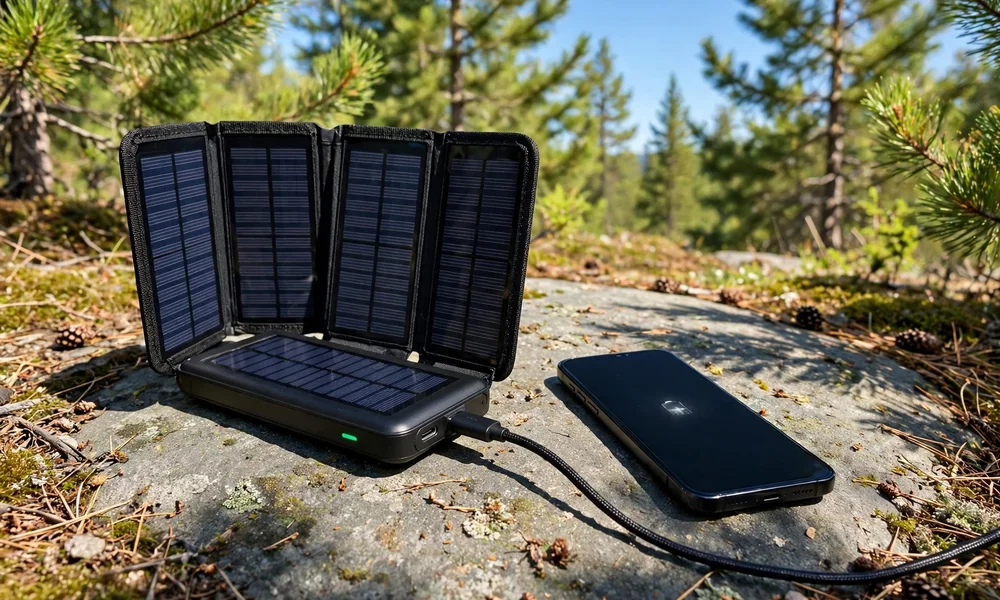
The honest verdict is that solar is a backup, not a plan. For trips of four nights or more, a folding panel plus a big bank is genuinely useful. For a weekend, a fully charged bank is lighter, cheaper, and more reliable.
Ruggedness Ratings Explained
Two ruggedness ratings matter. The IP rating measures protection against dust and water: IP65 means dust-tight and safe in rain, enough for most camping, while IP67 adds protection against brief immersion. Anything below IPX5 belongs in a dry bag.
The second is drop protection. Look for rubberised corners, a recessed port area, and a shell that flexes instead of cracking. A charger that survives a one-metre drop onto rock beats an extra thousand milliamp-hours that shatters on the first fall. Keep the bank in your sleeping bag on freezing nights and out of sun on hot afternoons.
How to Make One Charge Last a Whole Weekend
Stretching your power is mostly discipline, and a few habits can double the life of a single bank. Before you leave, charge everything to full and download maps, music, and reading material for offline use.
- Switch to airplane mode at night — searching for signal in a dead zone drains a battery fast.
- Lower screen brightness and shorten the timeout; the display is the biggest power draw on any phone.
- Charge devices in one session, not short bursts.
- Keep the bank warm on cold nights inside your sleeping bag or an inner jacket pocket.
- Use short, high-quality cables — long, cheap ones waste power and break at the worst moment.
- Charge the hungriest device first, usually the camera, so power is left for the headlamp later.
What to Pack With Your Charger
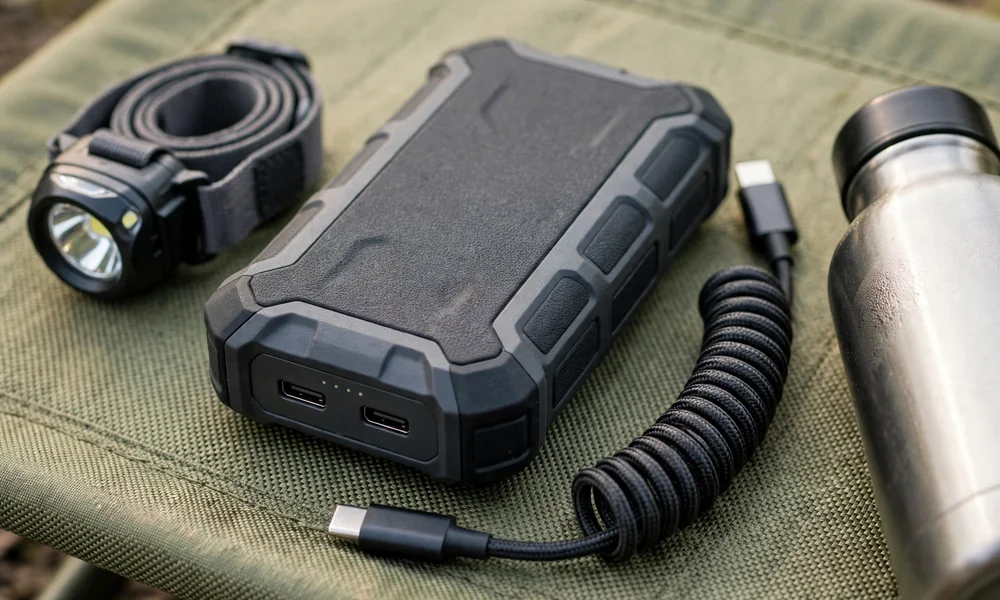
A charger is only as useful as the kit around it. The most important companion is a short, braided USB-C cable that survives being yanked from a bag a dozen times a day. A second cable covers older devices.
Lighting is the other half of camp power. A good headlamp runs for days on a single charge, and a lantern turns a dark tent into a living room. The best camping lanterns we tested include several that charge from the same USB-C banks on this list.
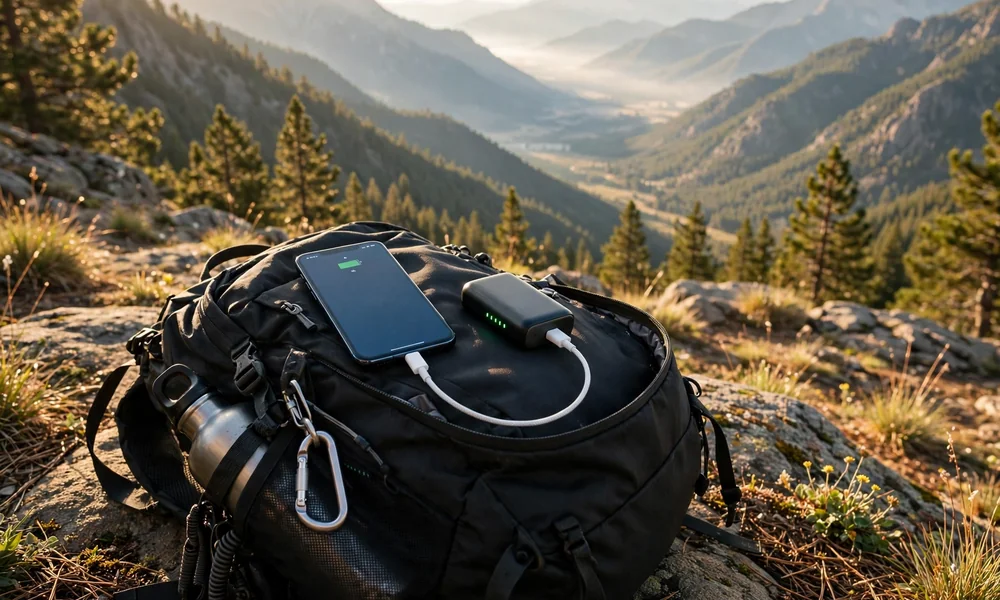
Cooking gear benefits from the same thinking. A camp kitchen runs on gas, but the small comforts around it — a fan, a light, a speaker — all draw from your bank. The best camping stoves we recommend are chosen for fuel efficiency. Keep the bank in a dry bag near the top of your pack.
Frequently Asked Questions
How many times can a 20,000mAh charger charge a phone?
Roughly four to five full charges, since conversion losses leave about 65 to 70 percent of the labelled capacity usable.
Can I take a portable charger on a plane to reach my campsite?
Yes, in cabin baggage, but not in checked luggage. Most airlines allow banks up to 100 watt-hours without approval, which covers every pocket bank on this list. Stations above that usually need approval.
Is a solar power bank worth it for camping?
For weekends, no — a fully charged bank is lighter and more reliable. For trips of four nights or more, a folding panel paired with a large bank can refill a 10,000mAh bank over a sunny day. A small built-in panel is an emergency trickle.
What is the best capacity for camping?
One person on a weekend: 10,000mAh. Two or three people, or three nights or more: 20,000mAh. Family base camps: a 250 to 300 watt-hour power station.
Do portable chargers work in cold weather?
They work, but deliver less power when cold. Lithium batteries lose capacity below freezing, so keep your bank in a warm pocket or your sleeping bag overnight. Never charge a freezing-cold bank — warm it up first.
How long does a camping power bank last?
A good lithium bank lasts 300 to 500 full charge cycles, several years of regular camping. Store it half-charged between trips, keep it cool and dry, and never leave it fully drained for months.
The Bottom Line
The best portable charger for camping in 2026 matches your trip: the Nitecore NB10000 Gen 3 for ultralight hikes, the Anker 737 for family weekends, and the Jackery Explorer 300 Plus for base camps. Pick the right capacity and charge it fully before you leave.