
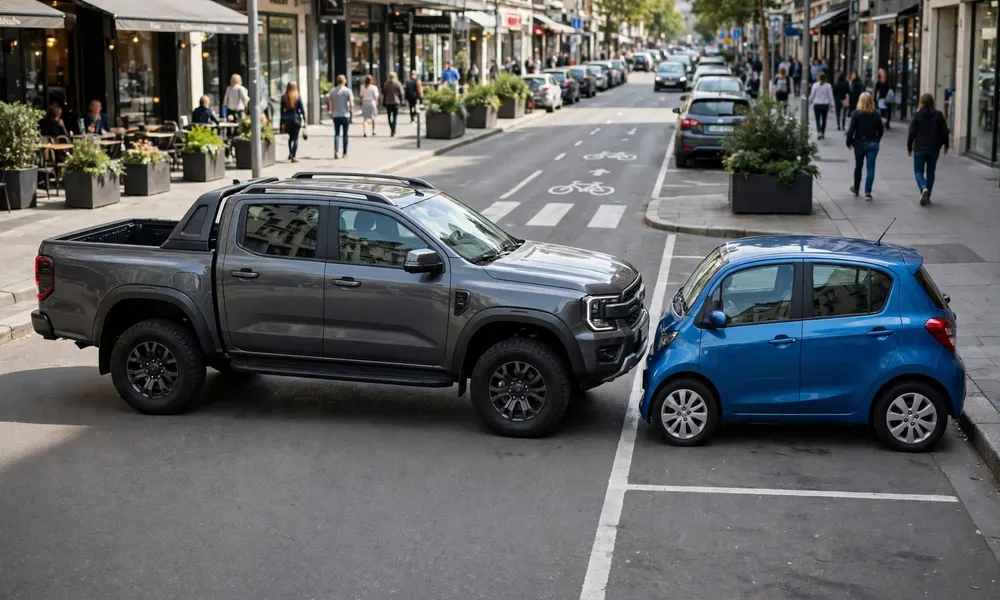
The worst pickup trucks for city driving 2026 all share the same problem: they were built for open roads, heavy loads and wide spaces, and the city gives them none of those. A full-size pickup is around 19 to 20 feet long, over 6.5 feet wide before the mirrors, and needs a turning circle of roughly 47 to 55 feet. Most city parking bays are 16 to 18 feet long, so every day becomes a slow negotiation with kerbs, bollards and multi-storey ramps.
That does not mean pickup trucks are bad vehicles: on a motorway, a building site or towing a trailer, a big truck is superb. But city driving rewards the opposite qualities: a short wheelbase, a tight turning circle, good visibility and modest fuel use. This guide names the pickups that struggle most in town and what to buy instead.
Key takeaways
- Full-size pickups are 19 to 20 feet long, while most city parking bays are only 16 to 18 feet, so they overhang almost everywhere.
- Turning circles of 47 to 55 feet make U-turns a three-point exercise in most city trucks.
- Urban fuel economy of 14 to 17 mpg means a city commute can cost twice as much in fuel as a compact car.
- High bonnets and thick pillars create blind spots that hide pedestrians, cyclists and small cars at junctions.
- Heavy-duty models add a stiff, unladen ride that is punishing on potholed and patched city streets.
How we judged the worst pickup trucks for city driving
We scored each truck only on what matters in town: length and width, turning circle, visibility, urban fuel economy, ride comfort when unladen, and the parking and insurance costs that rise with size. The trucks below failed on several of these measures at once.
The worst pickup trucks for city driving in 2026
1. GMC Hummer EV Pickup
The Hummer EV is the worst pickup for city driving, and it is not close. It is over 18 feet long, 86 inches wide before mirrors, and weighs more than 9,000 pounds, roughly double a family hatchback. Rear-wheel steering gives it a 44-foot turning circle, but that does not help you park a vehicle this wide in a bay built for cars half its size, and the flat bonnet hides a child or a bollard directly ahead.
2. Ford F-250 Super Duty
The F-250 Super Duty is a working truck, and its city failings follow from its job. In crew-cab form it stretches past 20 feet, with a turning circle close to 55 feet, the widest on this list, so a U-turn on a normal residential street is effectively impossible. The ride is the harshest here when the bed is empty, and urban fuel economy is in the low teens.
3. Ram 2500 Heavy Duty
The Ram 2500 is a heavy-duty truck first and a city vehicle a very distant second. At over 20 feet long in crew-cab form, with a turning circle near 54 feet, it needs more road than most city streets offer. Its width makes narrow lanes with cars parked on both sides a slow, mirror-folding exercise. Urban fuel economy sits in the low teens.
4. Chevrolet Silverado 1500
The Silverado 1500 is one of the most popular trucks in America, and also one of the most awkward in a city. A crew-cab short-bed model is about 19.5 feet long, with a turning circle of roughly 48 feet. Visibility is a real weakness: the high bonnet and thick A-pillars hide pedestrians and cyclists. In town the V8 petrol versions return around 15 mpg.
5. Toyota Tundra
The Tundra is Toyota’s full-size truck, and its 2026 version is wider and heavier than the model it replaced. At around 19.5 feet long with a turning circle of about 48 feet, it matches the Silverado for awkwardness, and its ride is firmer than a Ram’s when the bed is empty. The hybrid helps, but urban figures stay in the mid-teens because the truck weighs well over 5,500 pounds, and steering is heavy at parking speeds.
6. Ford F-150
The F-150 is the best-selling vehicle in America, which makes its city weaknesses easy to overlook. In crew-cab form it is about 19.5 feet long, with a turning circle of around 47 feet, and it overhangs most parking bays by a foot or more. The high bonnet creates a blind spot of several metres directly ahead. Urban fuel economy is 15 to 17 mpg for the petrol versions.
7. Ram 1500
The Ram 1500 is the most comfortable truck on this list, with a smooth ride and a quiet cabin, but comfort cannot fix its dimensions. At around 19 feet long and over 6.5 feet wide, it is too big for most city parking, and its turning circle of about 47 feet makes tight junctions a chore. Fuel economy is its other weakness: the V8 returns around 15 mpg in town.
8. GMC Sierra 1500
The Sierra 1500 is the Silverado’s twin, and it shares almost all of its city problems. The crew-cab model is about 19.5 feet long, the turning circle is close to 48 feet, and the high bonnet and thick pillars create the same blind spots. The ride is slightly firmer than the Silverado’s, urban fuel economy is the same 15 mpg, and it costs more while offering the same city drawbacks.
9. Nissan Titan
The Titan is the smallest full-size truck here, which sounds like good news until you check the numbers. It is still around 19 feet long, its turning circle is about 47 feet, and its V8 returns roughly 15 mpg in town. Being the smallest of a very large group does not make it a good city vehicle. Steering is heavy at low speed, rear visibility is poor, and the ride is firm when unladen.
10. Rivian R1T
The Rivian R1T is the most city-friendly truck on this list in some ways: it is shorter than the full-size trucks at around 18 feet, it has a tight turning circle for its size, and its electric drivetrain is smooth and quiet in traffic. But it is over 6.5 feet wide, weighs more than 7,000 pounds, its urban range drops sharply in cold weather, and it is very expensive to repair after a parking scrape.
Worst pickup trucks for city driving compared
| Truck | Length | Turning circle | Urban mpg | Biggest city problem |
|---|---|---|---|---|
| GMC Hummer EV Pickup | 18.1 ft | 44 ft | Electric | Extreme width and weight |
| Ford F-250 Super Duty | 20.4 ft | 55 ft | 12-14 mpg | Length and turning circle |
| Ram 2500 Heavy Duty | 20.2 ft | 54 ft | Length and stiff ride | |
| Chevrolet Silverado 1500 | 19.5 ft | 48 ft | 15 mpg | Visibility and parking |
| Toyota Tundra | 19.5 ft | 48 ft | 15-16 mpg | Heavy steering, width |
| Ford F-150 | 19.5 ft | 47 ft | 15-17 mpg | Blind spot and fuel use |
| Ram 1500 | 19.0 ft | 47 ft | 15 mpg | Width and fuel use |
| GMC Sierra 1500 | 19.5 ft | 48 ft | 15 mpg | Price with no city benefit |
| Nissan Titan | 19.0 ft | 47 ft | 15 mpg | No offsetting advantage |
| Rivian R1T | 18.0 ft | 45 ft | Electric | Width, weight, repair cost |
Every full-size pickup is at least 18 feet long, needs a turning circle of 44 feet or more, and returns 15 mpg or less in town unless it is electric, while a typical city parking bay is only 16 to 18 feet long.

Why pickup trucks struggle in cities
Parking is the most obvious problem. A turning circle of 47 to 55 feet means a U-turn needs a road at least that wide, and most residential streets are 20 to 30 feet wide, so three-point turns become a daily routine. Visibility is the most serious problem: a bonnet over four feet high creates a blind spot stretching several metres ahead, inside which a child or a cyclist can sit entirely hidden. Fuel economy is the other big cost: a truck that returns 22 mpg on a motorway can return 14 mpg in town, and over 10,000 miles of city driving a year, the gap between 15 mpg and 35 mpg is roughly 380 gallons, well over a thousand dollars a year. Our guide to the worst diesel cars for city driving shows the same pattern in smaller vehicles, where a poor city choice still costs far less to live with.

What to buy instead for city driving
The best alternative to a full-size pickup in the city is a mid-size truck like the Ford Ranger, Toyota Tacoma or Chevrolet Colorado: around 17 to 18 feet long, with a turning circle closer to 42 feet and noticeably better urban fuel economy. They still tow and carry useful loads, but they fit parking bays and cost less to insure and park. If you do not need a load bed, a compact SUV is better still, and if your truck use is occasional, hiring a van for the days you need one is far cheaper than owning a full-size pickup for a year. Our pickup vs SUV for towing comparison shows where a truck genuinely earns its size.
City driving checklist: is a pickup right for you?
- Measure your parking space: under 19 feet, a full-size pickup overhangs it daily.
- Test the turning circle with a U-turn on your own street before you buy.
- Check your car park: confirm the height limit, bay width and ramp gradient fit the truck.
- Count your city miles: if most of your driving is urban, work out the annual fuel cost at 15 mpg.
- Check insurance and parking charges, which rise with length and weight.
- Try the visibility test: sit in the driver’s seat and see how much of the road ahead the bonnet hides.
Frequently asked questions
What is the worst pickup truck for city driving?
The GMC Hummer EV Pickup: over 86 inches wide, more than 9,000 pounds, and too big for most city parking bays, ramps and car parks. The Ford F-250 Super Duty and Ram 2500 are close behind, over 20 feet long with turning circles near 55 feet.
Are pickup trucks bad for city driving in general?
Full-size pickups are poor city vehicles: long, wide, thirsty and hard to park, with turning circles of 47 to 55 feet and urban fuel economy of 14 to 17 mpg. Mid-size pickups are much better.
How long is a full-size pickup truck?
A full-size pickup in crew-cab form is around 19 to 20 feet long, and heavy-duty models stretch past 20 feet, while most city parking bays are 16 to 18 feet long, so a full-size truck overhangs the bay by one to two feet.
What is the turning circle of a pickup truck?
A full-size pickup needs a turning circle of roughly 47 to 55 feet, compared with about 35 feet for a compact car, so U-turns on normal residential streets are usually impossible.
Do pickup trucks use a lot of fuel in the city?
Yes. A petrol full-size pickup returns around 14 to 17 mpg in stop-start city traffic, roughly half what a compact car manages, which can cost well over a thousand dollars more in fuel over 10,000 miles a year.
What should I buy instead of a full-size pickup for city driving?
A mid-size pickup such as the Ford Ranger or Toyota Tacoma is the best alternative if you still need a load bed; if not, a compact SUV is better still. Our worst convertibles for daily driving guide shows how the same city trade-offs apply to other impractical body styles.
The bottom line
The worst pickup trucks for city driving are the biggest ones: the GMC Hummer EV, the Ford F-250 Super Duty and the Ram 2500, followed by the full-size 1500-class trucks. They are too long for city parking bays, too wide for narrow streets, too thirsty for stop-start traffic, and too tall to see pedestrians clearly. They are superb for towing and hauling, but in the city their size is a liability. If your driving is mostly urban, buy a mid-size truck or a compact SUV instead.


