
Bath time is one of the happiest parts of a baby’s day, and the right toys are what turn a quick wash into a game. A rubber duck bobbing past, a little boat that actually floats, a squirter that sends a gentle arc of water into the air: these small things hold a baby’s attention, encourage reaching and splashing, and make the whole routine easier for the grown-up holding the flannel. The best baby bath toys of 2026 are simple, sturdy, easy to clean and sized for small hands, and they are chosen for how well they play in water rather than how clever they look on a shelf.
What Makes a Baby Bath Toy Good
A good baby bath toy starts with the material. Look for soft, smooth rubber or food-grade silicone with no sharp edges, no peeling paint and no small parts that can come loose. The toy should feel solid in your hand, not thin or hollow in a way that cracks after a few weeks. Squeeze it: it should give a little and spring back, and it should not trap a large pocket of water inside that you cannot empty. Toys with a sealed body, or with a hole large enough to rinse and dry properly, stay fresh far longer than toys with a tiny hole that never quite dries out.
How to Choose: The Three Things That Matter Most
Start with safety and size. Check the age guidance on the packaging and choose toys made for your baby’s age, not for an older child. A toy for a six-month-old should be large, soft and impossible to swallow, while a toy for a two-year-old can be smaller and more detailed. Run your finger over every edge and seam. If anything feels rough, sharp or loose, put it back. A bath toy will be chewed, so the finish matters: look for toys that are free from flaking paint and strong chemical smells when you open the pack.
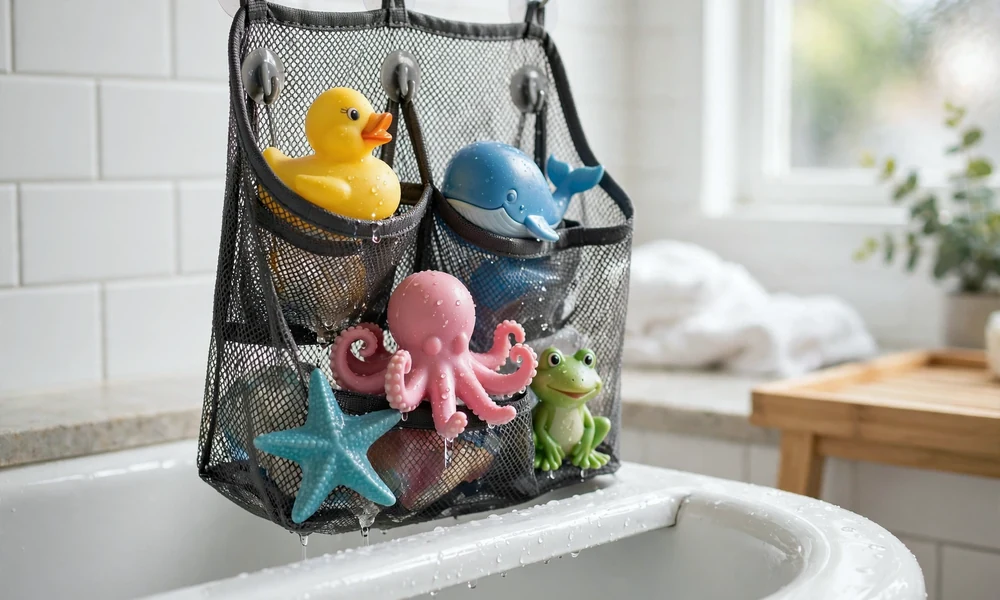
Next, think about cleaning. Every bath toy gets wet, and a toy that cannot dry will grow mould. Choose toys that are sealed, or that open up so you can rinse the inside, and avoid squirters with a tiny hole that you cannot clean or dry. After bath time, squeeze out the water, rinse the toy and leave it somewhere it can air-dry completely. A mesh bath toy organiser that hangs over the side of the tub is a simple way to do this, because the air can reach every toy and the water drains away instead of pooling at the bottom.
Then look at how the toy behaves in water. A floating toy should float upright, not tip over and sink the moment a baby touches it. A squirter should send a gentle stream, not a sharp jet. A pouring cup should pour smoothly without a lip that catches the water. If you can, test the toy in the bath before bath time, so you know how it floats, how much water it holds and whether it tips. A toy that works well in the water is worth far more than a toy that looks charming but sinks.
The Best Types of Baby Bath Toy
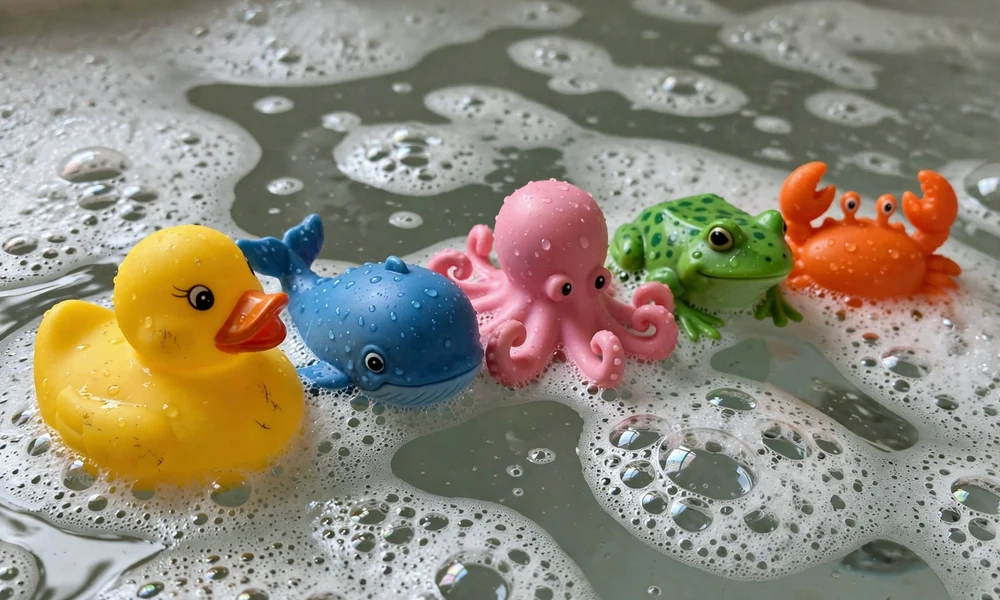
Rubber ducks are the classic for a reason. They float, they are easy to grip, they squeak gently when squeezed, and babies recognise them instantly. A set of ducks in different colours gives a baby something to choose between, and a larger duck makes a good first bath toy because it is impossible to swallow and easy to spot in the bubbles. Look for ducks with a sealed base rather than a small hole underneath, because those are the ones that stay dry inside and last the longest.
Squirters come second, and they are the toys babies reach for once they can squeeze with purpose. A whale, a frog or an octopus that squirts a soft stream of water turns bath time into a game of cause and effect, and it helps a baby learn how hard to squeeze. Choose squirters that are easy to fill and easy to empty, with a hole you can rinse. If a squirter starts to smell stale, or you cannot rinse it clean, it is time to replace it, however much your baby likes it.
The Best Bath Toys by Age
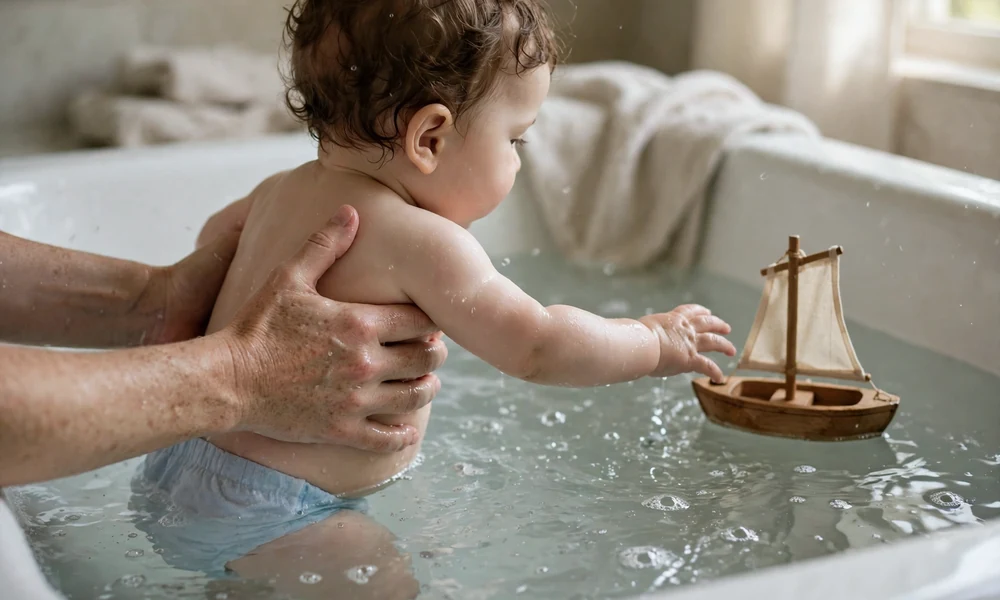
For babies under one, keep it very simple. Large soft ducks, a gentle squirter and a couple of floating animals are enough. The toys should be big, smooth and easy to hold with a whole hand, and they should do one obvious thing: float, squirt or squeak. At this age the bath is short, the baby is learning to sit, and the toys are there to hold attention while you wash hair and rinse off soap. Anything with small parts, batteries or complicated moving pieces is not needed yet, and it will only add worry.
Safety First: The Rules That Matter
The most important safety rule is also the simplest: never leave a baby alone in the bath, not even for a moment, and not even if the water is shallow. A baby can slip under the water in seconds, and a bath toy is never a substitute for a grown-up’s hands and eyes. Keep everything you need within arm’s reach before the baby goes in, so you never have to turn away to fetch a towel or a toy, and keep the water shallow and comfortably warm, tested with your wrist or elbow before the baby is lowered in.
For the rest of the bath routine, a gentle wash matters as much as the toys. Our guide to the best baby shampoo of 2026 covers mild, tear-free washes that suit delicate skin, and it is worth reading alongside this guide so the whole bath, not just the toys, is gentle. Keep shampoo and soap away from the toys where you can, because soap residue left on a toy dries into a film that is harder to rinse off later.
Keeping Bath Toys Mould-Free
Mould is the most common problem with bath toys, and it is also the easiest to prevent. The rule is simple: dry the toys after every bath. Squeeze the water out of squirters, rinse each toy under clean water, shake off the excess and leave the toys somewhere airy until they are completely dry. A mesh bag or organiser hanging on the side of the bath does this well, because air flows through the mesh and water drains away. A closed box, a pile at the bottom of the bath, or a damp shelf is the opposite of what you want.
Storage matters too. Keep the toys out of direct sunlight when they are not in use, because strong sun can make rubber brittle and colours fade, and keep them away from hot radiators for the same reason. A cool, dry bathroom shelf or a hanging mesh organiser is ideal. And when bath time is over, a soft towel finishes the job. Our guide to bath towels for kids looks at hooded towels that wrap a baby up warmly straight out of the water, which is the kindest way to end a bath.
What to Avoid When Buying Baby Bath Toys
Avoid toys with small detachable parts. Eyes that can be pulled off, tiny hats, little wheels and anything that unscrews are all risks for a baby who explores the world by putting things in their mouth. If a part can be pulled off with a firm tug, it will be pulled off in the bath. Choose toys that are made in one piece, with painted details that are part of the toy rather than stuck on.
Avoid buying a huge set all at once. A large bag of bath toys looks like good value, but it usually means thin rubber, weak seams and toys that are hard to tell apart. It also means more toys to clean, dry and store, which is the part of bath time nobody enjoys. Start with a small set of well-made toys, see which ones your baby loves, and add one or two at a time. A baby who has five toys they love will play more happily than a baby surrounded by twenty they ignore.
Bath Time as Play Time
The best bath toys do more than fill the bath: they turn washing into play, and play into learning. A baby who pours water from a cup is learning about full and empty. A baby who lines up ducks is learning about order. A baby who squeezes a squirter is learning about cause and effect. None of this needs to be taught; it happens naturally when the toys are simple, safe and easy to use. The grown-up’s job is to keep the water warm, the baby safe, and the toys clean, and then to let the play happen.
When the toys are put away, the play does not have to stop. Our guide to the best board games for toddlers covers simple games that suit the same age group, and the same idea applies: simple, sturdy, easy to understand and fun to play again. Bath toys and board games both work best when they are chosen for the child in front of you, not for the age on the box alone.
Frequently Asked Questions
How many bath toys does a baby need? Five or six good toys are plenty. A small set is easier to clean, easier to dry and easier for a baby to choose from, and a rotation of one or two new toys keeps the bath interesting without crowding it. If your baby has a favourite, keep that one in the bath every time and rotate the rest around it.
How do I know if a bath toy is mouldy? Look inside the toy and around any seams or holes for dark spots, and smell it after squeezing out the water. A stale or musty smell, or dark marks you cannot scrub away, means the toy should be replaced. Toys with sealed bodies, or with holes large enough to rinse and dry, are much less likely to develop this problem.
When should I replace a bath toy? Replace any toy that is cracked, torn, peeling or leaking, any toy with a loose part, and any toy you cannot clean properly. Also replace toys your child has outgrown, because a toy that was safe for a baby may be too small for a toddler. A quick check before each bath is the easiest way to catch these problems early.
The best baby bath toys are the simple ones: a rubber duck that floats, a squirter that works, a boat that stays upright, and a set of cups that pour cleanly. Choose toys that are big enough, soft enough and easy to clean, dry them after every bath, and keep a grown-up close at all times. Do that, and bath time stays what it should be: warm water, happy splashing, and a baby who cannot wait to get back in tomorrow.


