The best bath mats for small bathrooms in 2026 are the ones that disappear into the room until you need them: compact enough to fit a tight floor, grippy enough to stay put on wet tile, and quick-drying enough never to turn musty. In a bathroom where every centimetre counts, the wrong mat bunches against the door or stays damp for days — and the right one makes the room feel bigger.
We judged memory foam, cotton, teak, diatomite stone, and quick-dry microfibre mats on fit, grip, drying time, and washability. Size was the first filter: anything wider than about 60 centimetres was out, because a mat that overlaps the skirting board or curls under the door is worse than no mat at all.
This guide rounds up the best bath mats for small bathrooms in 2026, with notes on who each one suits, what to avoid, and how to measure your floor before you buy.
Key Takeaways
- Measure first: most small bathrooms only fit a mat 40–60 cm wide and 60–80 cm long.
- Memory foam feels best underfoot but dries slowest — pick a washable one with a non-slip base.
- Quick-dry microfibre and diatomite stone mats suit windowless or poorly ventilated bathrooms best.
- Teak mats look superb and dry fast, but check the slat spacing and weight first.
- Wash or air your mat weekly; a damp mat in a small bathroom goes musty fast.
Why Size Matters More Than Style in a Small Bathroom
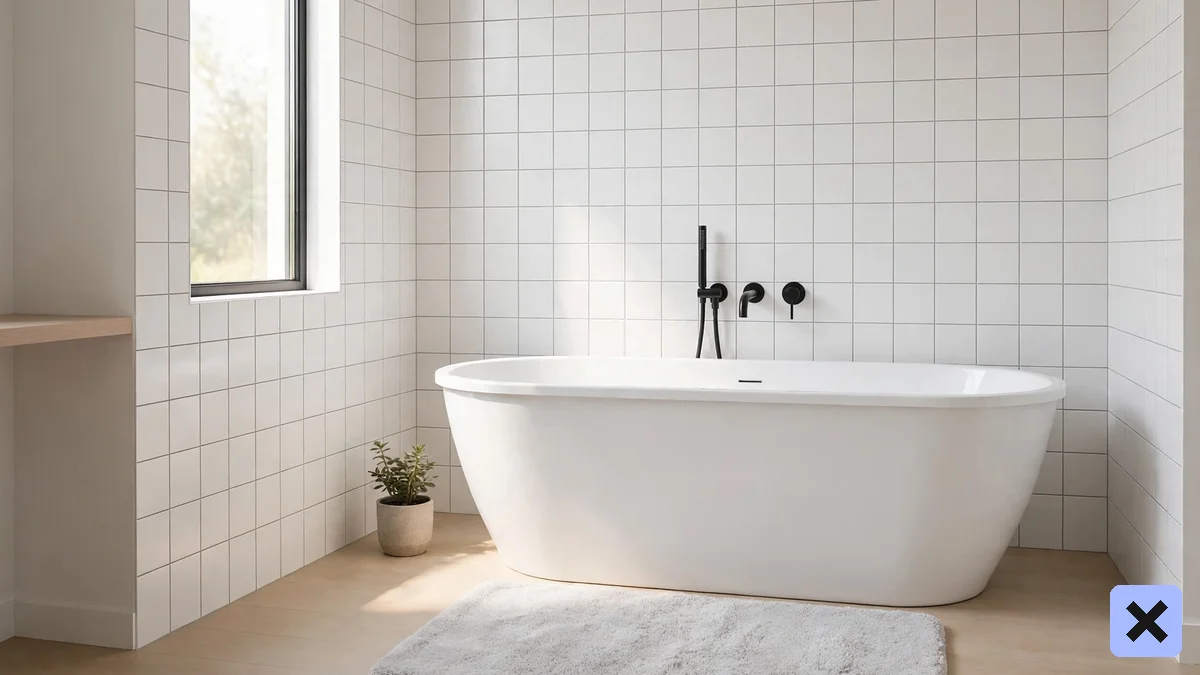
A bath mat has to work with the architecture, not against it. In a small bathroom, the mat shares its floor with a door swing, a vanity, and a toilet base, so every centimetre is contested ground.
The most common mistake is a standard mat whose edge the door catches; within weeks that corner curls, frays, and becomes a trip hazard. The opposite mistake is a mat so small that wet feet land on bare tile beside it. The sweet spot covers the landing zone where you step out, with a few centimetres of clearance on every side.
A mat that fits makes a small bathroom look tidy and deliberate, while an oversized one chops the floor into pieces. The same logic applies elsewhere: a well-chosen bathroom mirror can make a small room feel twice as big, and the right mat proportions do the same for the floor.
The Best Bath Mats for Small Bathrooms 2026
Our picks cover five mat types that earn their place in a small bathroom, each chosen for a different strength — comfort, washability, looks, drying speed, or all-round value. Whether you shower or soak changes what you need underfoot, and our shower versus bath comparison explains the difference.
1. Memory Foam Mats — Best for Comfort
Memory foam mats are the softest option here, and that matters: you step onto the same small patch of floor every morning, so a mat that cushions your feet turns a cold tile landing into a pleasant moment. The best ones use a dense foam core that springs back after each use rather than flattening within a month.
The trade-off is drying time: foam holds water, so these mats need a non-slip rubber base and regular washing. Look for a removable, machine-washable cover, and hang the mat over the bath or a towel rail after your shower so air reaches both sides. In a bathroom with decent ventilation, a 50 by 80 cm memory foam mat is the comfort pick.

2. Cotton Mats — Best for Easy Washing
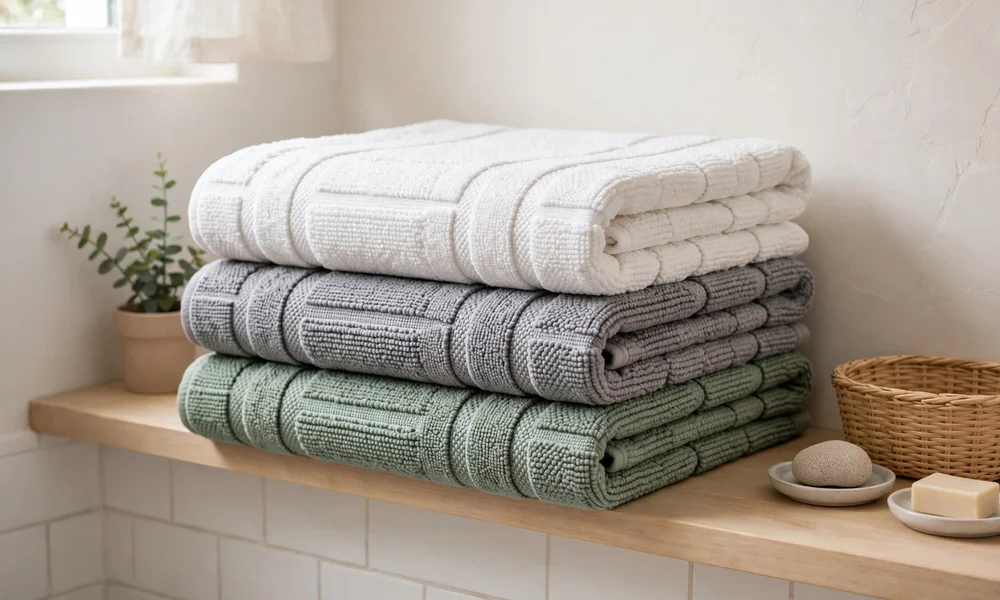
Cotton mats are the practical classic: thin, light, and easy to wash. They dry faster than memory foam, fold away for storage, and wash like new. If your bathroom has no window, washing the mat weekly is worth more than extra cushioning.
Choose a good weight — around 800 to 1,000 grams per square metre — so it feels substantial rather than flimsy, and pick a woven or tufted texture for grip on smooth tile. Pair it with one of the best bath towels for a matching set and the whole bathroom looks coordinated. The only weakness is that cotton can bunch when wet, so a non-slip latex or rubber backing is worth paying for.
3. Teak Wood Mats — Best for Style and Fast Drying
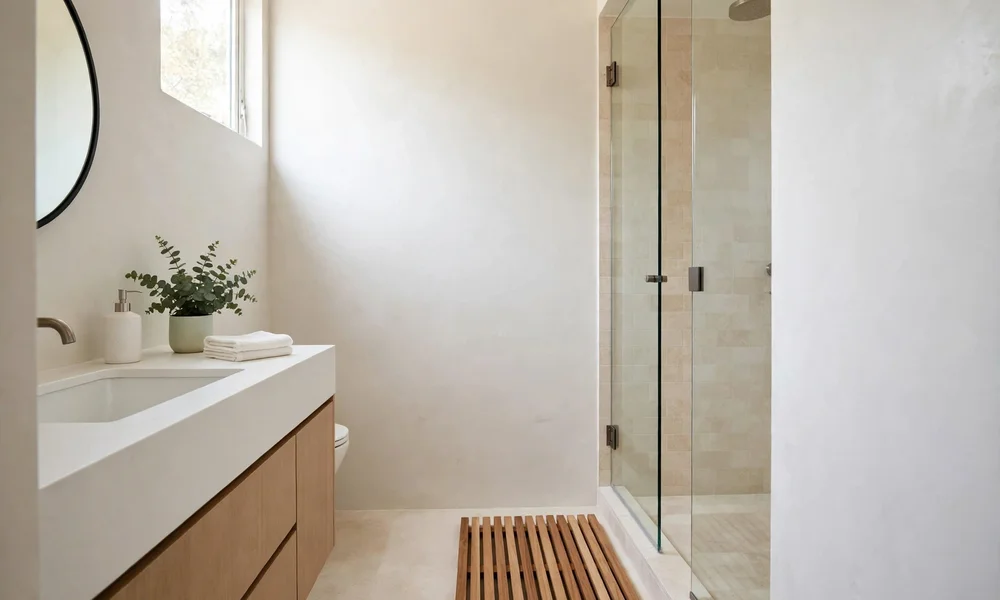
A teak bath mat is the style pick, and it solves a problem no fabric mat can: it never stays soggy. Water drains through the slats and the wood dries within minutes, which makes teak ideal where a damp fabric mat would stay wet all day. The warm wood also softens a room full of cold tile and chrome.
Before buying, check the slat spacing: gaps that are too wide feel uncomfortable under bare feet, while gaps that are too narrow trap water. A good teak mat also has small rubber feet that keep it stable and let air circulate underneath. Teak mats are heavy and do not fold away, so measure carefully and make sure the mat can live in its spot permanently.
4. Diatomite Stone Mats — Best for Tiny, Damp Bathrooms
Diatomite stone mats are the most unusual option here, and quietly brilliant for very small, damp bathrooms. Made from fossilised algae pressed into a slab, they absorb water on contact and dry within minutes, leaving no damp fabric behind. They are slim and rigid, and lean against a wall when not in use — a real advantage when floor space is scarce.
The surface feels cool and firm rather than soft, so this is not the mat for people who want cushioning. It needs an occasional light sanding to keep its absorbency. But for a windowless bathroom or a household where the shower runs several times a day, a stone mat is the most hygienic option — it cannot go musty, because there is nothing in it for mildew to eat.
5. Quick-Dry Microfibre Mats — Best All-Rounder
Quick-dry microfibre mats are the best all-rounder for small bathrooms, and the easiest recommendation in this guide. They combine a soft, plush top with a thin profile that dries far faster than cotton or memory foam, and most are fully machine washable — comfort, speed, and washability in one.
Look for a dense pile and a solid non-slip base, because cheap versions feel thin and slide on wet tile. The best ones dry in a couple of hours even with no window, and come in the compact sizes small bathrooms need. If you only want to buy one mat and never think about it again, this is the type to choose: not the softest or the prettiest, but the one that causes the fewest problems.
Bath Mats for Small Bathrooms Compared
| Mat Type | Best For | Drying Time | Machine Washable | Typical Price |
|---|---|---|---|---|
| Memory foam | Comfort underfoot | Slow, 6–12 hours | Sometimes | £20–£45 |
| Cotton | Easy weekly washing | Moderate, 3–5 hours | Yes | £12–£30 |
| Teak wood | Style and fast drying | Fast, under 1 hour | No, wipe clean | £35–£80 |
| Diatomite stone | Tiny, damp bathrooms | Very fast, minutes | No, sand occasionally | £25–£50 |
| Quick-dry microfibre | All-round value | Fast, 1–3 hours | Yes | £15–£35 |
How to Measure Your Bathroom Floor Before You Buy
Measuring takes two minutes and saves a return. Stand where you step out of the shower or bath and mark the area your feet actually land on — usually about 50 cm wide and 70 cm long. Then check the door swing: your mat must sit clear of the door’s arc by at least 3 cm.
Next, measure the gap between the bath or shower tray and the nearest obstacle — toilet, vanity, or wall. That gap is your maximum mat width, and in many small bathrooms it is 60 cm or less, which is why so many standard mats do not fit. Write both numbers down and shop with them. A rectangular mat suits most rooms, but a half-round mat can hug a pedestal basin or fit a corner.
What to Avoid in a Small Bathroom
Some mats that work in a large bathroom are a liability in a small one. Thick, heavy mats block low door clearances, take forever to dry, and are awkward to lift and wash. If your door clears the floor by less than a centimetre, a thick mat will catch every time.
Loose, lightweight mats without a non-slip base are the second problem: on smooth tile, a mat with no grip will skate across the floor the moment you step on it with wet feet. The third mistake is a mat that cannot be washed or aired easily. Humidity builds up fast and a damp mat becomes a home for mildew within days, so a mat that cannot go in the machine needs to dry quickly on its own — like teak or diatomite.
Keeping Your Bath Mat Clean and Dry
A bath mat in a small bathroom works harder, because the same small patch of floor absorbs every shower. Hang the mat over the bath or a towel rail after each shower so air reaches both sides — that single habit can halve drying time and is the best defence against mustiness.
Wash fabric mats weekly, or at least every two weeks, on a warm cycle with a small amount of detergent and no fabric softener, which coats the fibres and reduces absorbency. Let it dry completely before putting it back down — a damp mat will smell within a day. Wood and stone mats need only a wipe with a damp cloth. Keep a spare folded on a shelf for wash day.
Small Bathroom Bath Mat Checklist
- Measure the landing zone and door swing before you shop, and buy to those numbers.
- Choose a mat no wider than 60 cm unless your floor fits a larger one.
- Check for a non-slip rubber or latex backing, and test it on your own tile.
- Match the mat to ventilation: quick-dry for windowless bathrooms, memory foam only where air circulates.
- Confirm it is machine washable, or dries fast enough not to need washing often.
- Keep a spare folded and ready for wash day.
Frequently Asked Questions
What size bath mat fits a small bathroom?
Most small bathrooms fit a mat 40–60 cm wide and 60–80 cm long. Measure where you step out of the shower or bath, allow 3 cm for the door swing, and buy to those numbers.
Are memory foam bath mats good for small bathrooms?
Yes, if your bathroom has decent ventilation. Memory foam is the most comfortable option, but it dries slowly, so it suits bathrooms with a window or an extractor fan. In a windowless bathroom, microfibre or diatomite is safer.
How often should I wash my bath mat?
Wash fabric mats every one to two weeks, more often in a humid or windowless bathroom. Hang it up after every shower so both sides dry.
Do bath mats need a non-slip backing?
Yes. A non-slip rubber or latex backing is essential on smooth tile, especially where the mat sits close to the bath or shower. A mat without grip will slide under wet feet, exactly when you need it to stay still.
Are wooden bath mats practical in a small bathroom?
Yes: they drain fast, dry within minutes, and never go musty. The drawbacks are weight and the fact that they cannot be folded away, so measure carefully first.
What is the best bath mat for a bathroom with no window?
A diatomite stone mat or a quick-dry microfibre mat. Both dry fast and resist mildew, the main risk in a windowless bathroom. Avoid thick memory foam unless you can hang it up to dry.
The Bottom Line
The best bath mats for small bathrooms in 2026 fit your floor, dry fast, and stay put — and the best all-rounder is a quick-dry microfibre mat. For maximum comfort with good airflow, choose memory foam; for style and near-instant drying, choose teak; for a tiny, damp bathroom, choose diatomite stone. Measure first, buy to your numbers, and wash the mat weekly.