Every home has a shelf of board games, and every shelf has a secret: most of the boxes on it have been opened once, played once, and never touched again. The board games that actually get played in 2026 are a much smaller group, and they share something the dusty boxes do not. They are easy to start, quick to teach, and different enough each time that somebody at the table says “one more round” instead of reaching for a phone.
This guide is not a list of the most famous games or the most expensive ones. It is a guide to replayability: the games that earn their place on the table week after week, across different groups, moods and player counts. We judged every pick on how fast it can be taught, how long it really takes, how it plays the fifth time compared with the first, and whether people ask for it by name. A game that only works with exactly four experienced players on a free Saturday is not a bad game, but it is not a game that actually gets played.
Key takeaways
- The games that get played are the ones that can be taught in five minutes and finished in under an hour.
- Replayability comes from variety: randomised setups, hidden information and different strategies that work on different nights.
- Match the game to the group in front of you, not the group you wish you had, and keep a quick game ready for tired evenings.
- Player count matters more than the box claims: check how a game plays at two, four and six before buying.
- A game night works best with one longer game and two short ones, so a bad first round never ruins the evening.
Why most board games gather dust
Games gather dust for predictable reasons, and none of them is that people stopped liking games. The first is teaching time. A game that needs forty minutes of rules before the first move is a game that only gets played when someone has already learned it, and that person is rarely in the mood to teach it. The second is length. A three-hour game needs a free evening, a committed group and nobody with an early morning, which is a rare combination in adult life.
The third reason is the quiet killer: the game is solved. Once everyone knows the one winning strategy, every session plays the same way and the loser is decided by turn three. The games that survive on the table avoid all three traps. Their rules fit on a single page, they end before anyone watches the clock, and every session deals a different puzzle. That is the test this guide applies to every pick.
The quick games: fifteen minutes that turn into an hour
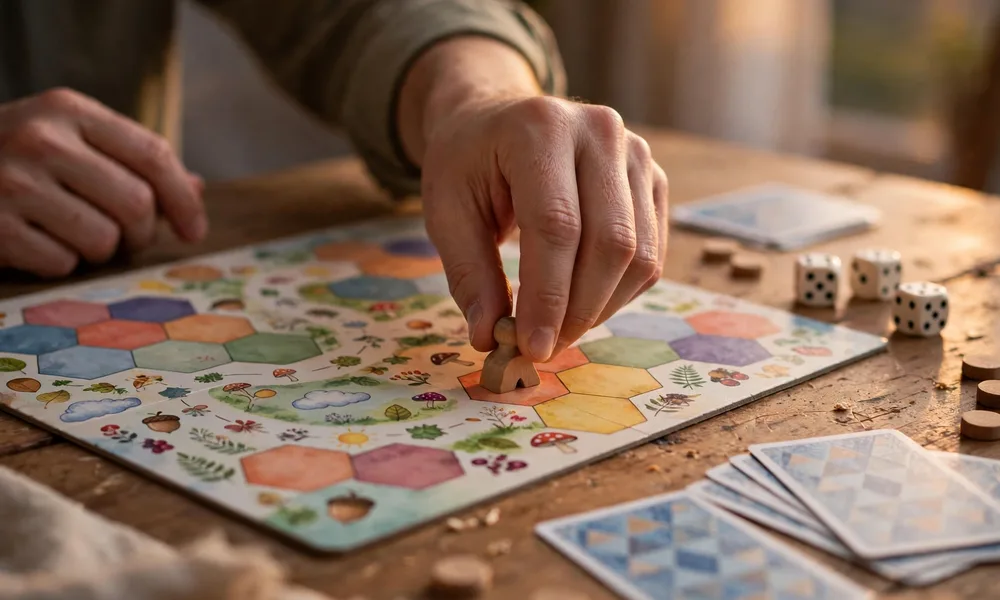
Quick games are the workhorses of a played collection, because they fit into real evenings. A fifteen-minute card game can be played after dinner on a Tuesday, while a heavy strategy game waits for a weekend that may never come. The best quick games hide surprising depth behind simple rules: a hand of cards, a set of dice, a few meaningful choices, and a scoring twist that keeps everyone guessing until the last round.
Look for quick games with almost no setup and no player elimination. Nobody wants to sit out for twenty minutes after losing early, and a game that ends with everyone still involved is a game that gets a second round immediately. Word games and bluffing games shine here, because they run on conversation rather than components, and they play differently with every group.
Strategy games that stay interesting after ten plays
Good strategy games reward planning without punishing a single mistake. The ones that actually get played tend to share a shape: a board or market that changes every game, several paths to victory, and turns that move fast enough that nobody waits five minutes between moves. Randomised tiles, shuffled decks and variable player powers all help, because they stop the tenth game from feeling like a repeat of the first.
Watch out for the two classic strategy traps. The first is analysis paralysis, where a player stares at the board for minutes while everyone else drifts away; games with limited choices per turn avoid it. The strongest strategy picks keep scores close, give trailing players a way back, and end with a final round that can still change the winner.
Party games: the ones that make the room laugh
Party games live or die on the group, not the box. The best ones need no skill to enjoy, reward the funniest answer rather than the cleverest one, and let eight people play without anyone waiting long for a turn. Drawing games, word-association games and team guessing games all work, because the entertainment comes from the players, and the game is really just an excuse for the room to talk.
If your regular crowd is mixed ages, pick games with no embarrassing dares and no knowledge questions that favour one generation. And if your table often includes adults who like a sharper, funnier night, our guide to the best board games for adults rounds up the party and strategy picks that suit a grown-up crowd.
| Style | Best for | Typical time | Players | Replay strength |
|---|---|---|---|---|
| Quick card games | Weeknights, tired evenings | 15–30 min | 2–6 | High: every hand differs |
| Strategy | Regular game nights | 45–60 min | 2–4 | High: many paths to win |
| Party | Large, mixed groups | 30–45 min | 4–10 | Medium: depends on the crowd |
| Cooperative | Families, mixed ages | 30–60 min | 2–5 | High: shared puzzles vary |
| Two-player duels | Couples, quiet evenings | 20–40 min | 2 | High: head-to-head tension |
| Word games | Talkative groups | 20–30 min | 3–8 | Medium: needs fresh players |
Cooperative games: winning together, losing together
Cooperative games solve the oldest problem in family gaming: somebody has to lose, and it is usually the youngest player. When everyone plays against the game itself, a loss is a shared joke instead of a sulk, and a win belongs to the whole table. That is why cooperative games get requested again and again, especially by families and mixed-age groups who want the evening to end happily.
The risk is the alpha player problem, where one confident person tells everyone else what to do. The best cooperative designs prevent it with hidden information, simultaneous decisions, or a timer that forces quick choices instead of committee meetings. For families planning a regular night around the table, our guide to the best board games for family night covers the cooperative and quick picks that work across ages, plus how to structure an evening that ends before anyone gets tired.
Two-player games for quiet evenings
Two-player games are the most played games in many homes and the most overlooked in most guides. A good duel is not a bigger game with fewer players; it is designed for two, with constant interaction, no waiting, and a result that can swing on the last move. Card duels, abstract strategy games and short campaign games all work, as long as both players stay involved on every turn.
The test for a two-player game is simple: does it still feel tense on the tenth play? If the answer is yes, it has earned a permanent spot near the table.

How to spot a game that will actually get played
Before buying, run the five-minute test. Read the rules summary, not the marketing, and ask whether you could teach it to a friend in five minutes over a drink. If the answer is no, the game will need a dedicated teacher every time, and it will stay on the shelf. Then check the real play time, not the optimistic number on the box: add fifteen minutes for teaching and chatting on a first play.
Next, check the player count honestly. Many games claim two to six players but only sing at four. Search for how it plays at your usual count before buying, and be wary of games that need exactly the right number. Finally, look at the shelf test: would you reach for this on a tired Tuesday, or only on a mythical free Saturday? The games that pass the Tuesday test are the ones that get played, and they are usually not the biggest boxes.
The shelf test: building a collection that gets used
A played collection is small on purpose. Ten games that get played beat fifty that do not, and every unplayed box makes the played ones harder to reach. Start with one quick game, one strategy game, one party game and one cooperative game, and add a new box only when an old one has earned its place or clearly has not. When a game has sat untouched for a year, pass it on: the space it frees is worth more than the box.
Keep the quick games at the front, the longer ones behind them, and the pieces organised so setup takes minutes, not a treasure hunt through mixed-up bags. If quiet solo or two-player tabletop time also appeals to you, our guide to the best puzzles covers the jigsaws and puzzle games that reward a slower evening just as well.
Your board game checklist
- Can you teach it in five minutes? If not, it will rarely reach the table.
- Does it finish in under an hour at your usual player count?
- Does every session play differently, through shuffled decks, random tiles or hidden roles?
- Is there a way back for a player who falls behind early?
- Does it work at the player count you actually have, not the one on the box?
- Would you reach for it on a tired Tuesday, not just a free Saturday?
Frequently asked questions
How many board games should a collection have?
For most households, eight to twelve well-chosen games cover every mood and group size. More than that and the choice itself becomes a chore. Add a game only when you know which gap it fills.
What is the best first modern board game to buy?
A quick, easy-to-teach card or tile game is the safest first buy, because it works with almost any group and gets played while you learn what your table likes. Add strategy once the habit is there.
Are expensive board games worth it?
Sometimes, but price tracks components more than fun. A twenty-pound card game can be played fifty times while a sixty-pound box with miniatures gathers dust. Judge by plays per pound, not by the weight of the box.
How do I get teenagers to play board games?
Let them choose, keep games short, and never force a family night. Fast party games and clever strategy with real decisions work best, and phones go away more easily when the game itself is the entertainment.
What if my group has very different tastes?
Rotate the choice, play short games so everyone gets a turn picking, and keep a cooperative game ready for nights when competition would spoil the mood. Variety is the point of a collection.
How should I store board games?
Store them flat, visible and within easy reach, with pieces bagged and rules on top.
The bottom line
The best board game is not the cleverest one on the shelf or the one with the highest rating online. It is the one that gets played, and that comes down to a short teach, a fair finish, and a different game every time. Build a small collection around those three tests, keep the quick games within reach, and let the unplayed boxes go. The table will thank you.