
A good puzzle is one of the cheapest forms of entertainment you can buy, and one of the most honest. There is no subscription, no screen, no battery, and no way to pay your way to the end. There is only a box of pieces, a table, and the slow satisfaction of watching something disordered become ordered.
Not every puzzle is worth your time or your table space. Some have pieces that barely fit, pictures that blur into mush, or piece counts that promise a weekend and deliver an evening. This guide explains how to tell the difference before you buy — and how to choose a puzzle you will actually finish.
Key Takeaways
- The picture matters more than the piece count: clear colours and distinct regions make a puzzle enjoyable; plain sky or sea makes it a chore.
- Buy for the solver: 500 pieces suits a relaxed evening, 1,000 suits a committed week, and anything above that needs a dedicated table.
- Piece quality is easy to check: thick cardboard, a clean cut and a snug fit matter more than the brand name on the box.
- Different puzzles suit different minds: jigsaws for patience, crosswords for word lovers, logic puzzles for deduction, 3D puzzles for builders.
- A puzzle is only as good as its space: a flat surface, good light and somewhere the pieces can sit undisturbed will decide whether it gets finished.
What Makes a Puzzle Worth Your Time
The best puzzles share one quality: they keep you absorbed, in that state where the rest of the room disappears. That depends on steady small wins — an edge piece here, a patch of roof tiles there — without long stretches where nothing fits. A puzzle that only frustrates you is not challenging; it is badly designed.
Three things decide whether a puzzle hits that balance. The first is the picture. A good puzzle image has distinct regions: a cottage, a stretch of river, a market stall, a stand of trees. Each region gives you a place to work. A bad image is one big wash of similar colour, where every piece looks like every other piece.
The second is the cut. Quality puzzles are cut cleanly, so each piece has a distinct shape and slots into its neighbours with a satisfying click. Cheap puzzles are cut loosely, so pieces wobble and the picture never quite locks together. The third is the material: thick, sturdy cardboard that does not bend or peel.
Jigsaw Puzzles: Size, Pieces and Picture
The jigsaw is the puzzle most people mean when they say “puzzle”, and the piece count is the first decision. A 300-piece puzzle is an evening’s work for an adult and a good first big puzzle for a child of eight or nine. A 500-piece puzzle is a relaxed weekend, and 1,000 pieces is the classic choice.
Above 1,000 pieces, the puzzle stops being a casual pastime and becomes a project. A 2,000-piece puzzle needs a table you can leave alone for a fortnight, and a 5,000-piece puzzle needs a room. If you have never finished a 1,000-piece puzzle, do not start with 2,000. The step up is bigger than the number suggests.
Picture choice matters as much as piece count. Photographs of landscapes work well when they have strong landmarks and varied colours — a village street, a harbour, a mountain lake. Paintings and illustrations often work even better, because an artist’s colours are bolder and the regions clearer.

Beyond the Jigsaw: Puzzles for Every Kind of Mind
Jigsaws are only the beginning. Crosswords suit people who love words and quiet concentration: a good cryptic crossword can occupy a skilled solver for an hour with nothing but a pencil. Sudoku and other number puzzles suit logical minds, and they travel well — a book of them fits in a coat pocket and needs no table at all.
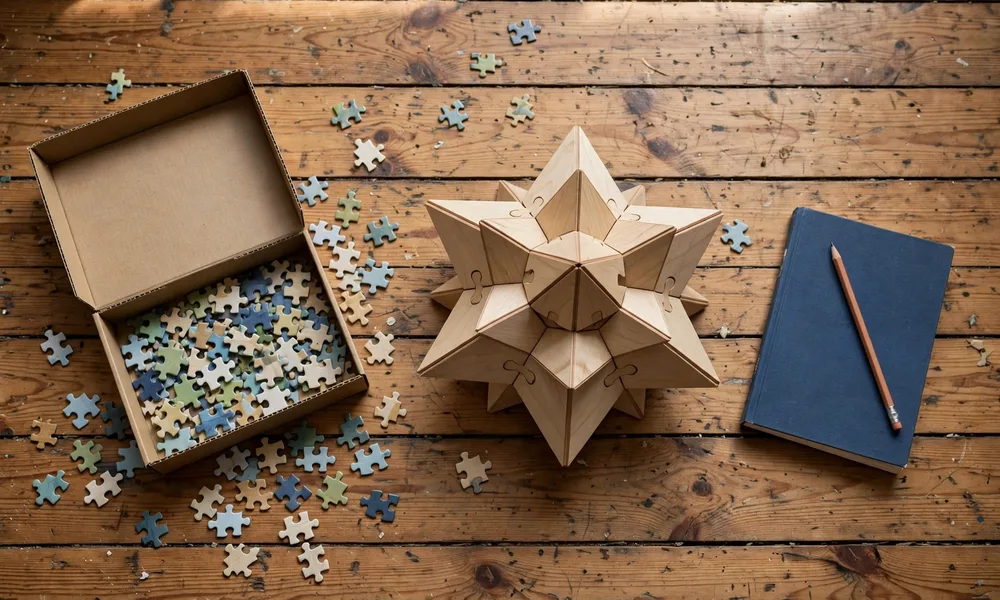
Then there are the physical puzzles: wooden 3D puzzles, metal disentanglement puzzles, and puzzle boxes that only open when you find the hidden catch. These are closer to engineering than to picture-making, and they suit people who like to build and fiddle. A wooden 3D puzzle can take an evening to assemble, then sits on a shelf as an ornament.
Word and picture puzzles also make good gifts, because they match the recipient rather than the giver’s taste. A mystery lover will enjoy a puzzle book built around a case to solve, and our guide to the best mystery books for adults is a good place to start if that person would rather read their way to an answer.
Puzzles for Kids, Couples and Solo Solvers
Children need puzzles that respect their patience, which is shorter than an adult’s but not small. A five-year-old will love a 25-piece wooden puzzle with big chunky pieces; a nine-year-old can handle 300 pieces and will feel genuinely proud of finishing. The mistake is buying too far ahead: a puzzle that is too hard teaches a child that puzzles are frustrating.
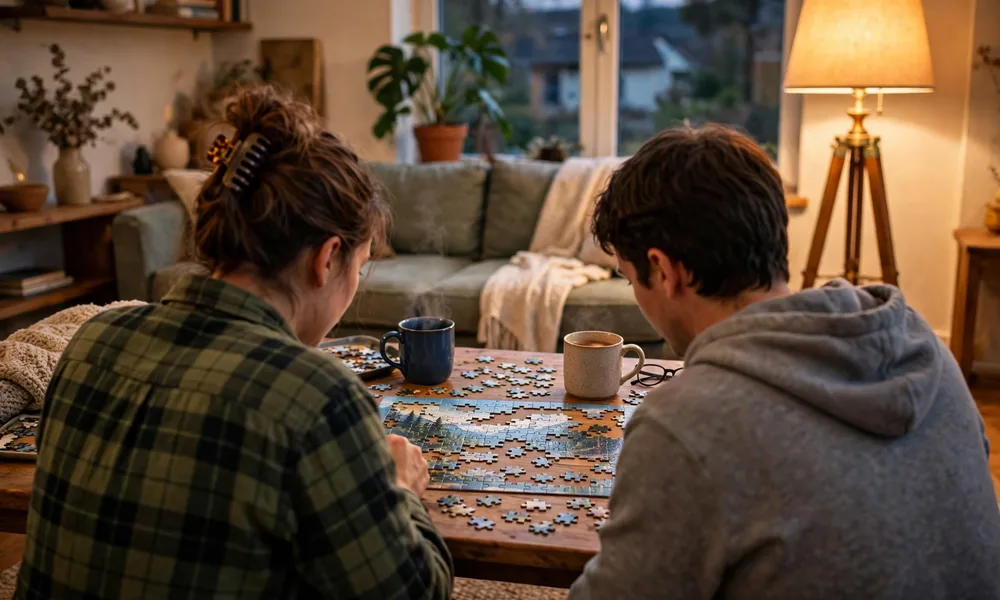
Couples often make the best puzzle teams, because two people can work on different regions at the same time — one on the sky, one on the buildings — and meet in the middle. A 1,000-piece puzzle is the classic couples choice: big enough to share, small enough to finish. If puzzles are becoming a shared habit, our guide to the best board games for couples has more ideas.
Solo solvers have different needs. Without a partner to share the sorting, a solo puzzler benefits from a puzzle mat or a board with drawers, so the work can be rolled away between sessions. Many solo solvers prefer smaller puzzles done well — a 500-piece puzzle finished in two evenings — over a giant that dominates the house for a month.
How to Choose the Right Puzzle
Start with the solver, then the space, then the picture. The solver sets the difficulty: a beginner needs clear regions and a modest piece count. The space sets the size: measure your table before you buy, because a 1,000-piece puzzle needs roughly 70 by 50 centimetres when finished. A puzzle that does not fit the table will not get finished.
Then check the quality. Read reviews for mentions of piece fit, dust in the box, and whether the picture on the box matches the pieces. Look for a brand with a track record, and check whether spare pieces are available: the best manufacturers will replace a missing piece for free, which is worth knowing before you discover one is missing.
Finally, think about what happens when the puzzle is finished. Some people break it up and start another; some glue it and frame it; some pass it on. If you plan to frame it, choose a picture worth living with and check the finished size against your wall. And if you are buying puzzles as gifts, our guide to the best stocking stuffers under $50 has more small gifts.
Puzzle Types Compared
| Puzzle type | Best for | Typical time | Needs |
|---|---|---|---|
| Jigsaw, 500 pieces | A relaxed evening | One weekend | Table space |
| Jigsaw, 1,000 pieces | A committed week | Several evenings | A table you can leave alone |
| Crossword book | Word lovers | Minutes to an hour each | A pencil and quiet |
| Sudoku and logic | Logical minds | Minutes to an hour each | Nothing but the book |
| 3D wooden puzzle | Builders and fiddlers | One evening | Patience and a clear surface |
| Puzzle box | A gift with a secret | Minutes to days | Curiosity |
The table shows the real choice is not between good and bad puzzles, but between puzzles that fit your life and puzzles that do not. A crossword book fits a commute; a 2,000-piece jigsaw does not. Choose the type that matches the time and space you actually have.
Setting Up Your Puzzle Space
A puzzle lives or dies on its space. The ideal setup is a flat surface at a comfortable height, with good light from above or from a window, and room to sort pieces around the edges. A dining table works if the household agrees to eat elsewhere for a few days; a puzzle mat is the budget option, letting you roll the unfinished puzzle away.
Sorting is half the craft. Turn all the pieces face up and pull out the edges — the flat-sided pieces that make the border. Then sort the rest by colour and region: sky pieces together, roof pieces together, green pieces together. Small trays, baking sheets or paper plates make good sorting trays.
The last part of the setup is the household agreement. A puzzle on the dining table is a shared project, and it needs a rule everyone understands: no moving pieces, no forcing a piece that does not fit, and no clearing the table without warning. Keep the box lid nearby as a reference picture.
Looking After a Finished Puzzle
When the last piece clicks in, you have three choices. The simplest is to break it up, put it back in the box, and pass it on or start another — puzzles are made to be reused. The second is to glue it: puzzle glue or adhesive film on the back will hold it together, and a frame turns it into wall art.
Whatever you choose, store unfinished puzzles carefully. A puzzle left half-done on a table gathers dust and loses pieces; a puzzle rolled in a mat keeps for weeks. Keep the box, because the box is the picture, the piece count and the proof of what you finished.
Puzzle Checklist
- Picture first: distinct regions, varied colours, no large areas of plain sky or sea.
- Piece count for the solver: 300 for a child, 500 for a relaxed evening, 1,000 for a committed week.
- Table space: measure before you buy — a 1,000-piece puzzle needs about 70 by 50 centimetres.
- Quality check: thick cardboard, clean cut, snug fit, and a picture that matches the box.
- Sorting plan: trays or plates, good light, and a lid nearby for the reference picture.
- After the finish: break it up, glue and frame it, or pass it on — but keep the box.
Frequently Asked Questions
How many pieces should a puzzle have for a beginner?
Start with 500 pieces. It is challenging enough to be satisfying and small enough to finish in a weekend. A 300-piece puzzle suits a child or a first attempt, while 1,000 is the step up.
What makes a jigsaw puzzle hard?
Three things: a picture with large areas of similar colour, small pieces, and a loose cut. A puzzle of a plain sky is far harder than the same piece count of a busy village street.
Are expensive puzzles worth the money?
Often, yes. Better puzzles use thicker cardboard, cleaner cuts and more accurate colours, and the pieces fit properly. The difference is obvious the first time you handle one.
How do I keep a puzzle safe from pets and children?
Use a puzzle mat or a board with a cover, and work on a surface that can be closed off. Keep the box lid as a reference and store loose pieces in trays.
Can I frame a finished jigsaw puzzle?
Yes. Apply puzzle glue to the front, let it dry fully, then mount it in a frame. Measure the finished size first — a 1,000-piece puzzle is about 70 by 50 centimetres.
What should I do if a puzzle piece is missing?
Search under the table, in the sofa and inside the box lid first. If it is truly gone, contact the manufacturer: many will replace a missing piece for free.
The Bottom Line
Puzzles are worth your time when they fit your life: the right picture, the right piece count, the right table, and the right company. Get those four things right and a puzzle gives you something few pastimes still offer — an evening of quiet concentration and the small, real satisfaction of the last piece clicking into place.


