
Coffee Mugs That Keep Your Brew Hot to the Last Sip in 2026
Most coffee mugs fail at the one job that matters: keeping your coffee hot while you drink it. You pour a fresh brew, sit down, and fifteen minutes later the last third is lukewarm and flat. The best coffee mugs in 2026 fix that with wall thickness, shape, and material choices that slow heat loss minute by minute. This guide measures how long each mug type holds coffee in its best drinking window, which handles stay comfortable when the coffee is piping hot, and which mugs survive the dishwasher and the microwave.
Key Takeaways
- A thick ceramic mug keeps coffee in its best flavour window for 25 to 35 minutes; a double-wall vacuum mug stretches that past two hours, but mutes aroma.
- Pre-warming a mug with boiling water adds 8 to 12 minutes of hot drinking time, and it costs nothing.
- A handle that fits two or three fingers and stands clear of the wall stays cool when the coffee is near boiling.
- Choose 300 to 350 ml for black coffee, 400 to 450 ml for milky drinks, and 60 to 90 ml for espresso.
- Most glazed ceramic mugs are microwave and dishwasher safe; metallic trim, gold rims, and unglazed stoneware are not.
How Long Should a Coffee Mug Keep Coffee Hot?
Coffee tastes best between roughly 60 and 70 degrees Celsius. Above 75 degrees it is too hot to taste; below 50 degrees it turns flat and sour. The mug decides how fast the coffee falls through that window. A thin glass can drop a fresh pour below 60 degrees in under ten minutes. A good thick ceramic mug holds it there for 25 to 35 minutes. A double-wall vacuum mug can hold it there for two hours or more.
Heat escapes three ways: conduction through the wall, convection off the open surface, and a little radiation. An open mug loses most of its heat from the surface, which is why a wide, shallow mug cools faster than a tall, narrow one. Wall thickness attacks conduction: a 6 mm ceramic wall loses heat far more slowly than a 3 mm one.
Ceramic vs Double-Wall: The Heat Retention Trade-Off
The real choice in 2026 is thick ceramic versus double-wall vacuum insulation, and they solve the problem in opposite ways. Ceramic stores heat in its mass: the thick wall warms with the coffee and releases that warmth slowly, holding the drink in its window for about half an hour. Vacuum insulation blocks heat transfer almost entirely, so the coffee stays hot for hours. The trade-off is aroma. An open ceramic mug lets steam rise to your nose with every sip, and that steam carries most of what you taste. A lidded vacuum mug traps it, so the coffee stays hot but tastes flatter.
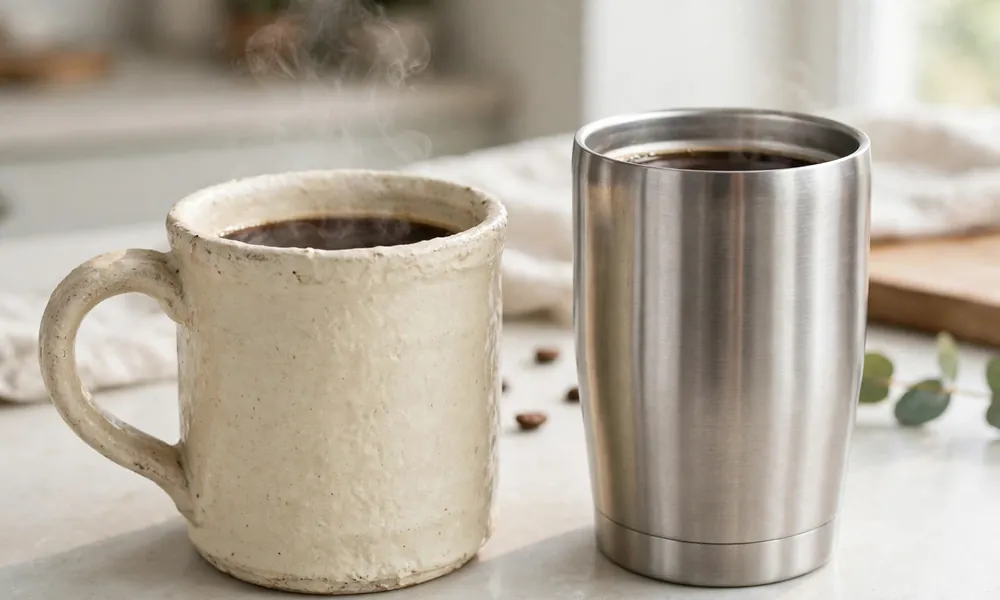
Double-wall glass sits between the two, but it cools faster than ceramic and is fragile. The table below compares the main options on the numbers that matter.
| Mug type | Hot window (above 60°C) | Weight | Aroma | Best for |
|---|---|---|---|---|
| Thick ceramic | 25–35 min | 350–450 g | Excellent | Daily black coffee |
| Stoneware | 30–40 min | 450–600 g | Excellent | Slow mornings, milky drinks |
| Vacuum steel | 2 hours+ | 250–350 g | Muted | Long desk sessions |
| Double-wall glass | 15–20 min | 200–280 g | Good | Lattes, layers |
| Thin ceramic | 12–18 min | 200–300 g | Good | Espresso, quick cups |
| Enamel | 8–12 min | 150–220 g | Fair | Camping, outdoors |
For most drinkers, thick ceramic wins the daily contest: hot long enough for a normal cup, full aroma, good in the hand. Vacuum steel wins only when the cup has to last, such as a two-hour meeting or a cold home office. The worst choice is a thin, wide mug, which can drop below 60 degrees before you are halfway through.
The Handle Test: Comfort When the Coffee Is Piping Hot
A mug can keep coffee hot and still be unpleasant to hold. When coffee is poured at 90 degrees, the wall warms within a minute, and a handle attached tight to the wall warms with it. A good handle stands clear of the wall by at least 20 mm, so air circulates and it stays cool for the whole cup. A small loop handle fails twice: it heats up faster, and it forces a pinch grip with one or two fingers, which tires quickly with a full mug.

The right handle fits two or three fingers with room to spare, and the thumb rests naturally on top. Pick a mug up full of water in the shop and hold it for a minute. If your knuckles press against the hot wall, the handle is too tight. If the mug tips forward, the handle is too small for its weight. Anyone with a weak grip should look for a broad, rounded handle rather than a thin, flat one.
Size, Shape, and the Pre-Warming Trick
Size decides how long coffee stays hot almost as much as material does. A small volume has less thermal mass, so it cools faster: a 90 ml espresso in a thin cup can drop below its best window in five minutes, which is why espresso cups are thick-walled and tiny. A standard black coffee suits 300 to 350 ml, enough mass to hold its temperature for half an hour in good ceramic. Milky drinks need 400 to 450 ml, since the milk takes up space. A 500 ml mug looks generous, but a normal 300 ml pour in it spreads thin across a wide surface and cools fast, so match the mug to the drink.
The cheapest heat-retention trick is pre-warming. Fill the mug with boiling water, leave it for 30 seconds, and empty it just before pouring. A cold ceramic mug absorbs a surprising amount of heat from the first pour, and that stolen heat is the difference between a cup that starts at 85 degrees and one that starts at 78. Pre-warming adds 8 to 12 minutes to the hot-drinking window. A good electric kettle makes it a one-step habit, since the water is already boiling when the coffee finishes brewing.
Dishwasher and Microwave Safety for Coffee Mugs
A coffee mug lives a hard life: boiling coffee every morning, a dishwasher every night, and the occasional microwave trip when the cup goes cold. Most glazed ceramic and stoneware mugs handle all three, but the details matter: Metallic trim, gold rims, and hand-painted decoration are not microwave safe, because the metal arcs and the decoration burns off. Unglazed stoneware and porous handmade mugs can absorb water in the dishwasher, then crack in the microwave when that water turns to steam. If a mug has no microwave-safe mark, test it: microwave the empty mug for 20 seconds, and if the mug itself comes out hot, it does not belong in the microwave.

The dishwasher is gentler than people think, but not harmless: high heat and detergent slowly dull printed designs and fade the glaze on cheaper mugs. Hand washing is kinder and takes less than a minute, but if you use the dishwasher, put mugs on the top rack, away from the heating element, with space between them so they do not chip.
Reheating a half-finished coffee for 30 to 45 seconds is safe in a microwave-safe mug, but overheating it past 80 degrees flattens the flavour. Put a spoon in the mug when reheating, stir before lifting, and never reheat the same cup twice. A mug that has gone cold twice was the wrong mug for a slow drinker.
Lid or No Lid? The Aroma Trade-Off
A lid is the most effective heat keeper you can add to a mug: it cuts surface heat loss by more than half and can double the hot-drinking window. The cost is aroma. Coffee’s flavour is mostly smell, and a lid traps the steam that carries it, so a lidded mug keeps coffee hotter but tastes flatter. At home, where the cup sits on the table, an open mug almost always wins on taste. The lid earns its place when the coffee has to travel across the house, sit on a desk for an hour, or survive a cold room.
Silicone lids that fit standard ceramic mugs are a good middle ground: they keep the heat in while you are busy and lift off in a second when you are ready to taste the coffee. A sealed lid belongs on a travel mug, not a home mug, and our guide to the best travel mugs of 2026 covers spill-proof designs and heat retention on the move.
Choosing the Right Mug for Your Coffee
Different coffees ask for different mugs. Black coffee tastes best from a thick ceramic mug of 300 to 350 ml with a medium opening, which lets the aroma out while the walls hold the heat. The beans matter as much as the vessel, and freshly ground beans lose aroma within minutes; our guide to the best coffee grinders of 2026 explains how grind size changes the brew. Milky drinks suit a larger stoneware mug of 400 to 450 ml, where the wide opening shows off the foam. Espresso belongs in a small, thick-walled cup of 60 to 90 ml.
Coffee Mug Buying Checklist
- Choose thick ceramic or stoneware for daily coffee; keep vacuum steel for long desk sessions.
- Pick 300 to 350 ml for black coffee, 400 to 450 ml for milky drinks, 60 to 90 ml for espresso.
- Check the handle fits two or three fingers and stands 20 mm clear of the hot wall.
- Pre-warm the mug with boiling water for 30 seconds before pouring.
- Confirm microwave and dishwasher safety, and avoid metallic trim and gold rims.
- Retire any mug with a chipped rim or cracked glaze; buy one mug before committing to a set.
Frequently Asked Questions
How long should a coffee mug keep coffee hot?
A good thick ceramic mug keeps coffee above 60 degrees for 25 to 35 minutes. A double-wall vacuum mug holds it there for two hours or more. A thin glass mug can drop below 60 degrees in under ten minutes.
Is ceramic or stainless steel better for coffee mugs?
Ceramic is better at home, because it holds heat well enough for a normal cup and lets the aroma reach you. Vacuum steel keeps coffee hot far longer, but the sealed design mutes the aroma, so the coffee tastes flatter.
Why does my coffee go cold so fast?
The usual causes are a thin-walled mug, a wide opening, a cold mug that steals heat from the first pour, and a cold room. Pre-warming the mug, choosing a taller and thicker mug, and pouring a smaller cup you finish in 15 minutes fix most of it.
Can I put my coffee mug in the microwave?
Most glazed ceramic and stoneware mugs are microwave safe, but mugs with metallic trim, gold rims, or unglazed porous bodies are not. Reheat for 30 to 45 seconds, stir before lifting, and never reheat the same cup twice.
Are double-wall mugs good for hot coffee?
Yes. A double-wall vacuum mug is the best insulator you can buy, holding coffee above 60 degrees for hours. The trade-off is flavour: the sealed design traps the aroma, so the coffee tastes flatter than from an open ceramic mug.
What size coffee mug is best?
Choose 300 to 350 ml for a standard black coffee, with room to stir and enough thermal mass to stay hot for half an hour. Milky drinks need 400 to 450 ml, and espresso needs only 60 to 90 ml.
The Bottom Line
The best coffee mug keeps your brew in its best window until the last sip, feels good in your hand, and survives the dishwasher and the microwave. For most people in 2026, that means a thick-walled ceramic mug of 300 to 350 ml, with a handle that fits two or three fingers and a smooth, thin rim. Pre-warm it for 30 seconds, pour fresh, and drink it while it is hot.