Curtain rings that slide smooth are the small piece of hardware that decides whether drawing your curtains feels effortless or like a daily wrestling match. When it fits the rod, matches the fabric’s weight, and moves freely, the whole curtain glides with one hand. When it does not, the curtain bunches and snags. This guide explains how to choose curtain rings that slide smooth in 2026, and the fitting mistakes that turn good rings into sticky ones.
Be clear about what this guide covers. These are rings for window curtain rods, the hardware that hangs drapes and sheers in living rooms and bedrooms. They are not shower curtain rings, built for wet bathrooms and lightweight plastic curtains, and they are not the rod itself. The rod is the beam; the rings are the moving parts that travel along it. Our companion guide to curtain rods that hold heavy drapes without sagging covers the beam, while this one covers the rings that ride on it.
Key Takeaways
- Match the ring to the rod first: its inner diameter should be 6 to 10 millimetres wider than the rod, so it glides without rattling or binding.
- Roller rings slide smoothest under heavy curtains, while plain metal rings suit light sheers and everyday drapes.
- Metal rings last longest and glide best, but nylon-lined rings are quieter and kinder to delicate rods.
- Count the attachment points before you shop: most panels need one ring every 10 to 15 centimetres.
- Clean the rod and rings twice a year, because dust and a bent ring are what make smooth rings start to stick.
What a Curtain Ring Actually Does
A curtain ring has one job: carry the weight of the curtain along the rod with as little friction as possible. The curtain hangs from the ring, the ring hangs from the rod, and every time you open or close the curtains, the ring must travel the full span without catching. A pair of lined velvet curtains can weigh five to eight kilograms, hanging from a dozen or so rings, each pressing on the rod at one small contact point. A ring that is too tight pinches the rod and stops dead; one too loose wobbles and digs its edge in; one with a rough inner surface drags. The best rings balance all three: the right size, a smooth bore, and a shape that stays square to the rod.
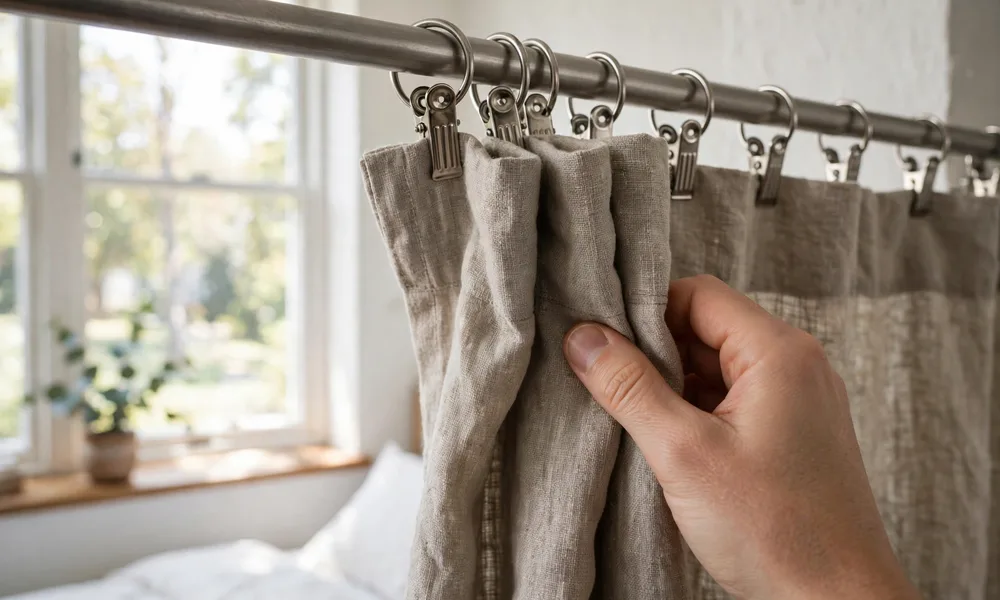
The ring also sets how the curtain hangs: evenly spaced rings make even folds, while rings too far apart let the fabric sag. Clip rings grip the fabric directly and suit curtains without a heading; eyelet rings thread through holes in the top edge for a clean, tailored look. The choice is part decoration and part engineering.

The Main Types of Curtain Ring Compared
Almost every curtain ring falls into one of five families, each suiting a different curtain weight and budget.
| Ring type | How it slides | Best for | Watch out for |
|---|---|---|---|
| Plain metal rings | Metal on metal | Light and medium curtains | Can squeak, mark soft rods |
| Roller rings | Small wheels inside the ring | Heavy drapes, daily use | Cost more, need a straight rod |
| Nylon-lined rings | Plastic liner on metal | Quiet rooms, bedrooms | Liner wears out over years |
| Clip rings | Clip grips fabric below the ring | Curtains without headings | Clips can mark delicate fabric |
| Wooden rings | Wood on the rod | Rustic and cottage rooms | Swell in damp rooms |
Plain Metal Rings
Plain metal rings are the classic choice and still the best all-round option for most windows. A well-made steel, brass, or aluminium ring has a smooth inner bore and enough weight to stay square on the rod, so it glides predictably. Stainless steel resists corrosion, brass suits traditional schemes, and aluminium is light enough for sheers but too soft for heavy drapes. The weakness is noise: metal can squeak on a bare rod and wear a painted wooden one, though a dab of silicone spray once or twice a year solves most of it.
Roller Rings
Roller rings hide a small wheel, or ball bearings, inside the ring, so the ring rolls along the rod instead of sliding. The difference is dramatic on heavy curtains: a lined drape that needs two hands with plain rings moves with one finger on roller rings, making them the best choice for wide windows and curtains opened several times a day. They cost two to three times as much as plain rings and need a straight, smooth rod, because a bent or sagging rod defeats the wheels.
Nylon-Lined and Plastic Rings
Nylon-lined rings are metal rings with a smooth plastic sleeve inside, and they are the quietest option by a clear margin: silent, scratch-free, and kind to painted finishes, ideal for bedrooms and nurseries. Plain plastic rings are the cheapest fix for a sticking curtain, light and easy to fit on thin rods and light sheers. Their limit is weight: under heavy drapes plastic rings flex, tilt, and eventually crack, so keep them on light curtains.
Clip Rings and Wooden Rings
Clip rings hang the curtain from a small sprung clip below the ring, suiting flat panels and any curtain without a heading or eyelets. They are a gift for renters, needing no sewing. The catch is the clip: a strong one can mark delicate fabric, and a weak one lets a heavy curtain slip. Wooden rings suit rustic rooms, where their warm grain looks right in a way metal never does, but they swell in damp air, so keep them out of bathrooms and unheated rooms.
Materials: What Lasts and What Slides Best
Stainless steel is the workhorse: it does not rust and keeps a smooth bore for years. Brass glides well and develops a patina many prefer to a bright finish. Aluminium is the lightest metal ring, ideal for sheers but too soft for heavy drapes. Wood suits wooden rods and natural schemes, though it needs dry air. Plastic is the quietest and cheapest, right for children’s rooms and light curtains. What matters more than the material name is the bore: run a finger inside the ring before you buy, and reject any with a rough seam, burr, or sharp edge. A smooth bore is the whole secret of a ring that slides.
Sizing: Matching Rings to Your Rod and Curtain
Sizing is where most curtain ring purchases go wrong. A ring’s inner diameter should be about 6 to 10 millimetres wider than the rod: a 25 millimetre rod wants a 32 millimetre ring, and a 28 millimetre rod wants a 35 or 38 millimetre ring. Too tight and the ring binds; too loose and it tilts and rattles. Next, count how many rings you need: one ring every 10 to 15 centimetres of rod, plus one spare, so a two-metre rod needs about fourteen to eighteen. Eyelet curtains need one ring per eyelet, and tab-top curtains one per tab. Buy spares in the same finish, because a single bent or lost ring is hard to match later. Finally, check the finials and brackets: the ring must pass over the brackets if the curtain is to travel the full span, and rings that are too large can jam against a low bracket.
How to Keep Rings Sliding Smoothly
Even the best rings stick if the rod is dirty, and the fix is usually cleaning rather than replacement. Dust, paint flakes, and grease all add friction, so wipe the rod with a damp cloth, dry it, and run a dry cloth along its length twice a year. If the rings still drag, a light spray of silicone lubricant, wiped thin, restores the glide. Avoid oil-based lubricants, which attract dust and stain fabric. Check each ring as you clean: one bent out of round will always catch, so bend it back gently with pliers or replace it.
Hanging matters too. Curtains too heavy for their rings will always drag, however smooth the hardware is: if a curtain needs two hands to move, the rings are undersized, and roller rings or a stronger rod are the answer rather than more force. When you draw the curtains, pull from the leading edge, the ring nearest the centre, rather than yanking the fabric from the middle. A straight pull keeps the rings square; a sideways yank tilts them and makes them catch.
Curtain Rings and Sheers: A Special Case
Sheer curtains are the lightest and easiest to get wrong. A sheer panel weighs almost nothing, so the rings barely matter for strength, but they matter for looks: a heavy brass ring on whisper-light voile looks wrong and can drag the fabric down. Light aluminium or slim nylon-lined rings suit sheers best, small enough to disappear into the folds. Our guide to sheer curtains for soft light and privacy explains how to layer sheers behind heavier drapes, with matching ring finishes. For wide windows, check our guide to curtains for large windows, because the ring count and rod support rules change as the span grows.
Common Mistakes to Avoid
The most common mistake is buying rings by looks alone, without measuring the rod: a ring two millimetres too small is useless. The second is mixing finishes and sizes across one window. The third is under-counting, which makes the curtain sag. The fourth is fitting rings to a sagging rod and blaming the rings: if the rod dips, every ring sticks, and the fix is a centre bracket or a stronger rod. The fifth is ignoring the brackets, which leaves a dead zone where the curtain cannot travel.

Your Curtain Ring Checklist
- Measure the rod diameter and buy rings 6 to 10 millimetres wider inside.
- Count the rings you need: one every 10 to 15 centimetres, plus spares.
- Match the ring type to the curtain weight: roller rings for heavy drapes, plain or nylon-lined rings for light ones.
- Check the bore is smooth, with no burrs, seams, or sharp edges.
- Confirm the rings clear the brackets and finials along the full span.
- Clean the rod and rings twice a year and replace any ring that is bent out of round.
Frequently Asked Questions
How many curtain rings do I need?
Allow one ring every 10 to 15 centimetres of rod, plus spares. A two-metre rod needs roughly fourteen to eighteen rings; eyelet or tab-top curtains need one ring per eyelet or tab.
What size ring fits a 28 millimetre rod?
A ring about 35 to 38 millimetres inside suits a 28 millimetre rod, roughly 6 to 10 millimetres wider so it glides without binding.
Are roller rings worth the extra cost?
Yes, if your curtains are heavy or opened daily. The wheels carry the weight, so a lined drape moves with one finger. For light sheers, plain rings are fine.
Why do my curtain rings stick?
The usual causes are a dirty rod, a bent ring, a ring too tight for the rod, or a sagging rod. Clean the rod, check each ring is round, and add a centre bracket if the rod dips.
Can I use the same rings for sheers and heavy drapes?
You can, but it is rarely best. Heavy drapes need strong rings, often roller rings, while sheers suit light, slim rings. Match the finish so the window looks coherent.
Do metal rings damage wooden rods?
They can wear the finish over time, especially with a rough bore. Nylon-lined rings are safest for a painted or polished wooden rod, and a light silicone spray keeps metal rings gliding without scratching.
The Bottom Line
Curtain rings that slide smooth come down to three decisions: the right size for your rod, the right type for your curtain’s weight, and a smooth bore. Get those three right, keep the rod clean, and the curtains will glide with one hand for years. The rings are the cheapest part of the window, and the part you touch every day, so choose them with the same care as the curtains themselves.