Large windows are the best feature of a room and the hardest to dress. A tall picture window, a wall of glass, or a wide set of sliding doors can flood a home with daylight, but the wrong curtains will fight the architecture instead of flattering it. The best curtains for large windows turn all that glass into the room’s strongest design statement.
The best curtains for large windows in 2026 balance scale, fabric, and function. They need enough width to gather generously when closed and stack neatly when open, a fabric weight that suits the room, and a hanging system strong enough to carry the load.
This guide compares the strongest curtain styles for oversized windows, explains how to measure and hang them, and includes a comparison table, a buying checklist, and answers to the most common questions.
Key Takeaways
- Choose a total curtain width at least twice the window width so the panels gather properly when closed.
- Hang the rod 15 to 30 centimetres above the frame and extend it past the sides so panels stack clear of the glass.
- Linen-look curtains are the best all-round choice for large windows, offering softness, drape, and light control.
- Layering sheers behind heavier drapes gives privacy by day and darkness at night without losing daylight.
- For very wide spans, a ceiling track or wave-fold heading works better than a standard rod.

Why Large Windows Are Different
Standard curtains are designed for standard windows. When the window is twice as wide or twice as tall as usual, every small mistake is magnified: a panel slightly too short looks dramatically wrong at three metres high, and a curtain that only just covers the window hangs flat instead of falling in soft folds. Large windows also admit more sun and glare and lose more heat at night.
The Scale Problem
Proportion comes first. A large window needs curtains that look substantial: generous fabric, a heading that holds its shape, and a drop that reaches the floor. A long rod needs centre supports or it will bow, and for spans over three metres a ceiling track spreads the weight evenly.
Light, Heat and Privacy at Once
No single curtain does everything. Sheers filter light beautifully but offer almost no privacy at night. Blackout panels give total privacy and darkness but can make a bright room feel heavy. Layering solves this: a sheer handles the daytime and a heavier drape takes over in the evening.
The Best Curtains for Large Windows
The five styles below cover almost every large window, from a tall living room window to a full wall of sliding doors.
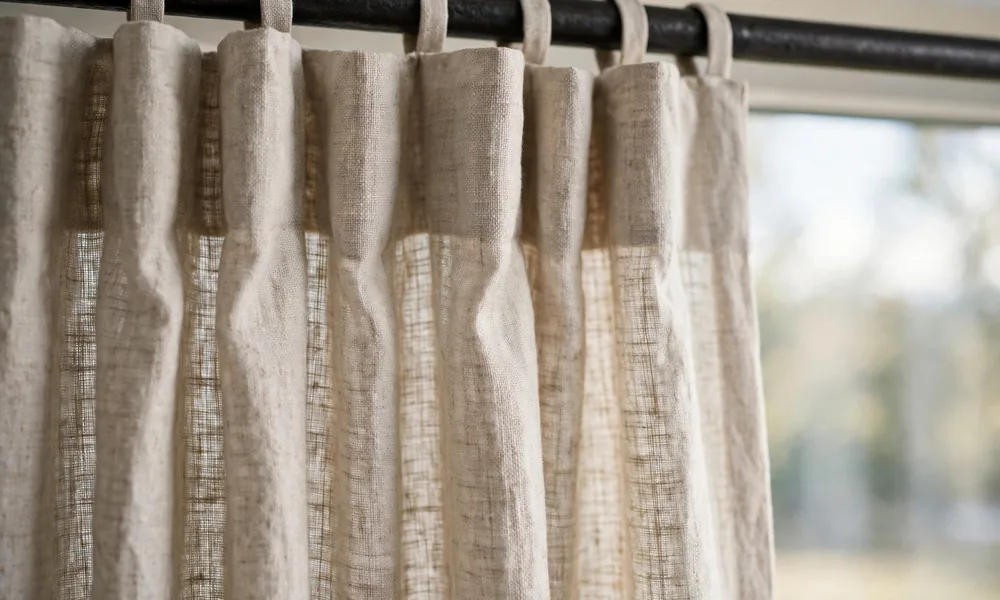
Linen-Look Curtains: Best Overall
Linen and linen-blend curtains are the most versatile choice for large windows. The fabric has a natural texture that looks expensive without trying too hard, drapes in soft folds, and filters light gently. A linen blend with cotton or polyester is often the better buy: blends hold their shape and are usually machine washable.
Velvet Curtains: Best for Drama and Insulation
Nothing makes a large window feel grand quite like velvet. Its depth of colour is unmatched by flat weaves, and its weight makes it hang in deep, even folds. Velvet is also one of the best insulating curtain fabrics, blocking draughts and muffling sound in a large, echo-prone room.
Sheer Curtains: Best for Light
If your priority is keeping the light and the view, sheer curtains are the answer. A voile or sheer linen panel softens harsh sunlight, cuts glare, and gives daytime privacy without darkening the room. They work best layered with heavier drapes, since alone they offer almost no privacy after dark.
Blackout Curtains: Best for Privacy and Sleep
Blackout curtains use a dense weave or a coated lining to block nearly all outside light. On a large window they are the most effective way to guarantee privacy and darkness, ideal for bedrooms and for living rooms with a television. If the large window is in a bedroom, our guide to the best curtains for bedrooms 2026 covers blackout and thermal options in detail. Make sure the panels overlap in the middle and extend past the frame.
Wave-Fold Curtains: Best for Wide Spans
Wave-fold curtains hang from a track on carriers spaced at regular intervals, so the fabric falls in smooth, even waves instead of gathered pleats. The effect is clean, modern, and architectural, suiting the straight lines of a large window or a sliding door. The folds stay uniform whether the curtains are open or closed.
Comparison Table
| Curtain style | Best for | Light control | Insulation | Price range |
|---|---|---|---|---|
| Linen-look | Everyday living rooms | Good, soft filtering | Moderate | Mid-range |
| Velvet | Drama and warmth | Very good | Excellent | Mid to high |
| Sheer | Daylight and views | Light filtering only | Low | Budget to mid |
| Blackout | Bedrooms and privacy | Excellent | Very good | Mid-range |
| Wave-fold | Very wide spans | Depends on fabric | Moderate | Mid to high |
The trade-offs are clear. Linen-look wins on versatility, velvet on insulation and presence, sheers on light, blackout on privacy, and wave-fold on wide spans. Many of the best setups combine two rows of the table, usually a sheer plus a heavier drape.
How to Measure Curtains
Measuring is where most large-window projects go wrong, and it is also the easiest part to get right. All you need is a steel tape measure, a pencil, and ten minutes. Measure twice and order based on the finished size you want.
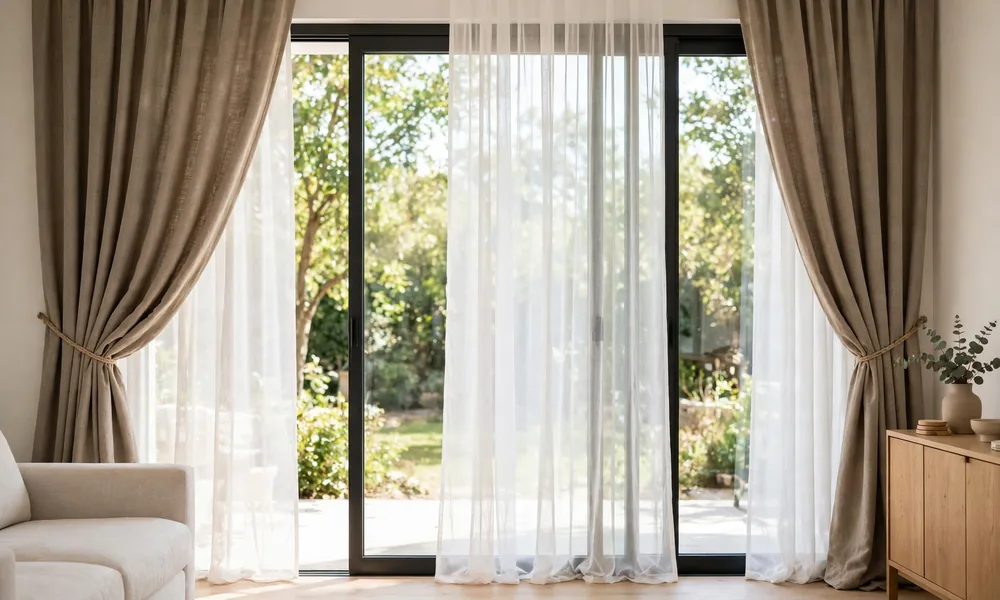
Width: The Fullness Rule
For curtains to look right when closed, the total width of fabric should be at least twice the width of the rod or track, and two and a half times is better for a fuller look. A three-metre window therefore needs at least six metres of fabric, split across two panels. Extend the rod 20 to 30 centimetres past the frame on each side.
Length: Floor, Puddle or Sill
For large windows, full-length curtains that reach the floor look best in almost every case. Measure from the top of the rod or track to the floor, then choose the finish: just touching the floor is the cleanest look, a one-centimetre break is practical for uneven floors, and a slight puddle looks luxurious in a formal room.
Rod Placement: Higher and Wider
Hang the rod or track 15 to 30 centimetres above the top of the window frame, or as close to the ceiling as looks sensible. This draws the eye upward, makes the window and the room feel taller, and means the curtains cover the frame completely when closed.
Hanging and Hardware
Hardware matters more on a large window than anywhere else, because the spans are longer and the curtains are heavier. Ceiling tracks are the most reliable option for wide spans: they support the weight evenly, glide smoothly, and can bend around corners, which is useful for bay windows and corner glazing.
Opening Styles That Suit Large Windows
How the curtains open matters as much as how they look closed. A centre opening, with two panels meeting in the middle, is the classic choice and works well for most large windows. A one-way draw, where a single wide panel stacks to one side, suits sliding doors.
Sheers, Blinds or Both
Some large windows are better served by combining curtains with another layer. A sheer curtain softens the glass while a blind underneath gives precise light control, and the combination looks more finished than either on its own. If you are weighing the two options, our comparison of curtains vs blinds for bedrooms explains the strengths of each.
Choosing Fabric and Colour
Fabric and colour decide whether large curtains feel like part of the room or like an afterthought. Because the curtains cover so much wall, colour has a bigger effect than it would on a small window, so test a swatch in the room before committing. Neutral colours are the safest choice: warm white, ivory, oatmeal, light grey, and soft beige.

Fabric weight deserves the same attention as colour. Light fabrics suit bright, casual rooms and sheer layers. Medium-weight fabrics are the most versatile for large windows. Heavy fabrics such as velvet and lined cotton suit formal rooms and cold climates.
Common Mistakes to Avoid
Most disappointing large-window curtains fail for a handful of reasons, and all are easy to avoid. The most common is ordering panels that are too narrow, leaving the curtains stretched flat when closed. The second is hanging the rod too low and too narrow, which shrinks the window visually. Before you buy, read about the worst curtain choices for rooms so you can recognise the traps.
Checklist: Before You Buy
- Measure the window twice with a steel tape, and note the wall space on each side for stacking.
- Choose a total curtain width at least twice the rod width, and two and a half times for a fuller gather.
- Decide on the drop: full length to the floor in almost every case.
- Pick the hanging system first for wide spans: a ceiling track or a supported rod rated for the curtain weight.
- Order fabric swatches and check the colour against the window in morning and evening light.
- Confirm the lining, heading style, and cleaning instructions before you order.
Frequently Asked Questions
How wide should curtains be for a large window?
The total width of fabric should be at least twice the width of the rod or track, and two and a half times is better for a full gather. For a three-metre window, that means six to seven and a half metres of fabric in total.
Should curtains for large windows touch the floor?
Yes, in almost every case. Full-length curtains that just touch the floor look the most polished and make the window and the room feel taller. A slight puddle suits formal rooms, while a one-centimetre break is practical for uneven floors.
What is the best fabric for large windows?
Linen-look fabric is the best all-round choice because it drapes well, filters light softly, and suits most rooms. Velvet is best for warmth and drama, sheers are best for daylight, and blackout fabric is best for privacy.
Are tracks or rods better for wide windows?
Tracks are better for spans wider than about three metres because they support the weight evenly, glide smoothly, and can bend around corners. Rods look better in traditional rooms but need centre supports to avoid sagging.
Can I use sheer curtains alone on a large window?
You can, but only if daytime privacy is not a concern. Sheers filter light beautifully and keep the view, yet they offer almost no privacy at night when the room is lit. Most people pair sheers with heavier drapes.
How do I stop large curtains from looking heavy and dark?
Choose a light or mid-tone colour, hang the rod high and wide so the panels stack clear of the glass, and add a sheer layer behind the drapes. A lighter fabric and good stack-back space keep a large window feeling bright.
The Bottom Line
The best curtains for large windows in 2026 are full-length, generously wide, and chosen for the job the window actually does. Linen-look panels are the safest all-round buy, velvet brings warmth and drama, sheers protect the light, and blackout fabric guarantees privacy. Measure carefully and hang the hardware high and wide.


