The worst curtain choices for rooms rarely look wrong in the shop. They look wrong at home, in daylight, against your walls, your sofa and your floor. A curtain is one of the largest pieces of fabric in a room, so when its length, colour, pattern or weight is off, it changes how big the room feels.
That is why curtains deserve more thought than they usually get. They frame the view, soften hard edges, and control privacy and glare. Get them right and a plain room can look calm and considered. Get them wrong and even good furniture can look out of place, as if the room was decorated around a mistake.
This guide looks at the worst curtain choices for rooms, one by one, so you can spot them before you spend money. It covers length, fabric, pattern, colour, rods and fullness, and explains why each mistake matters in real rooms.
Key takeaways
- Curtains that stop short of the floor make windows look smaller and rooms feel unfinished.
- Heavy, dark fabric in a small or dim room absorbs light and makes the space feel cramped.
- A large, busy pattern that clashes with the walls, rug or sofa will dominate the whole room.
- A rod hung too low and too narrow shrinks the window and blocks light even when the curtains are open.
- Measure the window, the light and the room first, and choose length, weight and colour around those facts.
Why Curtain Choices Go Wrong So Often
Curtains go wrong for a simple reason: people buy them for the window, not for the room. They measure the glass, pick a colour they like on a small swatch, and hope the result will work. But a curtain is judged by the whole wall: its length against the floor, its colour against the furniture, and its weight against the daylight.
Showrooms make this harder. Curtains there hang in tall, bright spaces with generous rods and perfect lighting. The same pair at home can look short, dark or heavy because the ceiling is lower or the window is narrower. A curtain that dates quickly can leave the whole room looking tired, in the same way as other home design trends that date fast.
The window is not the wall
A common error is treating the window frame as the edge of the job. In most rooms, the curtain should relate to the wall and the floor, not just the glass. A curtain that ends at the sill makes the wall look cut in half.
1. Curtains That Are Too Short
Short curtains are the most common of the worst curtain choices for rooms, and the easiest to recognise. They stop at the sill, or a few inches below it, leaving a bare stretch of wall between the hem and the floor. That gap can look like a mistake, and it can make the ceiling feel lower.
There are exceptions. A short curtain can work in a kitchen, where a long drop would sit in water or catch on a worktop. But in a living room or bedroom, a short curtain usually looks as if the fabric ran out. The better choice is to let the curtain just touch the floor, so the fabric hangs in a straight, even line.
2. Heavy Fabric in a Small, Dark Room
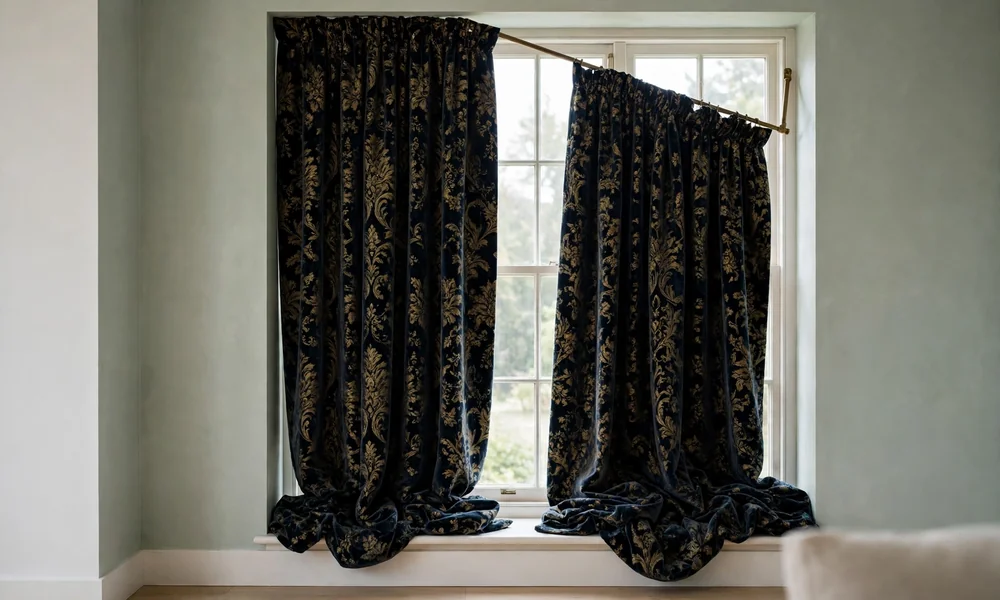
Heavy velvet, thick brocade and dense lined wool can look wonderful in a large room with tall windows and plenty of light. In a small room with one modest window, the same fabric can be a disaster. It absorbs light and leaves the room feeling smaller and darker than it is.
Weight also affects how curtains hang. A very heavy fabric needs a strong rod and enough space to stack when open. In a narrow room there may not be enough wall space, so the curtains cover part of the glass even when open. That blocks light all day, and it is one of the most common lighting mistakes in a room. Lighter fabrics are usually safer in small or north-facing rooms.
3. A Pattern That Fights Everything Else
A bold pattern is not automatically a bad choice, but a pattern that fights the rest of the room is. Large damask, oversized florals and strong geometrics can clash with a patterned rug or a striped sofa, and the result is a room where nothing can rest.
Scale matters as much as style. A large pattern needs space to repeat, and on a narrow curtain it can look cut off or random. The safest approach is to choose one main pattern in the room and keep the rest plain. Wall coverings cause the same problem, which is why the worst wallpaper choices for rooms often share the same fault: a large pattern that leaves nothing else in the room to rest on.
4. The Wrong Colour for the Light
Colour is where many curtain choices fail, because the same colour can look very different in different light. A warm cream can look yellow in a south-facing room. A cool grey can look blue or even lilac in a north-facing room. A small swatch cannot show these shifts.
Dark colours carry a particular risk. A very dark curtain on a pale wall draws the eye straight to the window, even when the view outside is plain. The best approach is to test the colour in the room itself: pin a sample up at the window and look at it in the morning, at midday and in the evening. If it still looks right in all three lights, it is a safe choice.
5. A Rod Hung Too Low and Too Narrow
The rod is part of the curtain choice, not an afterthought, and a badly placed rod can ruin good fabric. A rod hung just above the window frame makes the window look short and the ceiling look low. A rod that ends at the frame makes the window look narrow and leaves no room for the curtains to stack when open.
The usual fix is simple and cheap: hang the rod high, close to the ceiling or at least well above the frame, and extend it well beyond the window on both sides. That extra width lets the curtains sit against the wall when open, so they frame the glass instead of covering it.
6. Too Little Fullness, or Far Too Much
Fullness is the amount of fabric across the window compared with the width of the rod, and getting it wrong is one of the most visible curtain mistakes. Too little fabric looks flat and stretched, like a sheet pulled tight across the window. The folds are shallow, and the curtain looks cheap even if the fabric was expensive.
Too much fabric is just as bad. Excess folds make the curtain look bulky, take up too much wall space when open, and collect dust in deep pleats. As a rough guide, a curtain should be about one and a half to two times the width of the rod when gathered.
7. Curtains That Ignore How the Room Is Used
A curtain that works in a living room can fail in a bedroom, a bathroom or a kitchen, because each room asks for something different. A bedroom needs darkness and privacy. A bathroom needs a fabric that can cope with steam, and a length that stays clear of water. A kitchen needs a fabric that can be washed, and a length that stays clear of heat.
Bedrooms need darkness first
In a bedroom, a beautiful curtain that lets in street light is a failed curtain. Check the lining and the width. Gaps at the sides and at the top let in more light than most people expect, and a curtain that is too narrow will never close properly.
Kitchens and bathrooms need practical fabric
In a kitchen or bathroom, choose a fabric that can be washed or wiped, and a length that stays well clear of sinks, hobs and baths. The worst curtain choices for rooms are often the ones that look good in a photograph but fail at the ordinary job the room needs them to do.
What Good Curtains Do Instead
Good curtains are the right length for the wall, the right weight for the light, and the right colour for the room. They hang straight, move easily, and close fully when they need to.
| Worst choice | What happens | Better choice |
|---|---|---|
| Too short | Window looks small, wall looks cut in half | Just touching the floor |
| Heavy dark fabric in a dim room | Light is absorbed, room feels cramped | Lighter fabric that lets light through |
| Clashing large pattern | Room feels noisy and unsettled | One pattern only, rest plain |
| Rod too low and narrow | Window looks short and narrow | Rod high and wide, curtains stack on the wall |
| Too little fullness | Flat, stretched, cheap-looking folds | One and a half to two times the rod width |
| Wrong lining | Fading, glare, or a stiff, bulky hang | Lining matched to sun, privacy and room use |
Checklist Before You Buy
Use this checklist before you order. It takes ten minutes and it can save a costly mistake.
- Measure the wall height, the window width and the floor distance, and write all three down.
- Check the light in the room in the morning, at midday and in the evening before choosing a colour.
- Hold a large fabric sample against the wall, floor and sofa in daylight, not just under shop lights.
- Plan the rod height and width first, so the curtains stack on the wall and not over the glass.
- Confirm the finished width gives enough fullness, and that two panels will close fully in the middle.
- Match the lining and heading to the room: blackout for bedrooms, washable fabric for kitchens and bathrooms.
Frequently Asked Questions
What is the worst curtain length for a living room?
Curtains that stop at or just below the sill are usually the worst length for a living room. They make the window look small and the wall look unfinished. Curtains that just touch the floor make the room feel taller.
Are dark curtains always a bad choice?
No, dark curtains can work well in a large, bright room with tall windows and pale walls, where they add contrast and drama. In a small or dim room, they absorb light and make the space feel cramped.
Should curtains match the wall colour?
They do not need to match exactly, but they should sit comfortably with it. Curtains in a similar tone to the wall make a room feel calm and larger. A contrast that clashes with the wall, floor or sofa will look wrong.
How wide should curtains be?
As a rough guide, the finished gathered width should be about one and a half to two times the width of the rod. Too little looks flat and stretched. Too much looks bulky.
Do I need lining for my curtains?
Most curtains benefit from lining. It protects the fabric from sun damage, helps the curtain hang better, and improves privacy. Bedrooms usually need blackout lining, while living rooms usually need only a standard lining.
Can I fix curtains that are too short?
Sometimes. A contrasting border or a matching band sewn to the hem can add length and look deliberate, if it is done neatly. In most cases, replacing a badly short pair is better than trying to disguise it.
The Bottom Line
The worst curtain choices for rooms are not matters of taste. They are practical mistakes: curtains too short, fabric too heavy, pattern too loud, colour wrong for the light, a rod hung too low, or too little fullness. Each one is easy to avoid, once you measure first, test the fabric in the room, and choose around the light and the way the room is used.