
A backpack is the bag most of us reach for without thinking, and it is also the bag most of us get wrong. It carries a laptop to work, books to school, clothes for a weekend away, and everything a child needs for the day, yet it is often bought in a hurry, chosen by colour or price, and then blamed when shoulders ache, straps dig in, or a zip gives way on a crowded train. A good backpack disappears on your back. A bad one announces itself every few minutes, slipping, sagging, or digging into the same sore spot until the walk home feels twice as long.
The difference between the best and the worst backpacks in 2026 is not mainly about brand or price. The best backpacks fit the body that carries them, protect what is inside, and keep their shape and zips working after months of daily use. The worst look almost identical on the shelf, yet they sag under a normal load, soak through in light rain, and fall apart at the seams where cheap construction shows first. This comparison puts both sides head to head, across everyday use, work, school, and short trips, so you can tell them apart before you buy. For travel specifically, our comparison of the best and worst travel backpacks in 2026 looks at cabin-size packs, airport use, and packing in more detail.
Key Takeaways
- A good backpack puts most of the weight on your hips and shoulders evenly, while a bad one hangs from two thin straps and pulls you backwards.
- Fit matters more than volume: a 20-litre pack that sits properly beats a 35-litre pack that sags, swings, and digs into your shoulders.
- Padded straps, a padded back panel, a sternum strap, and a padded laptop sleeve are worth paying for, because they decide daily comfort.
- Cheap zips, thin fabric, and unpadded straps are the earliest signs of a pack that will fail, usually at the worst possible moment.
- Buy for the way you actually use a bag, not for the trip you imagine taking once a year, and try it loaded before you commit.
What Makes a Backpack Good or Bad
Comfort is the first thing to check, and it matters more than any other feature. A good backpack spreads the load across both shoulders and, on larger packs, across the hips as well, so no single point takes all the weight. The straps should be wide, padded, and adjustable, the back panel should be padded and slightly shaped, and a sternum strap should stop the shoulder straps sliding apart as you walk. A bad backpack hangs from two narrow, unpadded straps that cut into the shoulders within ten minutes, and it pulls backwards because the weight sits too far from the body. If a pack feels uncomfortable empty in the shop, it will only feel worse once it is full.
Capacity is the second thing, and most people get it wrong in both directions. A pack that is too small forces you to cram things in, strain the zips, and hang items from the outside, where they snag and swing. A pack that is too large tempts you to carry far more than you need, and the extra weight makes every step harder. For everyday use, 18 to 25 litres covers a laptop, a book, a water bottle, and a jacket, while 35 to 45 litres is usually enough for a weekend trip. The right size is the smallest one that holds what you carry most days.
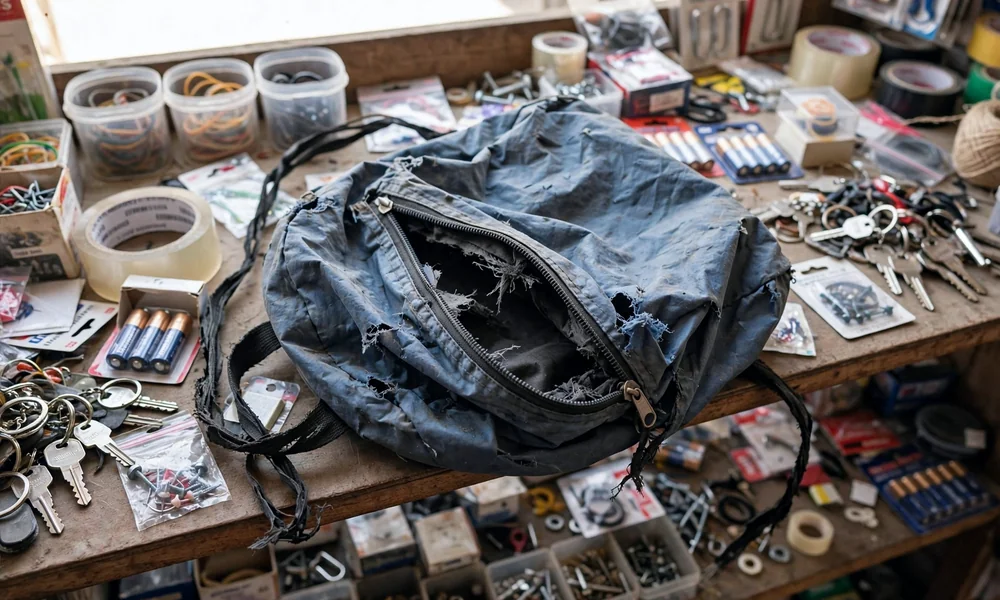
Materials and construction are the third thing, and they decide whether a backpack lasts a season or several years. A good pack uses thick, tightly woven fabric, strong stitching at the strap joins, and zips that run smoothly even when the bag is full. The base should be reinforced, because that is where the pack is set down, dragged, and scuffed every day. Water resistance matters too: a light shower should bead off the fabric rather than soak straight through to a laptop or books. A bad pack uses thin fabric that tears at the corners, single stitching that unravels, and small plastic zips that jam or split under a normal load. Check the seams and the strap joins before you buy, because that is where cheap packs fail first.
Organisation is the fourth thing, and it decides whether a backpack is a pleasure to use or a daily frustration. A good pack has a padded laptop sleeve that holds the machine away from the base, a main compartment that opens wide enough to see inside, a front pocket for keys, tickets, and a phone, and side pockets that actually hold a water bottle. A bad pack has one deep compartment where everything sinks to the bottom, pockets that are too small or too shallow to be useful, and a laptop sleeve that is really just a thin divider. You should be able to find what you need without emptying the whole bag onto a bench.
The Best Side: Backpacks That Earn Their Place
Everyday commuter backpacks are the best choice for most people, because they are built around the daily carry: a laptop, a charger, a water bottle, a book, and a jacket. The best ones have a padded laptop sleeve, a pocket for a phone and keys, a water bottle pocket that holds a full bottle, and a shape that sits close to the back so it does not swing on a crowded train. They are usually 18 to 25 litres, which is enough for the day without tempting you to carry the whole house. A good commuter pack looks plain and tidy, which is a point in its favour: it suits an office, a lecture hall, and a cafe without drawing attention to itself.

Work backpacks with real laptop protection are the best choice for anyone who carries expensive electronics. The best ones hold the laptop in a padded, suspended sleeve, so it does not hit the ground when the bag is set down, and they keep cables and chargers in a separate pocket where they cannot scratch the screen. A luggage strap that slides over a suitcase handle is a small detail that matters on work trips, and a hidden pocket for a wallet or passport is worth having too. If you carry a laptop every day, our guide to the top laptop bags that protect your gear in 2026 compares the strongest options in more detail, including shoulder bags as well as backpacks.
The Worst Side: Backpacks That Let You Down
Ultra-cheap fashion backpacks are the worst buy for daily use, because they are designed to look good in a photo and fail everywhere else. The fabric is thin, the straps are narrow and unpadded, and the zips are small and plastic, so the first heavy load strains every seam at once. They often have no laptop sleeve at all, no water bottle pocket, and a back panel that is a single flat sheet of fabric, so the contents press straight into your back. They are cheap for a reason, and the reason becomes clear within weeks, when a strap frays, a zip splits, or the base wears through. A backpack that costs less than a lunch is rarely a bargain.

Backpacks with gimmicks instead of basics are the worst value, because the money goes into features nobody needs while the essentials are left cheap. A built-in speaker, a solar panel that barely charges a phone, a dozen tiny pockets, or a charging cable that only works with one phone model all sound useful in the shop, yet they add weight, break first, and cannot make up for thin straps or weak zips. The best backpacks spend their budget on padding, fabric, stitching, and zips, and leave the gimmicks out. If a pack is selling you a gadget, ask what it left out to pay for it.
Choosing by Use: Work, School, Days Out, and Short Trips
For work, choose a pack that protects a laptop and looks tidy in an office. A padded sleeve, a pocket for a charger and cables, and a shape that stands up on its own are the features that matter most, and a dark, plain colour hides scuffs and suits most workplaces. For school, choose a pack that is light, tough, and easy to open, with straps a child can adjust alone and a water bottle pocket that is easy to reach. For days out, choose a pack with room for a jacket, food, water, and a few extras, and make sure it is comfortable enough to wear for several hours without a break.
For short trips, choose a pack that opens wide, packs flat, and fits the rules of the transport you are using. A clamshell opening, where the whole front unzips, makes packing far easier than a top-loading sack, and compression straps keep the load from shifting as you walk. For walking and hiking, the demands change again: the pack needs a proper hip belt, a frame that matches your torso, and room for water, food, and a waterproof layer. Our comparison of the best and worst hiking backpacks in 2026 covers torso sizing, hip belts, and multi-day loads in full, and it is the guide to read before buying a pack for the hills.
How to Test a Backpack Before You Buy
Try a backpack loaded, not empty, because an empty pack tells you almost nothing about how it will feel. Put in a laptop, a book, and a full water bottle, adjust the straps so the pack sits high on your back, and walk around the shop for a few minutes. The weight should sit close to your body, the straps should not dig in, and the pack should not swing from side to side as you turn. If the shop will not let you load it, fill it at home on the first day and walk around the house: if it hurts, send it back.
The Verdict
The best backpacks in 2026 are the ones that fit well, protect what is inside, and keep working after months of daily use. They have padded straps, a padded back, strong zips, and a size that matches the day, and they are bought for the life you actually live, not the one in the advertisement. The worst backpacks are the ones that look good on a shelf and fail on the street: thin straps, weak zips, no rain protection, and a size that is either far too big or far too small for the job.
Buy the smallest pack that holds your usual load, try it loaded, check the zips and the strap joins, and spend a little more on the bag you will carry every day than on the one you will use twice a year. A good backpack is not the most expensive one, and it is not the one with the most features. It is the one you forget you are wearing, because it fits, it holds, and it lasts. That is the test that matters, and it is the test the best backpacks pass.


