Curtain Tiebacks That Hold Curtains Neatly in 2026
Curtain tiebacks that hold curtains neatly are the small pieces of hardware that decide whether a window looks finished or faintly untidy. A tieback gathers a curtain panel to one side and holds it there, letting in light and showing off the window while the fabric hangs in even, deliberate folds. A tieback that slips, sags or pinches the fabric ruins the effect, and one that fights the curtain’s weight will not stay put. This guide compares the main types of tieback, explains how to fit them at the right height, and shows how to match them to the curtain, the room and the hardware already on the wall.
Key Takeaways
- Match the tieback to the curtain’s weight: light sheers need only a soft band, while lined velvet needs a strong rope or metal tieback.
- Fit tiebacks about two-thirds of the way down the window, where the gathered curtain falls in natural, even folds.
- Fix the hook or holdback into something solid, because a tieback pulling on a weak plaster fixing will work loose within weeks.
- A tieback holds curtains to the side; it is not a ring, which slides the curtain along the rod, and not the rod itself.
- Choose a tieback that suits the room: rope and tassels for classic rooms, magnetic and metal for clean modern ones.
What a Curtain Tieback Actually Does
A curtain tieback has one job: gather a curtain panel to the side and hold it there with a neat, even shape. When it works, the curtain falls in smooth folds from the tieback down to the floor, the window is clear, and the room feels brighter. When it does not, the fabric bunches, sags, or slowly slides out of the loop. A tieback that is too loose lets the curtain slip; one that is too tight crushes the folds and creases the fabric; one fixed too high pulls the curtain into a stiff triangle, while one fixed too low lets the top flop forward.
Be clear about what this guide covers. A tieback is the band, rope or clip that holds a drawn curtain to the side of the window. It is not a curtain ring, which is the moving part that carries the curtain along the rod, and it is not the rod, which is the beam everything hangs from. Our guide to curtain rings that slide smooth covers the rings that ride on the rod, while our guide to curtain rods that hold heavy drapes without sagging covers the beam itself. The curtains matter too: a tieback behaves very differently on a heavy blackout panel than on a light sheer, so our guide to blackout curtains that actually block the light is worth reading if your curtains are lined and heavy.
The Main Types of Curtain Tieback Compared
Almost every tieback falls into one of five families, and each suits a different curtain weight, room style and budget. The right choice depends on how heavy the curtain is, how often you open and close it, and how formal the room feels.
| Tieback type | Best for | How it holds | Watch out for |
|---|---|---|---|
| Braided rope | Medium and heavy curtains, classic rooms | Rope looped around the fabric, hooked to the wall | Can slip on smooth, silky fabric |
| Fabric band | Light and medium curtains, matching sets | Stiffened band in the curtain fabric, hooked or tied | Needs exact measuring; shows creases if too tight |
| Magnetic tieback | Light and medium curtains, daily use | Two magnets snap together through the fabric | Too weak for heavy lined drapes |
| Metal holdback | Heavy drapes, formal rooms | Fixed metal arm the curtain drapes over | Needs solid wall fixing; cannot be moved easily |
| Tassel tieback | Formal and traditional rooms | Cord with a tassel, looped and hooked | Tassels collect dust and can look fussy |
Braided Rope Tiebacks
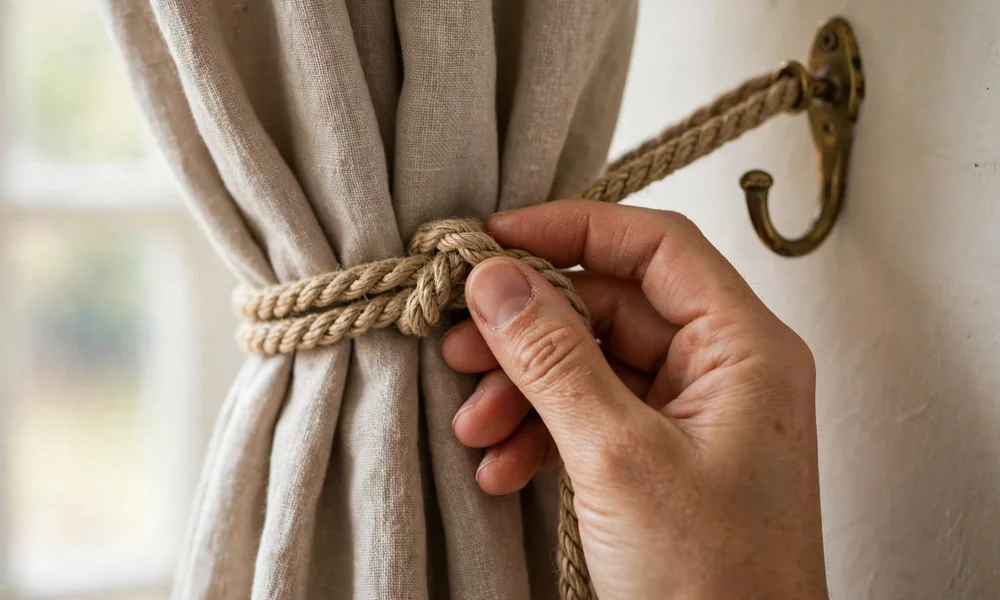
Braided rope tiebacks are the classic choice and the best all-round option for most windows. A thick rope grips a heavy curtain without slipping, and its weight helps the fabric fall in even folds. The trick is the length: too long and the curtain hangs slack, too short and the fabric is crushed. Measure with the curtain gathered in your hand before you buy, and choose a firm braid, since a loose one stretches over time.
Magnetic Tiebacks
Magnetic tiebacks are the easiest to live with day to day. Two strong magnets snap together through the gathered fabric, with no hook and nothing to fix to the wall, so you can open and close the curtains in seconds. They suit light and medium curtains, and they are the best choice for rented homes, where drilling is not an option. Their limit is strength: most will not hold a heavy lined curtain, and the magnets can slip on thick velvet. Test one panel before buying a full set.

Where to Fit a Tieback
The height of the tieback decides the shape of the whole window. The classic position is about two-thirds of the way down from the top of the curtain, or roughly at sill height for a full-length curtain — high enough that the gathered fabric falls in a long, graceful sweep, and low enough that the top of the panel does not flop forward. Fix it too high and the curtain hangs like a stiff triangle, with the bottom flaring out and the top pulled tight; fix it too low and the panel bunches at the floor while the top half hangs loose and shapeless. Stand back and look at the window from across the room after fitting one side, before you fix the other: the two sides should mirror each other, and the folds should fall straight down from the tieback without twisting.
The hook matters as much as the height. A tieback hook or holdback pulls sideways on the wall every time the curtain is drawn, so it must bite into something solid. A screw into a stud or masonry holds easily; a screw into bare plasterboard will work loose within weeks, especially with a heavy curtain pulling on it. Use a proper cavity fixing for plasterboard, or move the hook to a stud. The hook should sit a few centimetres out from the wall so the gathered curtain clears the frame, and it should be level on both sides: a centimetre of difference is visible from across the room.
Matching Tiebacks to Curtains and Rooms
Heavy curtains need a strong tieback: rope, a wide fabric band or a metal holdback, with a hook fixed into solid wall. Light sheers need almost nothing — a slim magnetic tieback or a narrow fabric band — and a heavy rope on a sheer pulls the delicate fabric out of shape. Velvet and lined curtains suit rope and metal; linen and cotton suit fabric bands and rope; silk and satin suit smooth magnetic or fabric tiebacks, which will not snag the surface. Colour matters too: a tieback in the curtain’s colour disappears, while a contrasting one becomes a feature.
The room sets the style. A formal living room or dining room suits tassels, rope and metal holdbacks, which read as deliberate decoration. A bedroom suits soft fabric bands and magnetic tiebacks, which are quiet and easy to use half-asleep. A child’s room suits magnetic tiebacks best, since there is no cord to loop. A rented flat suits them too: no drilling, no damage, and nothing to leave behind. In a small room, a slim tieback in the curtain’s colour keeps the window looking light.
What to Look for When You Buy
A few details separate a tieback that lasts from one that annoys you within a month. First, check the strength honestly: hold the gathered curtain in one hand and feel its weight, then choose a tieback rated for at least that weight, not one that only just copes. Second, check the length against your curtain, not against the packet: gather the panel as you would when the curtains are open, measure around the bunch, and compare that with the tieback’s loop. Third, look at the fixings. A tieback that needs a wall hook should come with a proper hook and screws; a magnetic one should have magnets strong enough that you can feel them snap through a fold of your curtain fabric. Fourth, check the finish: rope ends should be whipped or capped so they do not fray, metal should be smooth with no sharp edges that snag fabric, and fabric bands should be stiffened evenly, not floppy at the ends.

The Mistakes That Spoil the Look
Most tieback problems come from fitting, not from the tieback itself. The first is fixing the hook too high, which pulls the curtain into a stiff triangle and leaves the bottom flaring. The second is a hook fixed into weak plaster, which works loose and leaves the tieback hanging by a thread. The third is a tieback that is too tight: it crushes the folds, creases the fabric and makes the curtain look pinched rather than gathered. The fourth is mismatched sides, where one tieback is higher, tighter or a different length than the other, and the window looks lopsided from across the room. The fifth is choosing a tieback for looks alone, such as a delicate magnetic pair on a heavy lined curtain, which will slip within a day. Measure first, match strength to weight, fix into solid wall, and check both sides from across the room.
Curtain Tieback Checklist
- Match the tieback to the curtain’s weight: rope or metal for heavy drapes, magnetic or fabric for light ones.
- Fit tiebacks about two-thirds of the way down, and check both sides mirror each other from across the room.
- Fix hooks into a stud, masonry or a proper cavity fixing, never bare plasterboard.
- Measure the gathered curtain before buying, so the loop is neither too tight nor too slack.
- Keep the tieback style in step with the room: tassels for formal rooms, magnetic for bedrooms and rentals.
- Clean fabric bands and tassels with the curtains, and wipe rope and metal clean when you dust.
Frequently Asked Questions
What is the difference between a tieback and a holdback?
A tieback is a flexible band, rope or magnetic pair that wraps around the gathered curtain. A holdback is a fixed metal arm screwed to the wall that the curtain drapes over.
How high should a curtain tieback be?
About two-thirds of the way down from the top of the curtain, or roughly at sill height for a full-length curtain. Too high and the curtain hangs like a stiff triangle; too low and the top flops forward.
Can I use tiebacks on blackout curtains?
Yes, but use a strong rope tieback or a metal holdback fixed into solid wall. Most magnetic tiebacks are too weak for lined blackout panels.
Do tiebacks damage curtains?
A well-fitted tieback does not. One that is too tight creases the fabric, and a bare metal magnet can snag delicate silk.
Can I use tiebacks without drilling holes?
Yes. Magnetic tiebacks need no fixing at all, and some fabric bands tie rather than hook. They are the best choice for rented homes and for walls you do not want to drill.
Should both tiebacks be at exactly the same height?
Yes. Even a centimetre of difference is visible from across the room. Measure from the floor on both sides rather than from the top, since floors and rods are rarely perfectly level.
The Bottom Line
The best curtain tiebacks in 2026 are the ones matched to the curtain’s weight, fitted two-thirds of the way down, and fixed into solid wall: rope or metal for heavy drapes, fabric bands for a tailored look, and magnetic tiebacks for light curtains and rented homes. Measure the gathered curtain first, keep both sides level, and the window will look finished every time you draw the curtains back.