
The best desk fan for a small workspace in 2026 is the one you forget is there. It keeps a steady stream of cool air on your face and hands while you work, it hums so quietly that it never interrupts a call, and it takes up so little room that your keyboard, notebook and coffee still fit on the desk. A good desk fan does not try to cool the whole room. It cools one person, in one chair, at one desk, and that narrow job is exactly why it works so well.
Choosing well is mostly about three things: noise, size and airflow. This guide compares the main types of desk fan and picks the best desk fans for every kind of small workspace in 2026.
Key Takeaways
- A desk fan cools one person, not a room, so judge it on quietness and airflow at arm’s length, not on raw power.
- Noise decides whether you love a desk fan or switch it off: look for a stated rating under 40 decibels on its lowest useful speed.
- Clip-on and compact desk fans suit the smallest desks, while a standard desktop fan suits a desk with room to spare.
- Bladeless desk fans are the quietest and easiest to clean, but they cost more for the same airflow as a good bladed fan.
- USB-powered desk fans are the most flexible for small workspaces, running from a laptop, a power bank or a wall adapter.
Why the Right Desk Fan Matters
A small workspace warms up fast. A laptop throws out heat, a monitor adds more, a sunny window adds more still, and by mid-afternoon the air around the desk can feel several degrees warmer than the rest of the room. A desk fan solves exactly this problem, and it does so for a few pounds a year in electricity.
The best desk fans also protect your concentration. Heat makes you sluggish, and a stuffy desk makes an afternoon drag. A gentle, steady breeze keeps you alert without chilling you, and because a desk fan sits close to you, it needs far less power than a room fan to make the same difference.
The Main Types of Desk Fan Compared
There are four main types of desk fan, and they suit very different desks. Standard desktop fans stand on a small base, tilt up and down, and suit a desk with room to spare. Clip-on desk fans clamp to a shelf, a monitor stand or the edge of a desk, and suit the smallest workspaces because they use no desk surface at all. Bladeless desk fans push air through a smooth loop with no exposed blades, and suit quiet work, bedrooms and homes with small children or pets. USB desk fans are compact fans powered through a USB cable, and suit laptops and study desks.
If your whole room needs cooling rather than just your desk, our guide to the best tower fans covers the quiet room fans that cool a bedroom or living room without taking over the space.
| Desk fan type | Best for | Noise | Footprint | Typical price |
|---|---|---|---|---|
| Standard desktop | Most desks, best value | Low to medium | 15 to 25 cm wide | £15 to £40 |
| Clip-on | Tiny desks, shelves | Low | None on the desk | £15 to £35 |
| Bladeless | Quiet work, bedrooms | Very low | 15 to 20 cm wide | £40 to £90 |
| USB compact | Laptops, travel, study | Low to medium | 10 to 15 cm wide | £10 to £30 |

Our Picks: The Best Desk Fans for Every Small Workspace
We judged every type of desk fan on the same five tests: noise at the speeds you will actually use, airflow at arm’s length, stability on a real desk, ease of use, and value for money. These are the picks that came out on top.
Best Overall: Standard Desktop Desk Fan
A well-made standard desktop fan remains the best all-round desk fan for most people. Look for a model about 20 centimetres across with at least three speeds, a tilt head you can aim at your face or your hands, and a base heavy enough that it does not wobble or walk across the desk.
Best for Quiet Work: Bladeless Desk Fan
When a fan runs a metre from your ears all day, noise matters more than raw power, and a bladeless desk fan wins here. With no blades to chop the air, the sound is a smooth, steady whoosh rather than a whir, and there is nothing to clean but a wipe of the loop. Some models add a sleep mode and a display that dims completely. The trade-off is price: you pay noticeably more for the same airflow as a good bladed fan, but if you take calls all day, the quiet is worth it.
Best for Tiny Desks: Clip-On Desk Fan
When desk space is the limiting factor, a clip-on desk fan is the answer. It clamps to a shelf, a monitor arm or the edge of the desk, aiming a focused breeze exactly where you want it while leaving the whole desktop free. Check the clamp before you buy: it should grip firmly without marking the surface, and the fan head should tilt and swivel so you can aim it at your face rather than your keyboard.
Best Budget Pick: USB Compact Desk Fan
A compact USB desk fan is the cheapest way into a cooler workspace, and the most flexible. It runs from a laptop, a power bank or a phone charger, it folds or packs away in a bag, and it costs less than a takeaway lunch. The trade-off is power: it cools your face and hands, not your whole upper body, and on its highest speed it can sound busier than a bigger fan.

Noise: The Number That Decides Everything
Manufacturers quote noise in decibels, and the number is worth checking, but only with a pinch of salt, because there is no single standard for where the microphone sits. As a rough guide, a desk fan rated under 40 decibels on its lowest speed is whisper-quiet, 40 to 50 decibels is the sound of a quiet room with a fan running, and anything above 55 decibels will intrude on conversation and calls. The character of the noise matters as much as the volume: a smooth, steady whoosh fades into the background, while a whine, a rattle or a clicking oscillation will keep you aware of the fan all day.
The most useful test is also the simplest. Run the fan on the speed you will actually use, sit where you will actually sit, and try to forget it is there. If you cannot, it is too loud for your desk, whatever the box says. Remember too that a fan that is quiet on its lowest speed may not be quiet on its highest, so check the rating at the speed you need. Our best versus worst fans guide covers the noise and airflow traps that catch buyers across every type of fan, from ceiling fans to tower fans.
Airflow, Oscillation and Controls
Airflow is measured in cubic feet per minute, and for a desk fan the number to care about is the airflow at your seat, not the headline figure. A small fan that pushes a focused stream half a metre is more useful at a desk than a bigger fan that spreads its air across the room.
Controls matter more than most buyers expect, because you will use them every day. A single button that cycles through speeds is fine; a fiddly touch panel that needs three taps to turn the fan down is not. A timer is genuinely useful, switching the fan off after you have finished for the day. The best desk fans keep it simple: three or four speeds, a tilt head, and a button you can find without looking.
Placement: Where to Put a Desk Fan
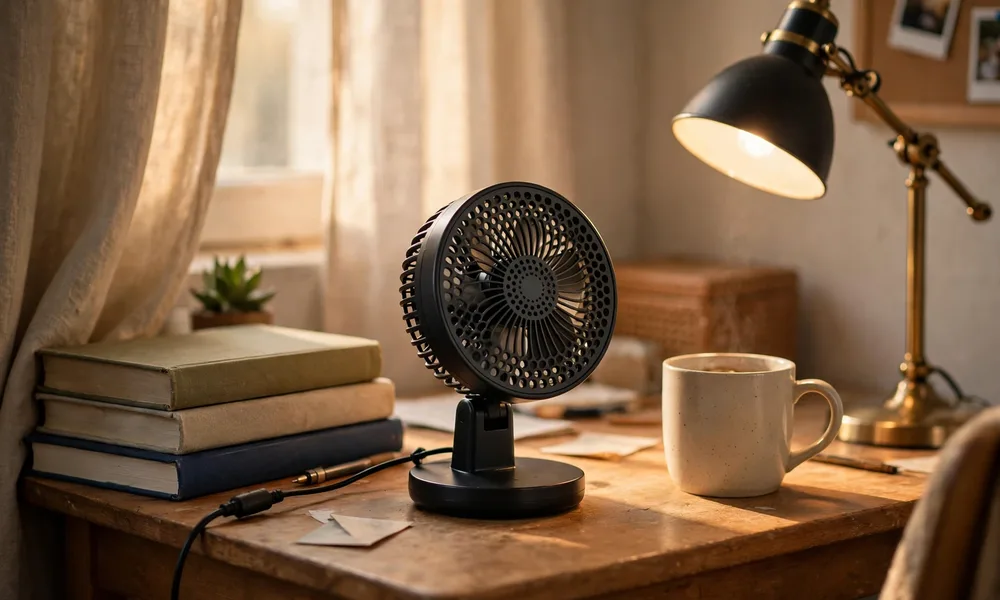
Placement decides whether a desk fan feels like a gentle breeze or a draught in your face. The sweet spot is about 40 to 60 centimetres away, aimed slightly to one side of your face rather than straight at it, and tilted so the air passes across your hands and your keyboard as well.
Keep the fan off the direct line between you and your monitor, or the glare and the breeze will compete for your attention, and keep it away from the edge of the desk where a sleeve or a cable can knock it over. If your desk sits in a corner, a clip-on fan on the shelf above works better than a desktop fan squeezed behind the monitor. And if your desk is the centrepiece of the room, our guide to the best desks covers the small desks that leave room for a fan, a laptop and everything else a workspace needs.
Buying Checklist
- Measure the free space on your desk first, then buy the fan size that fits it, not the biggest fan in the shop.
- Check the noise rating at the speed you will actually use, and aim for under 40 decibels on low.
- Choose clip-on for a tiny desk, bladeless for quiet work, and USB compact for flexibility and travel.
- Make sure the base is heavy and stable, or the clamp grips firmly, so the fan never wobbles or topples.
- Check the power source: USB fans need a spare port or adapter, while mains fans need a nearby socket.
- Look for a grille that comes off easily, because a desk fan gathers dust fast and needs regular cleaning.
Frequently Asked Questions
What is the best desk fan for a small workspace?
For most small workspaces, a standard desktop desk fan about 20 centimetres across is the best choice: quiet, stable and strong enough to cool one person at arm’s length. If your desk is very small, a clip-on fan is better; if you take calls all day, a bladeless fan is quieter.
Are desk fans worth it?
Yes, if you work at a desk that gets warm. A desk fan costs a few pounds a year to run, cools the one person who needs it, and makes a hot afternoon far more comfortable.
How loud should a desk fan be?
A good desk fan should be under 40 decibels on its lowest useful speed, which is whisper-quiet, and under 50 decibels on the speed you use most. Anything above 55 decibels will intrude on calls and concentration, so test the fan at your real working speed.
Do bladeless desk fans work well?
Yes, bladeless desk fans work well for one person at a desk. They are quieter and smoother than bladed fans, safer around children and pets, and much easier to clean.
Can a desk fan cool a whole room?
No, a desk fan is designed to cool one person, not a room. It moves air across your skin, which makes you feel cooler, but it does not lower the temperature of the room. For a whole room, you need a tower, pedestal or ceiling fan instead.
How much electricity does a desk fan use?
Very little. A typical desk fan uses 5 to 25 watts, so running one for eight hours a day costs only a few pence, and a whole summer of use costs a few pounds. A USB desk fan uses even less, often under 10 watts.
The Bottom Line
The best desk fan for a small workspace is the one that fits your desk, stays quiet enough to forget, and keeps a steady breeze on you all day. For most desks, that is a standard desktop fan with three speeds and a stable base. For the tiniest desks, it is a clip-on fan that uses no surface at all. For quiet work, it is a bladeless fan. Measure your desk, check the noise at the speed you will use, and buy the fan that matches the way you actually work.


