
The best tower fans in 2026 solve a very specific summer problem: the room is too warm to sit in, but you do not want the noise, the draught or the electricity bill of an air conditioner. A good tower fan moves a steady column of air across the room, quietly enough to forget it is there, and it costs a few pounds a year to run. The bad ones are easy to spot too: they rattle, they wobble, and they blow hard in one spot while the rest of the room stays still.
Tower fans have quietly become the default cooling choice for bedrooms and living rooms because they do the one job well without taking over the room. They stand in a corner, they oscillate, they switch themselves off at night, and the best of them are barely louder than the room itself. This guide explains what actually matters when you buy one — airflow, noise, oscillation, controls and size — and which types suit which rooms.
Key Takeaways
- Airflow is measured in cubic feet per minute, and a living room needs roughly twice the airflow of a bedroom.
- Noise decides whether you love a tower fan or switch it off: look for a stated rating under 50 dB on its highest useful speed.
- Oscillation matters more than raw power — a fan that sweeps 90 degrees cools a whole room, while a fixed fan cools one chair.
- A timer, a remote and a sleep mode are the three features worth paying for; everything else is decoration.
- Bladeless tower fans are the quietest and easiest to clean, but they cost more for the same airflow as a good bladed tower.
Why a Tower Fan Beats a Pedestal Fan
A pedestal fan moves air with a spinning head on a pole. It works, but it is bulky, it wobbles, and its blades are exposed, which matters in a house with small children or pets. A tower fan hides its workings inside a tall, slim column. The footprint is about the size of a dinner plate, it stands flat against a wall when it is not needed, and there are no exposed blades to catch a curtain or a curious finger.
The shape also changes how the air feels. A pedestal fan throws a narrow jet that fades fast, while a tower fan pushes a tall, wide column that fills more of the room at a gentler speed and cools a whole sofa, not just one chair.
How We Picked the Best Tower Fans
We judged every type of tower fan on the same five tests: airflow, noise, oscillation, ease of use, and running cost. Noise was weighted heaviest, because a fan that hums or rattles will be switched off, and a switched-off fan cools nothing.

The Main Types of Tower Fan Compared
There are three main types. Standard bladed tower fans are the cheapest and most powerful for the money. Bladeless tower fans use a hidden impeller and a narrow slot to shape the airflow; they are quieter, smoother and much easier to wipe clean, but they cost noticeably more. Evaporative tower fans add a water tank and a cooling pad, blowing air that feels cooler in dry heat, though they add humidity and need regular cleaning.
For most homes, a standard bladed tower fan is the right starting point. Bladeless is worth the premium for a bedroom, and evaporative models suit dry, hot summers but not an already damp house.
| Fan type | Best for | Strength | Weakness |
|---|---|---|---|
| Standard bladed tower | Most rooms, best value | Strong airflow, low price | Harder to clean inside, noisier |
| Bladeless tower | Bedrooms, nurseries | Quiet, safe, easy to wipe clean | Costs more for the same airflow |
| Evaporative tower | Dry, hot summers | Air feels cooler, adds moisture | Needs cleaning, adds humidity |
| Compact tower | Desks, small bedrooms | Tiny footprint, very quiet | Too weak for a large room |
Our Picks: The Best Tower Fans for Every Room
Best Overall: Full-Size Bladed Tower
The full-size bladed tower is the safest default choice. It stands about a metre tall, oscillates across 90 degrees, and moves enough air for a living room. Look for at least three speeds, a timer of up to eight hours, and a remote. Check the base before you buy: a wide, heavy base stops the fan wobbling and rattling as it oscillates.
Best for Bedrooms: Bladeless Tower
When a fan runs all night a few feet from your head, noise and safety matter more than raw power. A bladeless tower wins here: no blades, a smoother and steadier sound, and a sleep mode that drops the speed gradually as the room cools. Some models add a display that dims completely. If the air in your bedroom feels dry as well as warm, a humidifier running alongside the fan can help more than a bigger fan — our guide to the best humidifiers explains how to match one to your room.
Best for Large Living Rooms: Tall Oscillating Tower
A big room defeats a small fan. For an open living room, pick the tallest tower you can fit, with oscillation of 90 degrees or more and a wide, tall outlet that spreads air across the seating area rather than blasting one spot. Place it in a corner with clear space in front of it and let the oscillation do the work. For the wider question of keeping the room’s air pleasant all summer, our guide to the best air purifiers covers the machines that clean the air your fan is moving.
Best for Small Spaces: Compact Tower
When floor space is the limiting factor, a compact tower wins. It is roughly half the height of a full-size fan, sits happily on a bedside table or a desk, and still moves enough air for one person. Check it has a stable base and a timer, since a small fan is easy to knock over. The trade-off is range: it cools your side of the bed, not the whole room.
Noise: The Number That Decides Everything
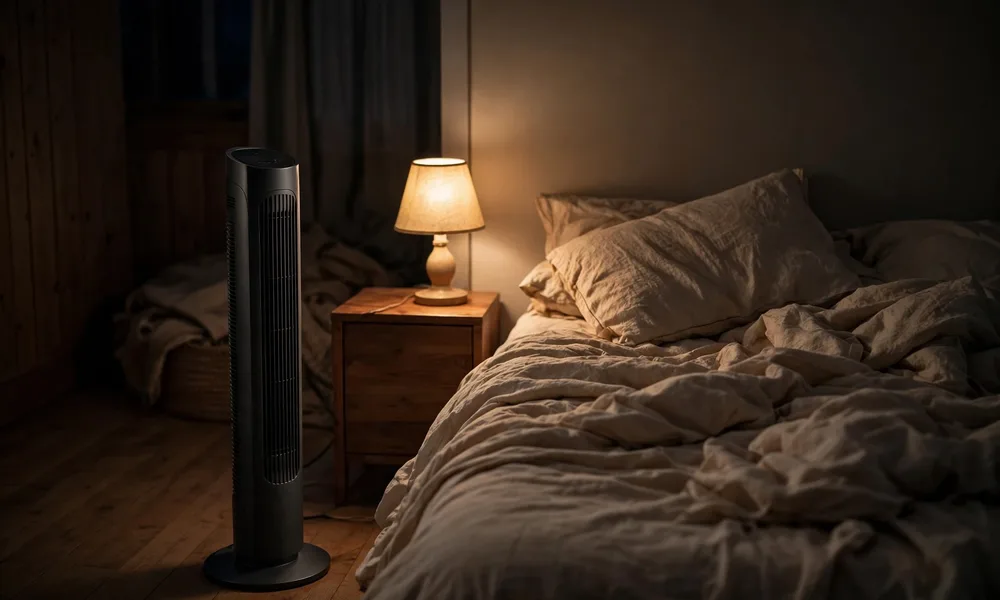
Manufacturers quote noise in decibels, and the number is worth checking, but only with a pinch of salt: there is no single standard for where the microphone sits. As a rough guide, a fan rated under 40 dB on its lowest speed is whisper-quiet, 40 to 50 dB is the sound of a quiet room with a fan running, and anything above 55 dB will intrude on conversation and sleep.
The character of the noise matters as much as the volume. A smooth, steady whoosh fades into the background, while a whine, a rattle or a clicking oscillation will keep you awake. A sleep mode is usually the quietest option, since it drops the motor to its slowest speed.
Where to Put a Tower Fan
Placement makes more difference than most people expect. A tower fan works best when it can draw in cool air and push it across the room, so put it near a window or a doorway in the evening when the outside air cools, and let it pull that cooler air in. During the day, place it where it blows across the people in the room rather than at a wall, and give it at least half a metre of clear space in front of the outlet.
At night, aim the fan across the bed rather than directly at your face, which dries the eyes and throat. Set the timer for the small hours, when the room is coolest. A smart thermostat can help here too, keeping the room in a steady range overnight — our guide to the best smart thermostats explains how to set one up for summer nights.
Cleaning and Keeping It Quiet
A tower fan gathers dust fast, and a dusty fan is a noisy fan that blows stale air. Wipe the outside weekly with a damp cloth, and vacuum the grille and the air inlet monthly. Bladeless models need little more than a wipe. Bladed models are harder: the internal column of blades is difficult to reach, so look for a model with a removable rear grille, or use a long, soft brush and a vacuum with a brush attachment.
If a quiet fan starts to rattle, the cause is almost always dust on the blades or a loose base. Clean it first, then check the base is tight and the fan stands level on a hard floor rather than a thick rug.

Running Costs and What to Avoid
A tower fan is one of the cheapest appliances in the house to run. A typical model draws 40 to 60 watts, which works out to roughly a penny an hour at average electricity prices — a whole summer of evening use costs less than a single takeaway. Bladeless models often draw a little more, but the difference is small either way.
A few things to avoid: do not buy a fan with no timer if it will run overnight, and do not trust a fan that claims to cool a room by ten degrees — a fan cools people, not rooms, by moving air across skin.
Checklist: Buying a Tower Fan Without Regret
- Match the airflow to the room: a bedroom needs far less than an open living room.
- Check the noise rating and look for a sleep mode if it will run overnight.
- Pick oscillation of 90 degrees or more so the whole room gets the air, not one chair.
- Make sure it has a timer of at least four hours and a remote you can reach from bed.
- Choose a wide, heavy base so it stands steady and does not wobble or rattle.
- Check the grille comes off or the fan wipes clean easily, or dust will build up fast.
Frequently Asked Questions
Do tower fans actually cool a room?
Not in the way an air conditioner does. A tower fan does not lower the temperature of the air; it moves air across your skin, which evaporates sweat and makes you feel cooler, even though the thermometer barely moves.
How much electricity does a tower fan use?
Very little. A typical tower fan draws 40 to 60 watts, roughly a penny an hour, so a whole summer of evening use costs only a few pounds.
Are bladeless tower fans worth the extra money?
For a bedroom or a nursery, yes: they are quieter, safer, and much easier to clean. For a living room where the fan runs for a few hours in the evening, a good bladed tower gives you the same cooling for noticeably less money.
What is the best tower fan for sleeping?
A quiet bladeless tower with a sleep mode and a timer, placed so it blows across the bed rather than directly at your face, with a display that dims or switches off completely.
How do I clean a tower fan?
Wipe the outside weekly and vacuum the grille and air inlet monthly. If the rear grille comes off, remove it and clean the blades inside. Never spray water into the fan or run it while it is wet.
Should I leave a tower fan running all night?
Yes, if it is quiet and has a timer. Set the timer for four to eight hours so it switches off in the small hours, and aim it across the room rather than at your face.
The Bottom Line
The best tower fans in 2026 are the quiet ones with wide oscillation, a timer and a remote — the features you actually use every day, not the ones on the box. Match the size to the room, buy bladeless if it will run beside your bed all night, and place it where it can pull in cool evening air. Do that, and a fan that costs a few pounds a summer will make the hottest weeks of the year comfortable without a single rattle to keep you awake.


