Dusting cloths that trap dust instead of spreading it are the simplest cleaning tool in the house, and the one most people buy badly. A dusting cloth is a flat, hand-held cloth you use dry, or barely damp, to lift dust off the surfaces you can reach: wooden furniture, shelves, picture frames, glass, and the tops of tables and televisions. A good one holds the dust in its fibres until you shake it out, and the surface looks clean in a single pass. A bad one pushes a grey film across the shelf, and the room looks dusty again within the hour.
This guide explains how to choose dusting cloths: the materials that trap dust and the ones that only move it, the weaves and naps that suit wood, glass and screens, and how to wash them so they keep working. A dusting cloth is a wiping tool, not a reaching tool. A handled duster reaches the high shelves and ceiling fans that a cloth cannot, and our guide to the best dusters of 2026 covers that tool in full. Use the cloth for the surfaces you can touch, and the duster for the ones you cannot.
Key Takeaways
- A cloth traps dust when its fibres are dense and slightly fluffy, because dust needs somewhere to sit instead of sliding across a flat surface.
- Microfibre suits most dusting jobs, cotton flannel suits polished wood, and a tack cloth suits the final wipe before paint or varnish.
- Use a dusting cloth dry on wood and shelves, and only barely damp on glass, because a wet cloth turns dust into muddy streaks.
- Fold the cloth into eighths and turn to a clean face as you work, because a folded cloth gives you eight fresh surfaces.
- Colour-code your cloths by room, because the cloth that dusted the bathroom should never be the one that polishes the wine glasses.
What a Dusting Cloth Actually Is
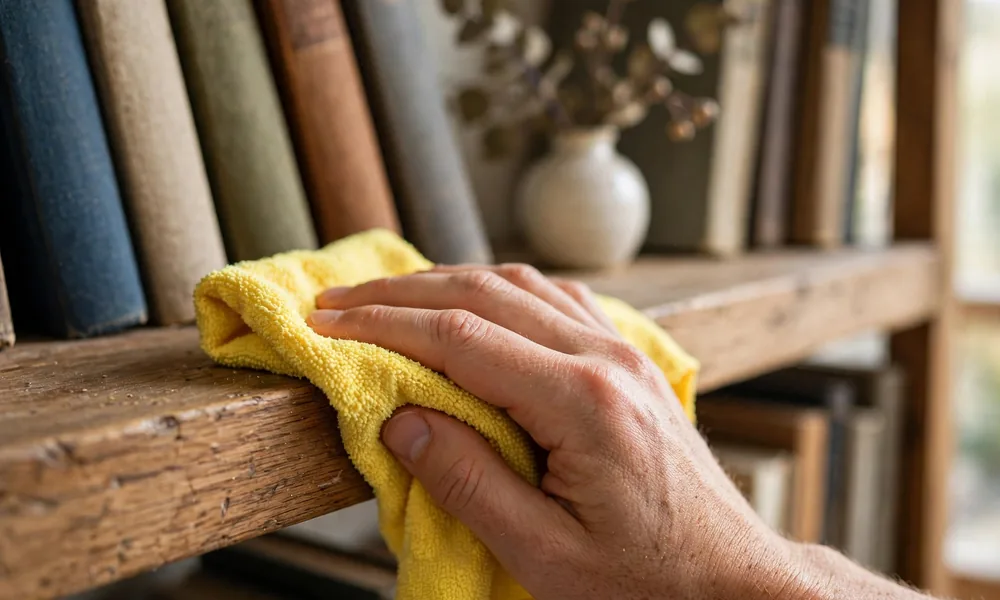
A dusting cloth is a flat cloth made to lift dry dust, and that narrow job is what makes it different from every other cloth in the cleaning cupboard. A dishcloth is made to soak up water, and a drying cloth is made to absorb. A dusting cloth holds fine, dry particles in its fibres through static and texture, and releases them when you shake it out outside. The best ones feel soft and slightly grippy.
The material decides most of the performance. Microfibre is the best all-round dusting cloth material for most homes, because its split fibres trap dust through static and hold it until the cloth is shaken or washed. Our guide to the best microfiber cloths of 2026 covers the whole family of microfibre weaves in detail, and this guide narrows that picture down to one job: dry dusting with a flat cloth. Cotton flannel is the traditional alternative, and it suits polished wood better than any synthetic, because it is soft, lint-free when well made, and leaves no static charge behind.
The Main Types of Dusting Cloths Compared
Every dusting cloth is a variation on five basic ideas, each made for a different job.
| Type | Best for | Nap | Typical price |
|---|---|---|---|
| Microfibre dusting cloth | Most surfaces, everyday dusting | Short to medium pile | $1 to $3 each |
| Cotton flannel cloth | Polished wood and antiques | Soft, brushed nap | $2 to $5 each |
| Flat-weave cloth | Glass, mirrors and screens | Flat, smooth | $1 to $3 each |
| Cheesecloth | Final wipe before painting | Loose open weave | $1 to $2 each |
| Tack cloth | Pre-paint and pre-varnish dust removal | Lightly sticky resin | $2 to $4 each |
Microfibre Dusting Cloths
A microfibre dusting cloth is the best all-round choice for most homes. Thousands of tiny split fibres hold dust through static, so a single slow pass leaves a shelf visibly clean, and the cloth comes away grey. The best ones have a short to medium pile: long enough to trap dust, short enough not to shed fibres. A plush, deep-pile microfibre cloth is made for drying cars and soaking up spills, not for dusting, and on a shelf it leaves lint behind. When you buy, check the edges: a cloth with stitched, bound edges lasts far longer than one with raw cut edges, which fray in the wash and shed threads. Wash microfibre cloths without fabric softener or dryer sheets, because softener coats the split fibres and destroys the static grip that makes them work.
Cotton Flannel Cloths
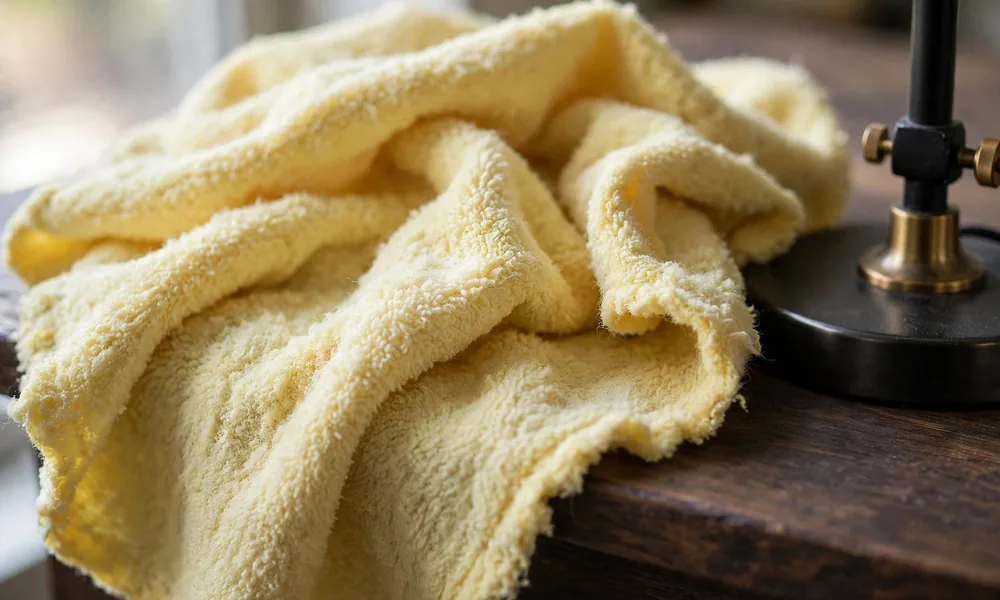
A cotton flannel cloth is the traditional dusting cloth, and it still does one job better than any synthetic: dusting polished wood. The brushed cotton nap is soft enough for varnish, lacquer and French polish, it leaves no static charge, and a well-made flannel cloth leaves no lint. It is the right cloth for antiques and pianos. Flannel cloths need more care than microfibre: they shrink in a hot wash, so wash them cool and let them dry naturally, and they wear out faster, because the nap flattens with use and a flat flannel cloth stops trapping dust. Buy flannel cloths in a plain colour, and keep one flannel cloth for the wood alone.
How to Dust Properly with a Cloth
Good dusting is a technique, not just a tool, and the technique is simple. Dust from the top down, always, so the dust you knock loose lands where you are about to clean next. Work in one direction across a surface, not in circles, because circles push dust back over the part you have just cleaned. Fold the cloth into eighths and turn to a clean face as you work: a folded cloth gives you eight fresh surfaces, and a fresh face traps dust while a dirty face just moves it around. Shake the cloth out outside every few minutes. Dust dry on wood and shelves, and only barely damp on glass, because a wet cloth turns dust into muddy streaks. Never use furniture polish on every dusting round: polish builds up into a sticky layer that attracts dust faster.
Dusting Cloths vs Dusters: Which One Do You Need?
The honest answer is both, because they do different jobs. A dusting cloth is a flat, hand-held tool for the surfaces you can touch: the top of a table, a shelf at waist height, a picture frame, a television screen. It gives you control and pressure on a flat surface. A duster is a handled tool for the surfaces you cannot touch: the top of a wardrobe, a ceiling fan, the gap behind a radiator, the top of a door frame. If you buy only one, buy the cloth first, because most of the dusting in a home happens on surfaces within arm’s reach. But if your home has high ceilings, ceiling fans or tall bookcases, a duster earns its keep within a week. For delicate surfaces, a feather duster wraps around ornaments and picture frames in a way no cloth can match, and our guide to the best feather dusters of 2026 covers the soft, dense dusters that suit ornaments and polished wood.
The Best Dusting Cloths of 2026 at a Glance
Use these picks to narrow your choice, then check the table above to compare them side by side.
Best Overall: A Medium-Pile Microfibre Dusting Cloth
For most homes, the best dusting cloth is a medium-pile microfibre cloth around 30 by 40 centimetres, with stitched edges and a weight of about 300 grams per square metre. It traps dust on wood, shelves and tables, and it lasts for years if you keep softener out of the wash.
Best for Polished Wood: A Cotton Flannel Cloth
If your home is full of polished wood, antiques or a piano, a cotton flannel cloth is the best buy. The brushed nap is gentle on varnish and lacquer, and it polishes as it dusts. Keep one cloth for the wood alone, wash it cool, and replace it when the nap flattens.
Best for Glass and Screens: A Flat-Weave Microfibre Cloth
Glass, mirrors and televisions want a flat-weave cloth, not a fluffy one. The smooth, tight weave wipes a mirror streak-free and lifts fingerprints off a screen without lint. Use it barely damp on glass and dry on screens.
Best Budget: A Pack of Plain Microfibre Cloths
The cheapest good dusting cloths are plain microfibre cloths bought in a pack of ten or twelve. They cost little each, they fit in a drawer, and a fresh cloth is always to hand.

What to Avoid
A cloth that is too thin is the worst buy of all, whatever the price. If the cloth has no depth, it cannot trap dust, so it pushes a grey film from one surface to another. A cloth with raw cut edges is the second trap: the edges fray in the wash and shed threads across the furniture. A cloth used with fabric softener is the third trap: softener coats the fibres and kills the static that traps dust. Finally, avoid using one cloth for the whole house: a cloth that has cleaned the bathroom carries grease onto the wine glasses, and a cloth that has dusted the shelves carries grit onto the mirror.
Buying Checklist
- Choose the material for the surface: microfibre for most jobs, cotton flannel for polished wood, flat-weave for glass and screens.
- Buy the right size: around 30 by 40 centimetres, big enough to fold into eighths and small enough to control.
- Check the edges are stitched and bound, because raw cut edges fray and shed threads.
- Pick a medium pile for dusting, not a deep plush pile that leaves lint behind.
- Buy a pack of four or five and colour-code them by room, so the bathroom cloth never polishes the glasses.
- Wash without fabric softener or dryer sheets, and wash microfibre separately from cotton towels.
Frequently Asked Questions
Should I dust with a dry cloth or a damp cloth?
Dust dry on wood, shelves and furniture, because a dry cloth traps dust in its fibres. Use a cloth only barely damp on glass and mirrors, where a dry cloth leaves streaks. A wet cloth turns dust into muddy streaks, so wring it out until it feels almost dry.
How often should I wash my dusting cloths?
Shake the cloth out outside after every dusting round, and wash it when it stops trapping dust or starts to smell, usually after three or four uses. Wash microfibre cloths without fabric softener, on a warm cycle, and let them dry naturally or on a low heat.
Can I use a dusting cloth on a television screen?
Yes, if it is a flat-weave microfibre cloth used dry. A fluffy cloth leaves lint on a screen, and a wet cloth can damage it. Never spray cleaner directly onto a screen: spray the cloth lightly or use it dry, and wipe gently.
Why does dust come back so quickly after dusting?
Dust comes back quickly when the cloth only moves it, usually because the cloth is thin, dirty or full. A clean, dense cloth traps dust in its fibres, so less of it ends up back in the air.
Do I need different cloths for different rooms?
Yes, and colour-coding is the simplest way to do it. One colour for the kitchen, one for the bathroom, one for the living room, and one for glass. The cloth that cleaned the bathroom should never polish the wine glasses.
What is the difference between a dusting cloth and a duster?
A dusting cloth is a flat, hand-held cloth for the surfaces you can touch. A duster is a handled tool for the surfaces you cannot touch, such as high shelves and ceiling fans. The cloth wipes what you can reach, the duster reaches what you cannot, and most homes need both.
The Bottom Line
The best dusting cloth is the one that matches your surfaces: a medium-pile microfibre cloth for most homes, a cotton flannel cloth for polished wood, and a flat-weave cloth for glass and screens. Buy a pack, colour-code them by room, and wash them without softener.