
A feather duster is the oldest tool in the cleaning cupboard, and it is still one of the most useful. It does a job that no cloth can do quite as well: it reaches into awkward corners, wraps around ornaments, and lifts dust from delicate surfaces without scratching them. A good one makes a room look cared for in a few minutes, while a bad one simply moves dust from a shelf into the air, where it settles again an hour later. The difference is not mysterious, and it is not mainly about price. It comes down to the feathers, the shape of the head, and the handle in your hand.
What Makes a Feather Duster Good
The feathers do almost all of the work, so they are the first thing to check. Good feathers are soft, dense, and full, with fine barbs that catch dust instead of flicking it away. When you run your hand gently over the head, it should feel springy and even, with no bare patches and no stiff, broken quills poking through. A duster that feels thin or patchy in the shop will only get worse at home, because loose feathers shed and sparse heads push dust around instead of trapping it.
The shape of the head matters almost as much as the feathers themselves. A round, fluffy head wraps around ornaments, lamp bases, and picture frames, reaching into curves that a flat cloth cannot touch. A longer, slimmer head slides between books, along the tops of door frames, and behind objects on a shelf. Some dusters have a slightly bent neck, which helps the head sit flat on a high surface while your hand stays at a comfortable angle. The best shape is the one that matches the surfaces you dust most often.

Ostrich Feather Dusters: The Classic Choice
Ostrich feather dusters are the classic choice, and for most homes they are still the best one. Ostrich feathers are long, soft, and naturally fluffy, with fine filaments that hold dust through gentle static and the sheer number of tiny fibres. A good ostrich duster feels almost weightless in the hand, yet it picks up a visible grey film from a shelf in a single slow pass. The feathers bend around objects rather than knocking them over, which makes them ideal for ornaments, plants, and framed pictures.
Ostrich dusters come in several sizes, and the size you choose changes what the duster is good for. A small ostrich duster, around thirty centimetres long, is perfect for desks, ornaments, and car dashboards. A medium one suits shelves and side tables, while a large one, fifty centimetres or more, covers wide surfaces quickly and reaches into high corners. Many homes are happiest with two: a small one for delicate work and a large one for the weekly pass over the whole room.
Other Feather Types Worth Knowing
Goose feather dusters are shorter and stiffer than ostrich dusters, and they suit a different kind of job. The feathers are broader and firmer, so they work well on sturdy surfaces such as wooden furniture, window frames, and the tops of doors. They are less gentle than ostrich feathers, so they are not the first choice for fragile ornaments or gilded frames, but they hold up well to regular use and they are often cheaper. A goose feather duster is a practical, hardworking tool for a busy household.
Some modern dusters use synthetic feathers, made from fine, soft fibres that imitate the shape of real feathers. The best of these are surprisingly good: they are washable, they do not shed, and they suit homes where allergies are a concern. They lack some of the softness and natural static of real feathers, and the cheapest ones feel plasticky and push dust around. If you choose a synthetic duster, look for fine, dense fibres and a flexible head, and avoid any head that feels stiff or scratchy against the back of your hand.
Short, Long, and Extendable Handles
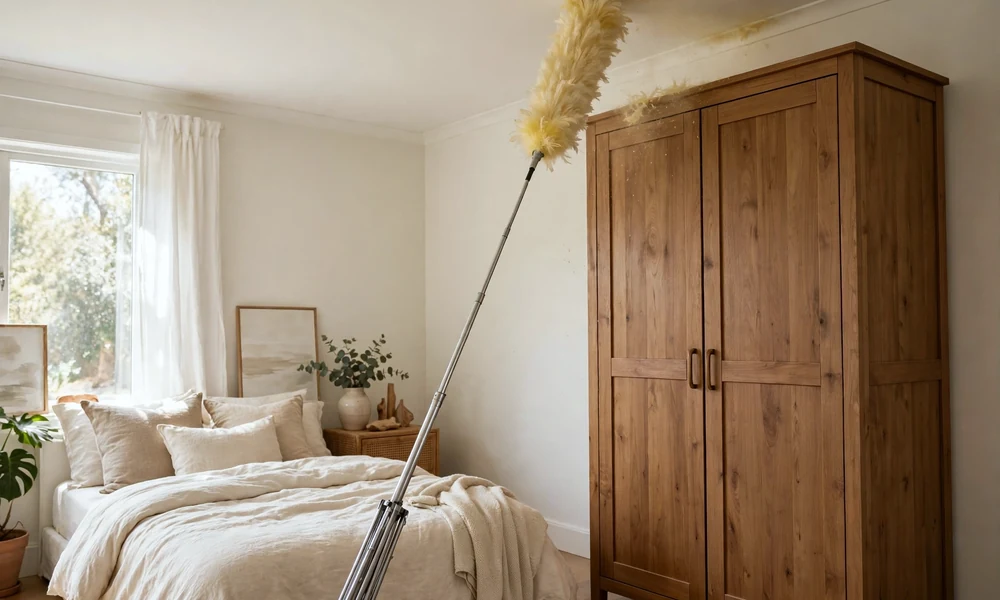
Extendable dusters combine both strengths, and they are the most versatile option for many homes. The handle telescopes out for high work and shortens for close work, locking firmly at each length. The best ones lock with a confident click and do not slip while you are dusting overhead. Cheaper extendable handles can slide shut at the worst moment, so test the lock in the shop if you can. An extendable ostrich duster is a strong choice if you want one duster that does almost everything, from a desk to a ceiling corner.
Where Feather Dusters Work Best
Feather dusters are at their best on delicate and awkward surfaces, where a cloth would be too clumsy or too harsh. Ornaments, ceramics, glassware, and framed pictures all benefit from a soft feather head that lifts dust without scratching or moving the object. The feathers slip into carved details, around lamp bases, and behind picture frames, places where dust gathers thickly and where a cloth simply cannot reach. For a home full of treasured objects, a feather duster is not a luxury; it is the safest way to keep them clean.
Feather dusters are also excellent for plants, blinds, and ceiling fans, three surfaces that are easy to neglect. A soft duster lifts dust from large leaves without bruising them, and it slips between the slats of a blind far more easily than a cloth. For a ceiling fan, turn the fan off first, then use a long-handled duster to sweep gently across the top of each blade, working from the centre outwards. A feather duster will not remove sticky grease or dried spills, but for dry dust on awkward shapes, it is hard to beat.
How to Use a Feather Duster Properly
The technique matters as much as the tool. The most common mistake is to flick the duster quickly, which throws dust into the air and leaves the surface almost as dusty as before. Instead, use slow, gentle strokes, letting the feathers brush the surface and trap the dust. Work from the top of a room downwards, so dust that falls lands on surfaces you have not cleaned yet, and finish with the lower shelves and tables. A slow pass takes only a few seconds longer, and it leaves the surface genuinely clean.
Shake the duster out regularly while you work, ideally outside or over a bin, so it does not become so full of dust that it starts leaving grey marks behind. A duster that is clogged with dust is worse than no duster at all, because it spreads old dust over clean surfaces. For a thorough clean, dust first and then wipe the surface with a damp cloth if it needs it. If you want a fuller picture of how feather dusters compare with other dusting tools, our guide to the best versus the worst dusters in 2026 puts microfibre, lambswool, electrostatic, and feather dusters side by side, so you can see where each one earns its place.
Feather Dusters and Allergies
It is also worth knowing that feather dusters themselves can hold allergens if they are not cleaned. Shake the duster out after every use, and give it a proper clean every few weeks, as described below. Some people with feather allergies prefer a synthetic duster or a washable microfibre tool instead, and that is a sensible choice. For everyday dusting after the feathers have done their work, a damp cloth finishes the job well, and our guide to the best microfibre cloths in 2026 covers the cloths that pair best with a feather duster for a full clean.
Caring for Your Feather Duster
A good feather duster will last for years if it is looked after, and the care is simple. After each use, take the duster outside and shake it firmly a few times, holding it by the handle and letting the feathers open out. This removes most of the dust and keeps the feathers fluffy. Store the duster hanging up, or lying flat in a dry place, rather than crammed into a cupboard where the feathers are bent out of shape. Damp is the enemy: it makes feathers clump together and can cause a musty smell that is hard to remove.
When a duster starts shedding feathers heavily, or when the head has gone flat and will not fluff up again after a wash, it is time to replace it. A worn duster does more harm than good, because it pushes dust around and leaves loose feathers behind on the furniture. Keep the old duster for a dusty job such as a garage or a shed, where precision does not matter, and buy a new one for the house. A good duster is not expensive, and replacing it when it is worn is part of keeping a home genuinely clean.
What to Avoid When Buying
The worst feather dusters share a few clear warning signs, and they are easy to spot once you know them. Thin, sparse heads with visible gaps are the most common fault: they look fluffy in the packet because the feathers are fluffed up for display, but they flatten as soon as you use them. Short, broken feathers are another warning sign, as are heads that shed the moment you touch them. If feathers come away in your hand in the shop, they will come away all over your furniture at home.

Choosing the Right Duster for Your Home
The right feather duster depends on the home it will clean. A small flat with a few shelves and ornaments needs only a small or medium ostrich duster, while a larger house with tall ceilings, many books, and high wardrobes will benefit from a long or extendable one. If you have many delicate objects, choose the softest feathers you can find, and keep a separate duster for the more robust jobs such as window frames and skirting boards, so the delicate duster stays clean and soft.
Think about storage before you buy, because a duster that is awkward to store will end up crushed in a cupboard and will not last. A hook inside a cleaning cupboard is ideal, and a long duster can hang neatly from a nail or a hook on the back of a door. If space is tight, a shorter duster or a folding extendable model is the better choice. Keeping the duster with the rest of your cleaning tools also helps: when everything is in one place, dusting becomes part of the routine rather than a job that needs hunting for tools. A tidy caddy makes that easier, and our guide to the best cleaning caddies in 2026 shows the carriers that keep a duster, cloths, and sprays together in one trip.
The Verdict
The best feather dusters of 2026 are the ones that do the simple job well: soft, dense feathers, a shape that fits the surfaces you clean, and a handle that feels steady in your hand. An ostrich feather duster is the best all-round choice for most homes, with a small one for delicate work and a larger or extendable one for high shelves and ceiling corners. Goose feather dusters suit sturdier surfaces, and synthetic dusters suit homes where washing and allergies matter most. Whatever type you choose, buy the best-made one you can afford, use it slowly and gently, shake it out after every use, and wash it now and then. Do that, and a feather duster will keep your home looking cared for for years, with very little effort at all.


