Earring Organizers That Keep Pairs Together in 2026
Earring organizers solve the smallest, most annoying problem in any jewelry collection: the single earring. A pair goes into a drawer together and comes out alone, and one stud rolls under a dresser. The best earring organizers of 2026 end that hunt: every pair gets a fixed, visible home, studs stop rolling away, and long earrings stop tangling.
Key Takeaways
- Pairs are the whole point: an organizer must keep two earrings together and visible.
- Studs need paired holes or divided sections; drops and hoops need hooks so they never tangle.
- Count your pairs before you shop, and leave a few spaces empty for the pairs you will add.
- Display organizers suit pairs you wear weekly; closed storage suits pairs you wear rarely and want protected.
- Check what your earrings touch: smooth holes, soft lining, and no rough edges that snag a hook or scratch metal.
What an Earring Organizer Actually Does
An earring organizer has one job that no other jewelry storage does quite the same way: it keeps pairs together. A jewelry box protects a whole collection, but an earring organizer is built around the fact that earrings come in twos and get lost one at a time. Every good design answers three questions: can you see both earrings at once, can you take one pair out without disturbing the rest, and will the pair still be together next week?
A stud needs a hole that holds it upright so it cannot roll, a drop needs a hook with space below it, and a hoop needs a bar that holds its curve. The best earring organizers of 2026 handle all three shapes, or they are honest about which shape they are built for.
The Six Types at a Glance
Every earring organizer is a variation on six types. The right one depends on how many pairs you own and whether you want to see your earrings or hide them.
| Type | Best for | Capacity | Price | Watch for |
|---|---|---|---|---|
| Earring tree | Daily pairs | 10–25 pairs | $15–$45 | Light base topples |
| Velvet tray | Studs, growing collections | 20–40 pairs | $15–$50 | Dust gets in |
| Wall-mounted holder | Seeing everything | 20–50 pairs | $20–$60 | Needs fixings |
| Rotating display | Large collections | 20–40 pairs | $25–$70 | Wobbles when spun |
| Travel case | Trips away from home | 8–15 pairs | $15–$40 | Weak zips |
| Lidded box | Valuable pairs | 15–30 pairs | $20–$80 | Hides daily pairs |
1. Earring Trees: The Daily Favourite
An earring tree is a small branching stand, usually wood or metal, with holes or hooks along its branches. It is the only type that keeps pairs together and visible at the same time, and for the pairs you wear every week, that combination is hard to beat. Studs sit in holes through the branches, while hooks hold drops and small hoops. You choose from what you can see, so a tree gets used daily while a closed box gets opened once a week. Check the spacing and the base before you buy: long earrings must not catch on each other, and a base that rocks when you pull a pair off one-handed will topple sooner or later.
2. Velvet Trays and Drawer Inserts: The Stud Solution
A velvet tray is a shallow, divided tray that sits inside a drawer or on a dresser top, and it is the best type for studs and for a collection that keeps growing. Each pair gets its own small section, the velvet stops studs rolling, and the sections keep pairs apart so a gold stud never scratches a silver one. Trays stack, so you can add a layer next year, but a tray a centimetre too wide for its drawer is a tray you will never use, so measure the drawer first. The trade-off is that a tray has no lid, so it works best inside a drawer, where dust and light cannot reach it. For studs, though, nothing else comes close.

3. Wall-Mounted Holders: Everything in View
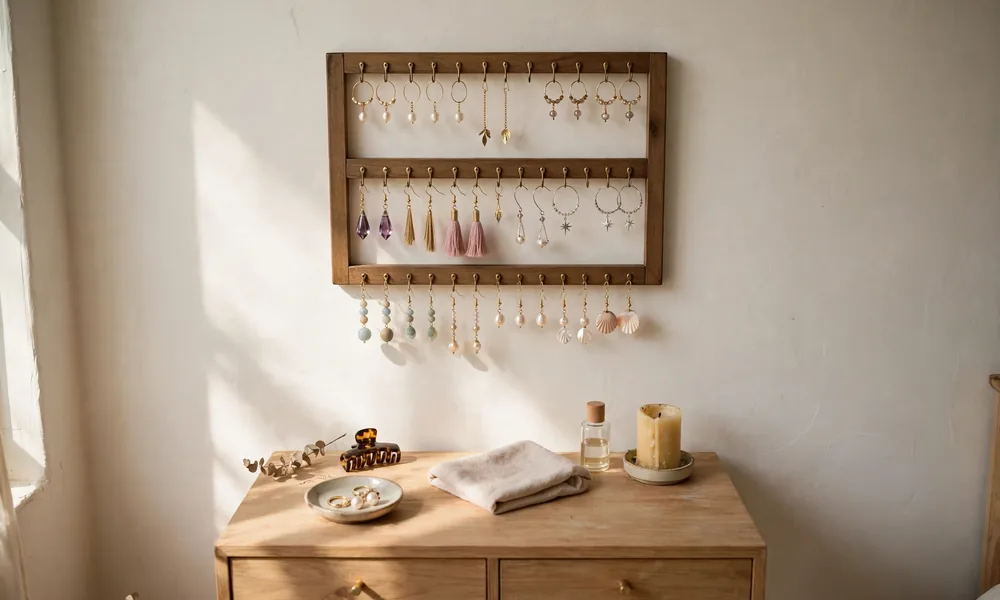
A wall-mounted earring holder is a framed panel, a row of hooks, or a mesh screen fixed to the wall, and it is the best answer when dresser and drawer space have run out. It turns a bare stretch of wall into storage, shows the whole collection at once, and keeps long earrings hanging straight so they never tangle. Hooks hold drops and hoops, while small holes or mesh hold studs. Seeing everything at once means you wear pairs you forgot you owned. Wall holders need more commitment than a tray or a tree: screws in the wall, a proper fixing, and a spot out of direct sunlight. Check the spacing before you buy, because hooks too close together mean long earrings catch on each other.
4. Rotating and Tiered Displays: For Bigger Collections
A rotating display turns on its base so you can spin to the side you want, and a tiered display stacks two or three levels above each other. Both suit a larger daily collection, because they hold more pairs in the same footprint as a single tree. The rotating form suits a corner you cannot walk around; the tiered form suits studs on trays with drops hanging below. The trade-off is stability, so check the base weight before you buy, and spin it the way you would in real life, with pairs hanging on it. A display that wobbles when spun will wobble when you reach for a pair in a hurry.
5. Travel Cases and Rolls: Pairs That Survive the Trip
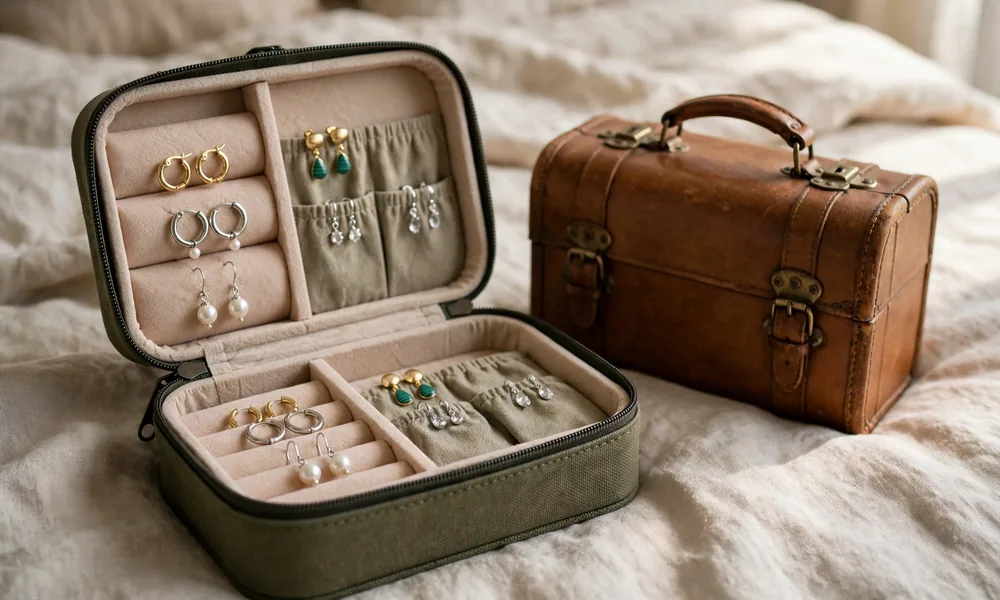
A travel earring case is the only safe way to take earrings away from home, and it is an addition to home storage, not a substitute. A good one is a zippered case with a soft lining, separate compartments, and rolls or strips that hold studs in place. The test is simple: pack the pairs you would actually take, close it, turn it upside down, and shake it gently. If a pair has moved, it will be lost by the time you reach the hotel. Pack only what the trip needs, and keep the case in your hand luggage, never in a checked bag. Backs are the part most people forget, so a good travel case has a small pocket for spare backs. Our guide to what makes a great jewelry organizer worth buying covers travel cases too.
6. Lidded Boxes With Earring Sections: Protection First
A lidded box with earring sections is the classic choice for valuable pairs: a wooden or leather case with a hinged lid and rows of paired holes or small compartments inside. Its strength is protection: a lid that closes properly keeps out dust, light, and air, which stops silver tarnishing and keeps stones from fading. For pairs you wear rarely but value highly, a box is the best home they can have. The weakness is the same as its strength: a box hides everything, so daily pairs are the ones you dig for. Use it as a partner to a display organizer, not a replacement: daily pairs on the tree, occasion pairs in the box. Our guide to jewelry boxes worth buying to protect your collection covers lining, hinges, and locks in detail.
Matching the Organizer to Your Earrings
The layout of a good organizer follows the earring, because each shape fails in its own way. Studs are the easiest to lose: they need holes, small divided sections, or a roll that holds each stud upright. Drop earrings need hooks and hanging space: two drops in one compartment tangle within days, and a drop stored flat bends at the hook. Hoops need a bar or a wide hook that holds their curve, and spacing, because hoops stored flat in a pile scratch each other. Statement earrings, the big, heavy pairs worn for evenings out, need the strongest hooks and the most space, and they belong in a lidded box between wearings. Our comparison of the best vs worst earrings of 2026 covers which metals and clasps last.
Materials: What Touches Your Earrings
The material matters most where the organizer touches the earring. Velvet is the classic lining: soft, dense, and kind to metal and stones. Wood brings warmth and weight, and a solid wooden tree or box lasts for decades if kept dry. Metal suits trees and wall holders: slim, strong, and stable. Acrylic is the clear choice when visibility matters: you can see every pair through it, and it wipes clean in seconds, though it scratches more easily than wood or metal. Leather suits travel cases: light and flexible without adding weight. Avoid cheap plastic, which scratches easily and can mark soft metals, and run a finger over every hole and hook before you buy: if it feels rough to your finger, it will feel worse to your earrings.
The Tarnish Question
Open display has one real cost: tarnish. Silver darkens in air, faster in a humid bathroom or near a window, and a tree or wall holder leaves silver exposed to both. Gold is far more forgiving, and costume jewelry barely cares. The fix is simple: keep display organizers out of the bathroom and out of direct sunlight, keep silver pairs you wear rarely in a lidded box, and clean silver gently before it darkens rather than after. Earrings worn weekly stay brighter than earrings stored for months.
Earring Organizer Checklist
- Count your pairs first, by shape: studs, drops, hoops, and statement pairs need different space.
- Give every pair its own home: studs in paired holes or sections, drops on their own hooks.
- Test stability: pull a pair off one-handed and make sure nothing rocks or topples.
- Measure where it will live, and buy one size bigger than you need today.
- Feel every hole and hook for rough edges, and choose soft lining where earrings rest.
- Keep display organizers out of bathrooms and sunlight; keep rarely worn silver closed away.
Frequently Asked Questions
How many pairs should an earring organizer hold?
As many as you own, plus a few empty spaces. Count your pairs before you shop, then buy an organizer with room for five or ten more. An organizer that is exactly full on arrival will be overflowing within a year.
Are earring trees or trays better for studs?
Trays are better for studs, because a stud needs a small divided section or a hole that holds it upright so it cannot roll. Trees suit drops and hoops, which need to hang.
Can I store all my earrings in one organizer?
Yes, if the organizer has different kinds of space: holes or sections for studs, hooks for drops, and a bar for hoops. Most collections use a tray or box for storage plus a tree or wall holder for daily pairs.
How do I stop earrings from tangling in storage?
Hang drops from their own hooks with space below them, and never pile them in a shared compartment. For travel, use a case with separate pockets or rolls so pairs cannot touch each other.
Will a display organizer tarnish my silver earrings?
It can, because open air and daylight darken silver faster than closed storage. Keep display organizers out of steamy bathrooms and direct sunlight, and keep rarely worn silver in a lidded box.
What is the best earring organizer for travel?
A zippered travel case with a soft lining, separate compartments, and a spare-back pocket. Pack only the pairs the trip needs, and keep it in your hand luggage rather than a checked bag.
The Bottom Line
The best earring organizers of 2026 keep pairs together without asking you to think about it. A tree for the pairs you wear every week, a velvet tray for studs, a wall holder when the collection outgrows the dresser, and a zippered case for trips: each type solves one specific way earrings get lost. Count your pairs, match the organizer to the shapes you own, buy one size bigger than you need, and check the base, the hooks, and the lining before you pay.