
What Makes a Great Jewelry Organizer Worth Buying in 2026?
A jewelry organizer earns its place the morning you stop digging — when necklaces have knotted, earrings have lost their partners, and rings have rolled away. A good organizer gives every piece a fixed home.
The best jewelry organizer of 2026 is not the biggest or prettiest on a shelf. It is the one matched to what you own, where you get dressed, and how your collection is growing. This guide covers all five forms.
Key Takeaways
- Count your collection before you shop: each type needs a different kind of space.
- One form rarely does everything: most collections use a tray or box for storage plus a stand for daily pieces.
- Necklaces need to hang or lie straight in their own channel — a chain in a shared compartment will knot within days.
- Buy for the collection you will have in a year, and leave a few compartments empty.
- Where it lives matters: a cool, dry dresser beats a steamy bathroom.
The Five Organizer Forms, Compared
Every jewelry organizer is a variation on five forms: a box protects, a tray sorts, a stand displays, a wall-mounted organizer shows everything at once, and a travel case keeps pieces safe away from home.
| Form | Best for | Typical capacity | Typical price | Watch out for |
|---|---|---|---|---|
| Lidded box | Protecting a medium collection | 20–40 pieces | $20–$80 | Thin lining, flimsy hinges |
| Open tray / drawer insert | Sorting a growing collection | 40+ pieces | $15–$50 | No lid, so dust gets in |
| Stand | Daily pieces on display | 10–25 pieces | $15–$45 | Exposes silver to air |
| Wall-mounted | Seeing everything at once | 30–60 pieces | $25–$70 | Needs wall fixings |
| Travel case / roll | Trips away | 8–15 pieces | $15–$40 | Weak zips |
1. Lidded Boxes
A lidded box is the classic jewelry organizer: a wooden or leather case with a hinged lid and a fitted tray inside, kept on a dresser. Its strength is protection — a lid that closes properly keeps out dust, light and air, which stops silver tarnishing. For twenty to forty pieces, a box with a tray is the best starting point. Our guide to jewelry boxes worth buying in 2026 covers lining, hinges and locks. A box is one form, not the whole answer: it hides everything, so daily pieces are the ones you dig for.
2. Open Trays and Drawer Inserts
An open tray is a shallow, usually velvet-lined tray that sits inside a drawer or on a dresser top, and it is the best form for a growing collection. Compartments sort each group into its own space: long channels for necklaces, a roll for rings, small sections for earring pairs. Trays stack, so you can add a layer next year. With no lid, a tray works best inside a drawer.

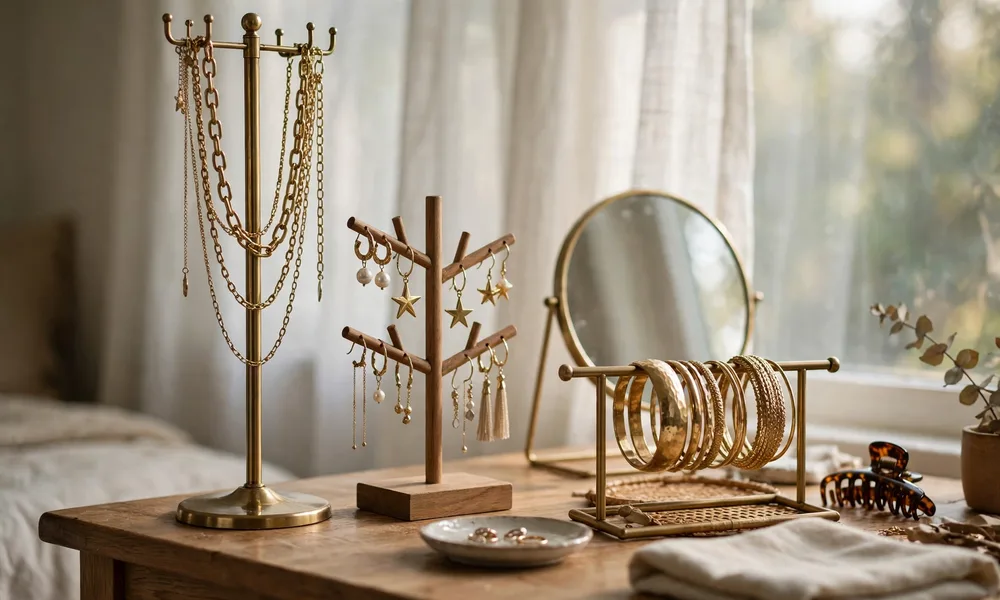
3. Stands: Necklace Stands, Earring Trees and Bracelet Bars
A stand is the only form that displays jewelry instead of hiding it. A necklace stand holds chains hanging straight, so they never knot. An earring tree keeps pairs together and visible. A bracelet bar holds bangles in a row. Stands belong on the dressing table, holding the ten or so pieces you wear most often.
The trade-off is exposure: open air and daylight tarnish silver faster, so stands suit pieces you wear weekly rather than occasion pieces. They also need a stable spot — a toppled stand scatters everything it held.
4. Wall-Mounted Organizers
A wall-mounted organizer — a divided cubby shelf, a row of hooks, or a pegboard — is the best answer when drawer and dresser space have run out. It turns a bare stretch of wall into storage, shows the whole collection at once, and keeps necklaces hanging straight, which is the only reliable way to stop them tangling. Cubby shelves suit earrings and rings; hooks underneath hold necklaces and bracelets.
They need more commitment than a tray: screws in the wall, a proper fixing, and a spot out of direct sunlight. They also make your collection visible to anyone who walks in.
5. Travel Cases and Rolls
A travel case is the only safe way to take jewelry away from home, and it is an addition to home storage, not a substitute. A good one is a zippered case with a soft lining, separate compartments, and straps to hold necklaces flat. The test is simple: turn it upside down and shake it gently. A travel roll is the lighter alternative for a weekend. Pack only what the trip needs, and keep the case in your hand luggage, never in a checked bag.
Organizing by Jewelry Type: Necklaces, Rings, Earrings, Bracelets
The layout of a good organizer follows the jewelry, because each type fails in its own way. Necklaces are the worst behaved: two chains in one compartment will knot within days. They need to hang from hooks, lie straight in their own channel, or sit in a pouch with the clasp fastened — fastening the clasp is the single most effective anti-tangle habit there is.
Rings need rolls or slots that hold them upright, so the stones do not touch — a diamond can scratch every stone it meets. Earrings need paired spaces: holes, small divided sections, or hooks that keep a pair together, because a single earring is the most commonly lost piece in any collection. Studs suit shallow compartments; long earrings need hooks. Bracelets are the easiest group: a wide compartment or a bar. Count each group before you shop.
Materials: Velvet, Wood, Acrylic, Metal and Leather
The material decides how an organizer feels, cleans, and lasts. Velvet is the classic lining: soft, dense, kind to metal and stones, and it stops pieces sliding around. It shows dust and needs a gentle brush, but nothing cushions jewelry as well. Wood brings warmth and weight, and lasts for decades if kept dry.
Acrylic is the clear choice when visibility matters: you can see everything inside, and it wipes clean in seconds. Metal — usually brass or steel — suits stands, because it is slim, strong and stable. Leather suits travel cases: light, and it flexes instead of cracking. Be careful with cheap plastic, which scratches easily and can mark soft metals. Check the lining first — it is what your jewelry touches.
Size: Buy for the Collection You Will Have
The most common mistake is buying an organizer that is exactly full on the day it arrives. A collection grows — a birthday bracelet, earrings from a trip, an inherited necklace — and an organizer full on day one is overflowing within a year. An overflowing organizer is no better than a drawer. Buy one size bigger than you need today.
Measure before you buy, too. A tray a centimetre too wide for its drawer is a tray you will never use. Measure the spot where the organizer will live before you shop. Then measure the collection: count each group, and check the longest necklace against the compartments on offer.
Display or Hidden: What Suits Your Routine
The real choice underneath all the forms is simple: do you want to see your jewelry, or hide it? Display — stands and wall-mounted organizers — makes the morning faster, because you choose from what you can see, and you wear more of what you own. It suits daily wearers with mostly everyday pieces. Hidden storage — lidded boxes and drawer trays — protects better, keeps dust and light out, and suits valuable pieces and silver. Most collections use both: daily pieces on display, the rest behind a lid.
Travel: Taking Jewelry Away From Home
Travel is where most jewelry damage happens: a necklace tossed loose into a suitcase pocket will knot, and a ring rattling against a zip will chip. The fix is a dedicated travel case, packed with the same discipline as home storage: each necklace in its own strap or pouch, clasp fastened, rings in their slots, earring pairs together. Pack the case last and unpack it first.

For a short trip, a travel roll is often enough: a flat sheet with pockets that rolls into a parcel the size of a glasses case, holding eight to twelve pieces. For a longer trip, a structured zippered case with a rigid shell is worth the extra weight. Take only what the trip needs.
Jewelry Organizer vs Jewelry Box vs Makeup Organizer
Three products that sound alike do three different jobs. A jewelry box is one form of organizer, focused on protection: a lidded case whose job is to keep pieces safe from dust, light and each other. A jewelry organizer is the wider idea: the whole system of boxes, trays, stands, wall-mounted storage and travel cases. If a box is a single room, an organizer is the whole house.
A makeup organizer is a different job entirely. It is built for lipsticks, brushes, palettes and bottles — tall, round and spillable things that need upright slots and wipe-clean surfaces — and our guide to the best makeup organizers for a tidy vanity in 2026 covers acrylic drawer units and bamboo trays for exactly those shapes. Jewelry needs the opposite: flat channels, rolls, paired holes, and soft lining. And if your storage needs go beyond jewelry and makeup, our guide to closet organizers that double your storage space in 2026 applies the same thinking at wardrobe scale.
Before You Buy: A Quick Checklist
- Count your collection first, then buy an organizer whose layout matches those numbers, with room to grow.
- Measure the spot where it will live.
- Decide display or hidden: stands and wall shelves for daily pieces, lidded boxes and drawer trays for the rest.
- Check the lining: soft, dense, firmly fixed, with no loose fibres and no rough edges.
- Choose the material for the room: wood and velvet for the dresser, acrylic for visibility, leather for travel.
- Plan where it sits: a cool, dry bedroom dresser or wall, never a steamy bathroom or a sunny windowsill.
Frequently Asked Questions
What is the best type of jewelry organizer?
There is no single best type — it depends on what you own. For most people the best setup is a velvet tray or lidded box for the bulk of the collection, plus a stand for daily pieces.
How do I stop necklaces from tangling in an organizer?
Fasten the clasp before you put a necklace away, then hang it from a hook or lay it straight in its own long channel. Never drop a necklace into a compartment with another chain.
Do jewelry organizers stop silver from tarnishing?
They slow it down a great deal, but they do not stop it completely. A lidded box keeps out most of the air and moisture that cause tarnish, and an anti-tarnish strip absorbs what gets in. Keep silver lidded and wear it often.
Should I store jewelry in the bathroom?
No. A bathroom is the worst room for jewelry: steam and humidity tarnish silver, loosen glue in settings, and dull some stones. Keep your organizer in a cool, dry bedroom.
Can I use a jewelry organizer for watches too?
Yes, but give watches their own space. A watch is heavier than any other piece and will scratch rings and earrings. Use a dedicated watch compartment with a soft cushion.
How big should a jewelry organizer be?
One size bigger than your collection needs today. Count each group, then choose an organizer with a compartment for each and a few spares left empty.
The Bottom Line
A great jewelry organizer in 2026 is the one that fits what you own, where you get dressed, and how your collection is growing: a velvet tray in a drawer for the bulk of it, a stand for daily pieces, hooks on the wall for necklaces, and a travel case for the pieces that leave the house. Count first, measure the space, and buy one size bigger than you need.


