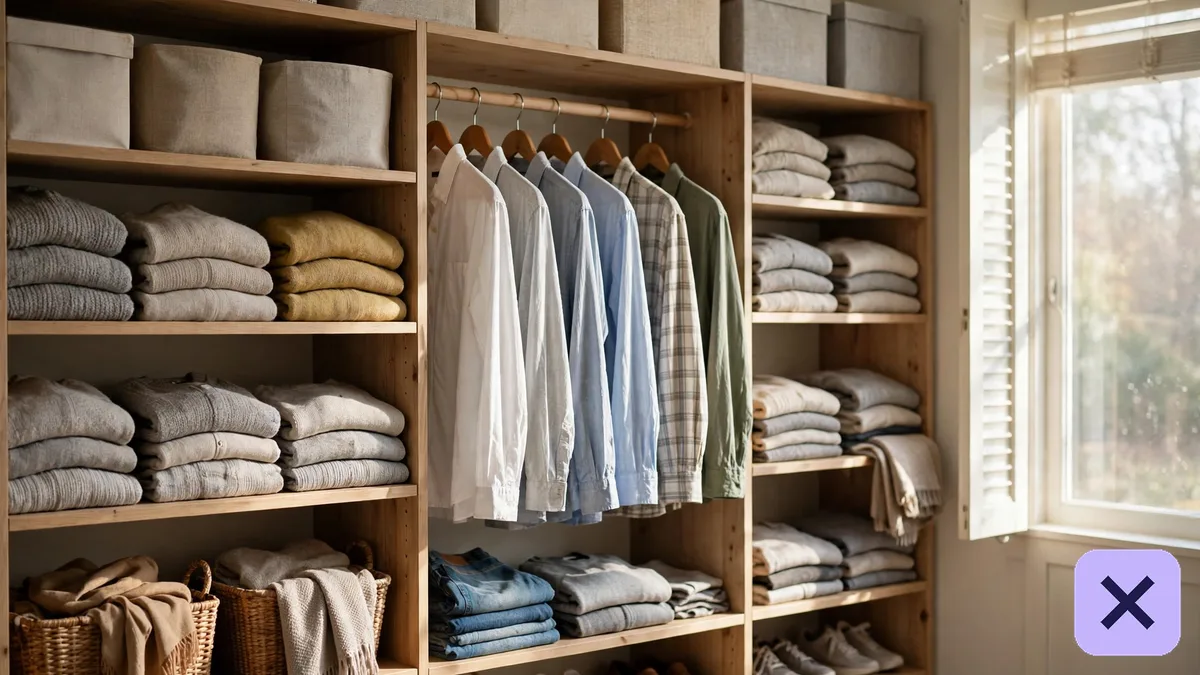
The best closet organizers of 2026 do not give you a bigger closet. They give you the closet you already have, used twice as well. A closet organizer is any system that turns one long rail and a pile on the floor into zones: hanging space, folded space, shoe space and a place for the small things. Most closets waste about half their volume, because a single rail leaves a dead zone above the clothes and a dead zone below them. Fill those zones, and the same small closet suddenly holds a whole wardrobe.
The mistake most people make is buying a pretty set of matching boxes before they have measured anything. A closet organizer only works when it fits the exact width, depth and height of your closet, and when it matches the clothes you actually own. A rail for long dresses is useless if you mostly wear folded jumpers.
Key Takeaways
- Measure the closet first: width, depth, height, and the height of the existing rail before buying any organizer.
- A second rail doubles hanging space instantly, and it is the cheapest big win in any closet.
- Folded clothes belong on shelves, hanging clothes belong on rails, and mixing the two wastes both.
- Shoe racks, drawer dividers and door hooks use the dead zones most closets waste: the floor, the back of the door and the top shelf.
- One category per shelf or box keeps the system working; an unlabelled box becomes a junk drawer within a month.
Why Most Closets Only Hold Half What They Could
Look at a standard closet. There is one rail, about chest height, with clothes hanging from it. Above the rail is a shelf, usually piled with whatever did not fit anywhere else. Below the clothes is the floor, where shoes gather in a heap and bags get tossed. The closet is full, but half of its volume is air: the air above the hanging clothes, the air below the hems, and the air on the shelf that nobody can reach without a stool.
Closet organizers work by claiming that air. A second rail hung lower doubles the hanging space for shirts and trousers. Shelf dividers stop folded stacks from toppling. A shoe rack lifts shoes off the floor into a tidy row. None of these is expensive on its own, and none of them needs a carpenter.
The Organizers That Actually Double Your Space
There are dozens of closet products on the market, but only a handful change how much a closet holds. The rest are decoration: pretty boxes that look organised for a week and then quietly become the same pile in a nicer container. The five systems below are the ones that genuinely add space, and they work in almost any closet, rented or owned, because none of them needs drilling or permanent fixings.
Double hanging rails
The single biggest win. A second rail hung below the first, at about waist height, turns one row of hanging clothes into two. Shirts, blouses, folded trousers and short jackets all fit on the lower rail, while longer items keep the top rail. The trick is the spacing: the lower rail needs enough clearance below it for shoes or a drawer, and the top rail needs enough room above the lower clothes for hangers to slide. Adjustable hanging rails that hook onto the existing rail are the easiest option for renters, because they install in minutes and leave no marks.

Shelf dividers and shelf risers
Folded clothes are the enemy of a tidy shelf, because a stack of jumpers topples the moment you pull one out from the middle. Shelf dividers are simple upright panels that split a long shelf into bays, so each stack has walls to lean on. They cost very little and they stop the slow collapse that turns every shelf into a leaning tower. Shelf risers add a half-height shelf inside a tall space, so you can stack two rows of folded clothes where one row used to sit.
Drawer systems and drawer dividers
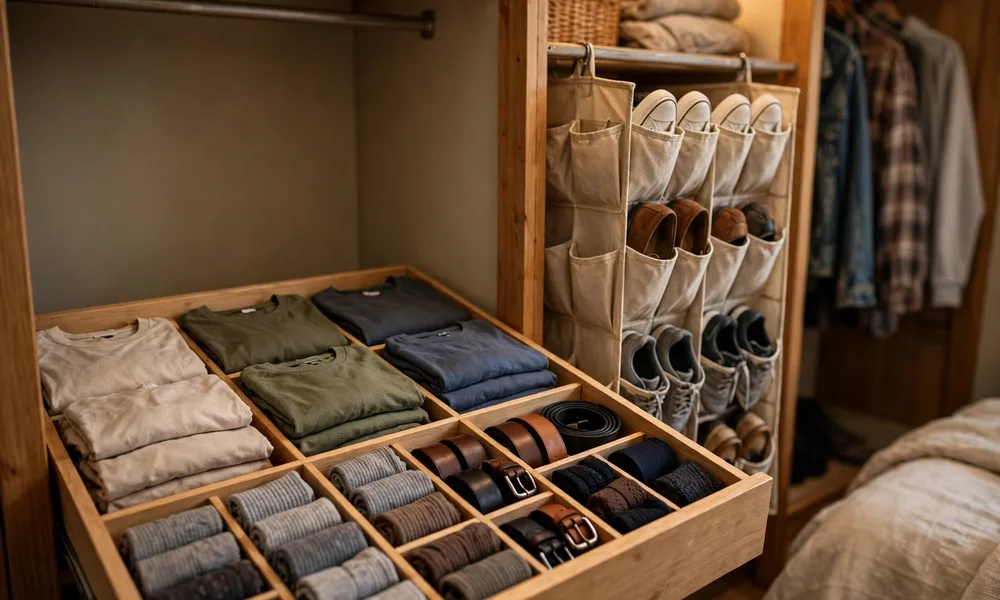
Drawers are where small things go to disappear. Socks, underwear, belts, scarves and ties all end up in one tangled drawer unless something divides them. A drawer organizer, whether it is a set of wooden dividers or a fabric honeycomb, gives every small item its own cell. The effect is bigger than it sounds: when you can see everything at a glance, you stop buying duplicates of things you already own, and getting dressed in the morning takes half the time.
Shoe organizers and door racks
Shoes take up a surprising amount of floor, because a pair left flat takes twice the space of a pair stored upright. A shoe rack with two or three tiers holds a dozen pairs in the space of four, and it keeps them off the floor where they gather dust. Hanging shoe organizers that hook over the closet door use space that is otherwise completely wasted, and they are ideal for flat shoes, trainers and sandals.

Fabric boxes, baskets and hanging cubbies
Fabric boxes on the top shelf hold the out-of-season clothes, the spare bedding and the things you need twice a year. Woven baskets on a lower shelf hold scarves, hats and gloves where you can grab them on the way out. Hanging cubbies, the fabric shelves that hang from the rail, are the fastest way to add shelf space to a closet with no shelves at all, and they are perfect for folded jumpers and jeans. The key is to keep the boxes consistent in size and colour, because matching boxes look calm and make the closet feel bigger, while a jumble of different boxes looks like a storage unit.
Closet Organizers Compared
| Organizer | Space gained | Best for | Needs drilling? |
|---|---|---|---|
| Double hanging rail | Doubles hanging space | Shirts, trousers, short jackets | No |
| Shelf dividers and risers | Stops stacks toppling | Folded jumpers, jeans, linen | No |
| Drawer systems | Uses floor space | Socks, belts, small items | No |
| Shoe racks, door racks | Frees the floor | Everyday shoes, bags, scarves | No |
| Fabric boxes and cubbies | Adds top-shelf storage | Seasonal clothes, bedding | No |
How to Plan Your Closet Before You Buy
Start by emptying the closet completely. It sounds dramatic, but you cannot plan a system around clothes you cannot see, and most people are surprised by how much they own. Sort everything into three piles: keep, store elsewhere, and let go. The keep pile is what the organizer has to hold. Count the hanging items and the folded items separately, because that tells you whether you need more rail or more shelf.
Then measure the closet itself. Write down the width, the depth and the height, and note where the door opens and whether the closet is wider than the door, which creates hidden corners that are hard to reach. Sketch the layout on paper: rails on one side, shelves on the other, shoes at the bottom, boxes on top. A ten-minute sketch saves a hundred pounds of organizers that do not fit.
The Zones Every Good Closet Has
A well-organised closet has four zones, and every item belongs in exactly one of them. The hanging zone holds the clothes that crease: shirts, dresses, jackets and trousers. The folded zone holds the clothes that do not: jumpers, jeans, t-shirts and knitwear. The small zone holds the things that vanish: socks, underwear, belts, jewellery and scarves. And the top zone holds the things you use rarely: out-of-season clothes, spare bedding and luggage.
When each zone has its own organizer, getting dressed becomes a straight line instead of a hunt. You open the door, you see the hanging clothes, you pull a jumper from its stack, you take the shoes from the rack. Nothing is buried. The system also makes it obvious when something does not belong, because an item with no zone stands out immediately.
The Mistakes That Shrink a Closet
The first mistake is buying matching boxes before measuring, which leaves you with beautiful boxes that do not fit the shelf. The second is hanging everything, including jumpers, which stretch out of shape on hangers and take up rail space that shirts need. Fold the knits, hang the shirts, and the closet will thank you.
The third mistake is filling every centimetre. A closet that is packed wall to wall is a closet you cannot use, because you cannot slide a hanger or pull out a box without a struggle. Leave a little air: an empty hanger or two, a gap at the end of a shelf, a box that is not quite full. The system needs slack to stay usable, just as a suitcase needs a little room to close. If you want to see which storage habits backfire, our guide to the worst storage ideas that create more clutter is a useful warning before you spend anything.
Packing for a trip uses the same logic in miniature, which is why the best packing cubes work so well: one category per cube, everything visible at a glance. The same thinking helps in a small bedroom, where the right duvet covers for small apartments keep the bed from swallowing the room.
Your Closet Organizer Checklist
- Empty the closet, sort everything, and count hanging items and folded items separately before buying.
- Measure width, depth and height, and sketch the layout: rails, shelves, shoes at the bottom, boxes on top.
- Add a second rail first, because it is the cheapest way to double hanging space.
- Use shelf dividers for folded stacks and drawer dividers for socks, belts and small items.
- Put shoes on a rack or a door organizer, and keep everyday pairs where you can see them.
- Leave a little slack in every zone, and check the system each season to keep it working.
Frequently Asked Questions
How can I double my closet space without renovating?
Add a second hanging rail, shelf dividers and a shoe rack. Those three changes use the air above and below your existing clothes, and they typically double the usable storage without any drilling or building work.
Are closet organizer systems worth the money?
The simple ones are. A double rail, a set of dividers and a shoe rack cost very little and change how the closet works every day. The expensive fitted systems are worth it only if you own the home and the closet is an awkward shape that off-the-shelf parts cannot fix.
Should I hang or fold my jumpers?
Fold them. Knitwear stretches on a hanger, and folded jumpers stack neatly on a shelf. Hang shirts, dresses and jackets, and fold everything knitted or stretchy.
How do I organize a very small closet?
Use the door and the floor. A door rack holds shoes, bags and scarves, a second rail doubles the hanging space, and a slim shoe rack or a drawer unit uses the floor. Keep only the current season in the closet and store the rest elsewhere.
What is the best way to store shoes in a closet?
On a rack, in pairs, with the everyday shoes at eye level. A two-tier rack holds twice as many pairs as the floor, and a hanging door organizer is best for flat shoes and trainers. Keep occasion shoes in boxes on the top shelf.
How often should I reorganize my closet?
Twice a year, when the seasons change. Swap the summer and winter clothes, check what no longer fits or never gets worn, and take out what does not belong.
The Bottom Line
Closet organizers that double your storage space are not the most expensive ones, and they are not the prettiest sets in the shop. They are the ones that fit your closet, match the clothes you own, and claim the air your closet is wasting: a second rail, shelf dividers, a drawer for the small things and a rack for the shoes. Measure first, sort first, and add the system one piece at a time.