
The best storage bins of 2026 do something no amount of tidying can do on its own: they give every loose thing in the house a fixed address. A storage bin is not just a box. It is the difference between a shelf that looks calm and a shelf that slowly slides back into a pile, because once a category has a container with edges, it stops spreading. The right bins turn the same shelves, the same cupboards and the same garage into a system you can actually keep, instead of a clean-up you repeat every few months.
Most people buy bins the wrong way round. They fall for a colour or a shape, bring home a dozen of the same size, and then discover that half of them do not fit the shelf and the other half swallow small things whole. This guide works the other way, starting with what you are storing and where it lives, then matching the bin to the job.
Key Takeaways
- Measure the shelf before you buy anything: a bin that is one centimetre too tall for its shelf is a bin you will never use.
- Clear bins belong where you need to see at a glance, solid bins where you want the clutter hidden, and fabric bins where the bin itself is on show.
- Buy one size for each job, not one size for the whole house, and keep the sizes consistent so bins stack and line up.
- Lids matter more than looks: snap-on lids keep dust and damp out, while open-top bins are faster for things you grab every day.
- A bin only works if it has one category inside it; mixed bins become junk drawers with handles, however pretty they are.
Why the Right Bin Changes the Whole Room
A room does not get messy because people are lazy. It gets messy because putting things away takes more decisions than leaving them out. When a shelf has no containers, every object needs its own decision: where does this go, what sits next to it, will it fall over. When the shelf has bins, the decision is already made. The batteries go in the battery bin. The spare cables go in the cable bin. The decision is made once, at the shop, instead of every evening.
The Five Bin Types Worth Knowing
Every storage bin on the market is a variation on five basic ideas, and once you know the five, the wall of choice in the shop stops being overwhelming.
Hard plastic bins with lids
The workhorse. A hard plastic bin with a snap-on lid is the right answer for anything stored out of sight: the garage, the loft, under the bed, the top of a wardrobe. The lid keeps dust, damp and insects out, the plastic wipes clean, and the flat top means you can stack them three or four high without a wobble. Clear versions let you see the contents, which matters for seasonal clothes and holiday decorations. Solid colours hide the mess, which matters when the bin sits on an open shelf. Buy the same footprint in two heights if you can, so the stack lines up neatly, and check the lid actually clicks rather than just resting on top, because a lid that slides off in the loft is no lid at all.

Clear stackable bins
Clear bins earn their place anywhere you need to find something fast without opening five lids. The pantry, the craft cupboard, the kids’ toy shelf and the home office all benefit, because you can see at a glance whether the bin holds pasta or printer paper. The trade-off is that clear bins show everything, including the mess, so they reward a little discipline about what goes inside. They also tend to be made from thinner plastic than solid bins, so do not overload them with books or tools.
Fabric cubes and soft bins
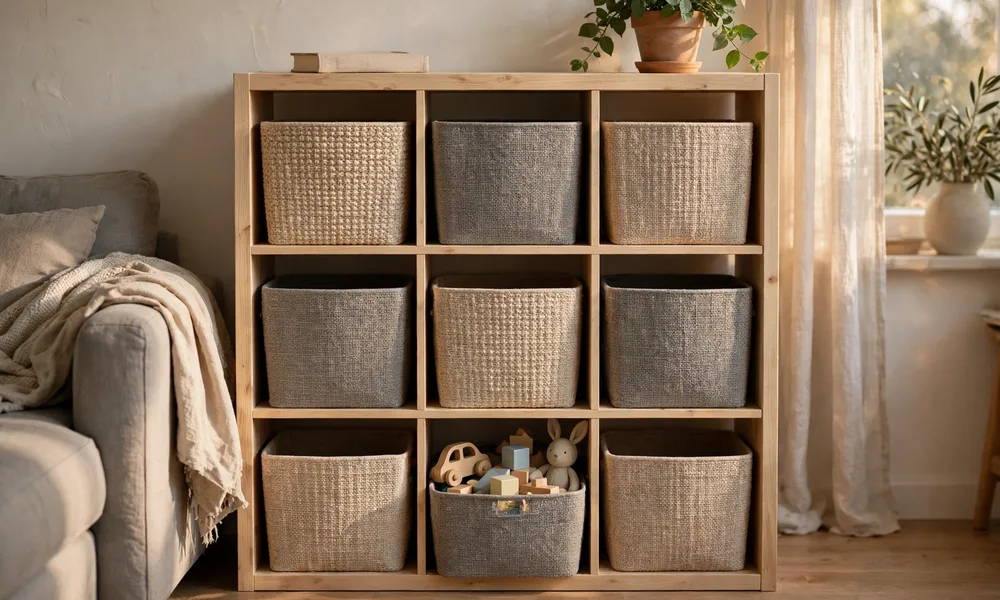
Fabric bins are for the rooms people actually live in. A woven or canvas cube slipped into a shelving unit looks like furniture, not storage, and it hides toys, games, scarves and spare bedding without the hard edges of plastic. They are light, they fold flat when empty, and they come in colours that match a room rather than fighting it. Their weakness is structure: they sag when half empty and they cannot be stacked, so they belong inside a cube shelf or on a shelf of their own, not piled on the floor.
Open-top and front-open bins
Some things get used too often for a lid. The bin by the back door that holds gloves and hats, the one under the kitchen counter for cleaning cloths, the basket for the dog’s toys: these need to be open, because a lid adds a step every single time. Front-open bins are the cleverer version of the same idea. They look like a lidded box from the front, but a cut-out or a drop-down panel lets you pull things out without lifting the bin down from a high shelf. They are the best choice for deep shelves, where a normal bin hides everything behind the first row. Put the things you use weekly in front-open bins and the things you use yearly in lidded ones, and the house starts to run itself.

Under-bed bins and small canisters
The last two types are specialists. Under-bed bins are long, low and usually on wheels, and they turn the dead space under a bed into a whole extra drawer for out-of-season clothes, spare bedding and shoes. Measure the clearance under the bed first, because a bin that is a centimetre too tall will not slide under at all. Small canisters and mini bins belong in the kitchen and the bathroom, where they hold dry food, cotton wool, hair ties and all the tiny things that vanish into a drawer. They are the smallest bins you will buy and the ones you will use most often, so buy them in a matching set rather than one at a time.
Storage Bins Compared
| Bin type | Best for | Watch out for | Price in 2026 |
|---|---|---|---|
| Hard plastic, lidded | Garage, loft, under bed | Lids that do not click shut | Low |
| Clear stackable | Pantry, crafts, office | Thin walls under heavy loads | Low to mid |
| Fabric cubes | Living room, kids’ rooms | Sagging when half empty | Low to mid |
| Open-top, front-open | Daily-use items, deep shelves | Dust on open contents | Mid |
| Under-bed, small canisters | Seasonal clothes, kitchen, bathroom | Wrong height for the space | Low to mid |
How to Size Bins for Real Shelves
Here is the step most people skip, and it is the reason so many bins end up unused. Take a tape measure to the shelf before you go shopping, and write down three numbers: the width of the shelf, the depth, and the height between shelves. Then subtract two centimetres from the width and three from the height. That is the biggest bin that will fit and still come out easily. A bin that fits exactly is a bin that scrapes, sticks and eventually gets left on the floor.
Where Each Type Earns Its Keep
In the kitchen, clear canisters and small bins do the heavy lifting. Dry food stays fresh longer in a sealed container than in a half-open bag, and you can see when you are running low without opening anything. Keep the everyday things at eye level and the rarely used things up high.
In the garage and the loft, hard lidded bins are the only sensible choice. They stack, they keep damp out, and they survive being knocked. Label them on the end you can see when they are stacked, not on the lid, because the lid is the part you cannot see. And in the bedroom, under-bed bins quietly add a drawer you never had, which is often enough to stop the wardrobe from bursting.
The Mistakes That Fill a House With Empty Bins
The first mistake is buying before sorting. If you buy bins and then try to fit your things into them, you will end up with bins that are the wrong size for what you own. Sort first, throw out what you do not need, and only then buy the bins for what is left. Most people find they need fewer bins than they thought, which is a pleasant surprise.
The second mistake is mixing categories inside one bin. A bin labelled “miscellaneous” is a junk drawer with a lid, and it will grow until it is the biggest mess in the house. One bin, one category, no exceptions. The third mistake is buying a dozen identical bins for the whole house. Different rooms need different bins, and a bin that is perfect for the pantry is useless in the garage.
It is also worth knowing which storage ideas do more harm than good, because a bad system is worse than no system at all. Our guide to the worst storage ideas that create more clutter shows the traps to avoid before you spend anything. And if the shelves themselves are the problem, the right bookshelves for small rooms can give your bins a proper home, while a tidy desk starts with the best desk organizers for the small things that never seem to have a place.
Your Storage Bin Checklist
- Measure every shelf first: width, depth and height between shelves, then subtract a little for clearance.
- Sort and declutter before buying a single bin, so you buy for what you actually own.
- Choose the bin type by the room: lidded plastic for garage and loft, clear for pantry, fabric for living spaces.
- Keep one category per bin, and label the end you see when the bins are stacked.
- Buy matching footprints so bins stack neatly, and keep one empty bin spare for what comes next.
- Check the lid clicks, the handles hold, and the bin lifts comfortably when full before you buy a dozen.
Frequently Asked Questions
How many storage bins do I actually need?
Fewer than you think. Sort first and count the categories that are left, not the things. Most rooms need between three and six bins, and a whole house rarely needs more than twenty.
Are clear bins or solid bins better?
Clear bins are better where you need to find things quickly, like the pantry or the craft cupboard. Solid bins are better where you want the clutter hidden, like an open shelf in the living room or a garage.
What size storage bin should I buy?
Buy the size that fits your shelf with a little clearance, and the contents with a little room to spare. A bin that is too big invites clutter, and a bin that is too small means things get crushed.
Do fabric bins last?
Yes, if they live indoors and are not overloaded. Fabric bins last for years in a living room or bedroom, especially the sturdier woven and canvas kinds. They do not last in a damp garage or under heavy weight.
Should storage bins have lids?
Lids belong on bins stored out of sight or for a long time, because they keep dust and damp out. Bins you use every day are faster without a lid, or with a front opening.
How do I stop bins from becoming junk drawers?
Give every bin one category and a label, and set a rule that a full bin means something leaves before anything new goes in. Check the bins twice a year, when the seasons change, and take out what no longer belongs.
The Bottom Line
The best storage bins of 2026 are not the prettiest ones on the shelf, and they are not the cheapest pack of twelve. They are the ones that fit your shelves, suit the room they live in, and hold one category each. Measure first, sort first, and buy for the job.


