
The best bookshelves for small rooms do more than hold books. They draw the eye upward, keep the floor clear, and turn a blank wall into the most interesting part of the room. A badly chosen shelf does the opposite: it crowds the wall, blocks light, and makes a compact room feel like a storage cupboard. The difference is rarely about money. It is about depth, height, colour, and how much of the wall you leave empty.
A bookshelf that makes a small room feel bigger follows a simple rule: it should look light even when it is full. Slim frames, open backs, pale finishes, and shelves that stop short of the ceiling all help. This guide explains which bookshelf styles work in small rooms, how to measure for one, and how to style it so the room feels open rather than crammed.
Key Takeaways
- Tall, narrow bookshelves use vertical wall space and leave more floor free than wide, deep units.
- Open-backed shelves and pale finishes let light and wall colour through, so the unit feels lighter in the room.
- A shelf depth of 25 to 30 centimetres fits most books without jutting into the walking space.
- Leave about a third of each shelf empty, or mix books with open space, to avoid a heavy, cluttered look.
- Measure the wall, the doorways, and the delivery route before ordering, and anchor tall units to the wall.
Why the Right Bookshelf Changes a Small Room
A small room feels cramped when furniture competes for the same few square metres of floor. A bookshelf that stands tall and narrow takes up as little as a third of a square metre of floor, yet it can hold 80 to 120 books. That is the same storage as a wide, low bookcase that eats twice the floor space. In a room of 12 square metres, the difference between those two footprints is the difference between a clear path to the window and a room you have to edge around.
Height matters too. The eye reads a tall shelf as part of the wall, not as an obstacle on the floor, and shelves rising toward the ceiling pull attention upward. A low, wide unit does the opposite: it cuts the wall in half and makes the room feel wider and shorter. For a small room, vertical storage almost always wins.
The Visual Tricks That Make Rooms Feel Bigger
Three details decide whether a bookshelf opens up a room or closes it in. The first is the back panel. An open-backed shelf lets the wall colour show through, so the unit reads as a frame rather than a solid block. The second is the finish. Pale wood, white, or a soft neutral reflects light, while dark walnut or black absorbs it and reads as a heavy mass on the wall. The third is the gap above the top shelf. Leaving 15 to 20 centimetres between the top of the unit and the ceiling keeps the room feeling tall.
Bookshelf Styles Compared
No single bookshelf suits every small room, because the right choice depends on the wall you have, the books you own, and how the room is used. A ladder shelf suits a rented flat because it leans rather than fixes to the wall. A tall narrow tower suits a bedroom corner. Floating shelves suit a wall that already holds a desk or a television.
| Style | Footprint | Best For | Typical Price |
|---|---|---|---|
| Tall narrow tower | 40–60 cm wide | Bedroom corners, narrow walls | $80–$300 |
| Ladder shelf | 50–70 cm wide | Rentals, living rooms | $60–$250 |
| Floating shelves | Wall only | Above desks, small nooks | $30–$150 |
| Low wide bookcase | 100–150 cm wide | Under windows, room dividers | $100–$400 |
| Corner shelf | Corner only | Dead corners, awkward layouts | $70–$220 |
| Built-in alcove shelving | Wall recess | Period homes, chimney breasts | $300–$1,200 |
Prices vary with material. Solid oak or walnut costs two to three times as much as the same design in veneered board or painted MDF, and it lasts far longer. For a shelf that will move between homes, a mid-priced veneered unit is the sensible compromise.
Bookshelf Styles That Work Best in Small Rooms
1. The Tall Narrow Tower
The tall narrow tower is the workhorse of small-room storage. At 40 to 60 centimetres wide and 180 to 200 centimetres tall, it fits the strip of wall beside a door, between two windows, or at the end of a bed. It holds roughly 100 paperbacks across five or six shelves, and because it is narrow, it never dominates the room. Choose one with adjustable shelves so tall art books and short paperbacks can share the unit without wasted vertical space.
The main risk with a tall tower is tipping. Any unit taller than about 150 centimetres should be fixed to the wall with the anti-tip strap supplied in the box, especially in a home with children.
2. The Ladder Shelf
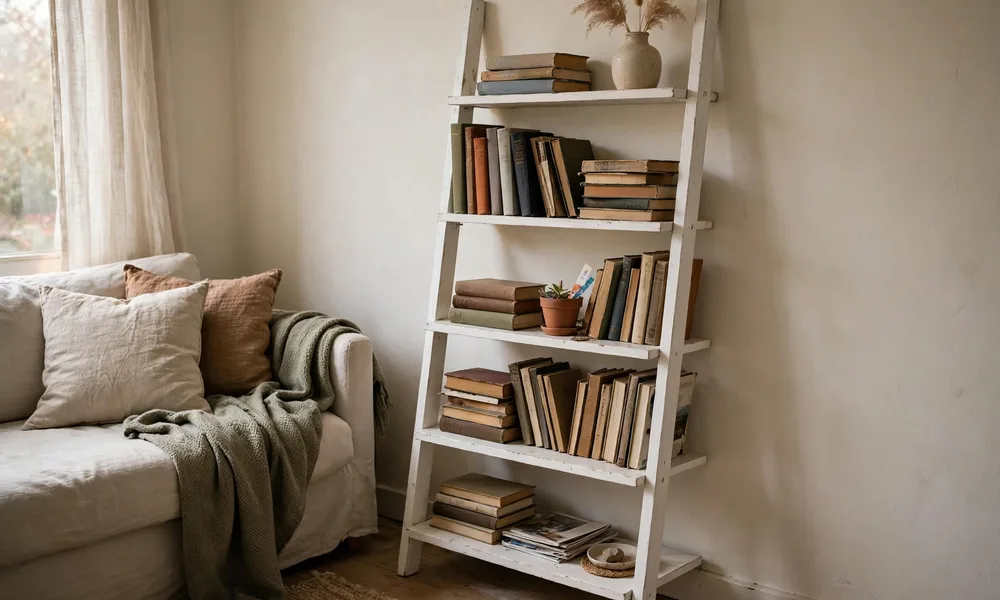
A ladder shelf leans against the wall, with deep shelves at the bottom and shallow ones at the top. That taper is exactly what a small room needs: the bulky books sit low, where the shelf is deepest, while the top shelves hold a plant or a framed print and stay visually light. Because the shelf leans, it needs no wall fixings, which makes it the best choice for rented homes where drilling is not allowed.
Ladder shelves hold fewer books than a tower of the same height, typically 40 to 60, because the top shelves are too shallow for large books. Pair one with a soft throw and a reading chair and the corner becomes a reading nook, and our guide to the cosiest throw blankets for every room covers the finishing touch for that corner.

3. Floating Shelves
Floating shelves use no floor at all, which makes them the lightest-looking option of all. A run of two or three shelves above a desk or a sofa holds the books you reach for most, while the wall below stays free for furniture. They work best in short runs of 60 to 90 centimetres: longer spans sag under the weight of books unless they are fixed into studs or solid masonry with proper brackets.
The trade-off is capacity: a run of three shelves holds perhaps 30 to 40 books, so they supplement a main bookshelf rather than replacing one. They also demand honest fixings: use ones rated for at least twice the weight you plan to load, or a shelf can pull out of plasterboard under a row of hardbacks.
How to Measure Before You Buy
Start with the wall: measure the width of the space at floor level and at the height the top of the shelf will reach, because walls in older homes are rarely straight and a shelf that fits at the bottom can jam at the top. Then measure the ceiling height and subtract the 15 to 20 centimetres of breathing room you want above the unit.

Styling a Bookshelf So It Looks Bigger, Not Busier
A styled bookshelf follows the same rule as a small room: less is more, and empty space is part of the design. Aim to leave about a third of each shelf empty. Mix vertical rows of books with a short horizontal stack, and put one object, a vase, a plant, or a framed photograph, on each shelf rather than three. Group books by size so a row of similar height reads as a single calm band.
Colour matters too. Grouping the loudest spines together calms the whole unit, and if the shelf sits opposite a television, keep the styling calmest at screen height. Our guide to the best smart TVs for living rooms is worth reading if the shelf and the screen share a wall.
What to Avoid in a Small Room
The most common mistake is buying a bookshelf that is too deep. A shelf 40 centimetres deep holds books with room to spare, but it also juts 10 to 15 centimetres further into the room than a 25-centimetre shelf, and in a small room that is a real loss of walking space. Unless you own oversized art books, 25 to 30 centimetres of depth is enough.
The second mistake is filling every shelf to the brim, which makes the wall feel heavier. The third is buying a dark, bulky unit because it looked good in a large showroom: a heavy dark bookcase that looked elegant there can feel like a wardrobe in a 12-square-metre room. Our guide to the worst furniture buys for small spaces explains the same trap. The fourth mistake is forgetting the weight: a full bookshelf can weigh 80 to 120 kilograms, so check shelf thickness is 18 millimetres or more for spans over 60 centimetres, or the shelves will sag within a year.
Bookshelf Buying Checklist
- Measure the wall at floor and ceiling height, the ceiling height, and the narrowest doorway on the delivery route.
- Choose a depth of 25 to 30 centimetres unless you own oversized art books that need more.
- Pick a tall narrow unit for corners and narrow walls, and a low wide unit for under windows.
- Check shelf thickness is at least 18 millimetres and shelves are adjustable for mixed book sizes.
- Fix any unit over 150 centimetres tall to the wall with an anti-tip strap.
- Leave a third of each shelf empty when styling, and keep the top 15 to 20 centimetres below the ceiling.
Frequently Asked Questions
What size bookshelf is best for a small room?
A tall narrow unit, 40 to 60 centimetres wide and 180 to 200 centimetres tall, is usually the best fit. It stores 80 to 120 books on a third of a square metre of floor and fits the narrow strips of wall that small rooms often leave free.
How deep should a bookshelf be?
For most books, 25 to 30 centimetres is ideal: a paperback is about 15 centimetres deep and a hardback about 17. Only oversized art books, which can be 35 centimetres deep, need a deeper shelf.
Do open shelves or closed cabinets look better in small rooms?
Open shelves usually look lighter, because the wall colour shows through and the unit reads as a frame rather than a solid block. Closed cabinets hide clutter but add visual weight. A good compromise is open shelves for the books you use most, with one closed section or a basket on the lowest shelf.
How do I stop a tall bookshelf from looking cluttered?
Leave about a third of each shelf empty, group books by height, and put no more than one decorative object on each shelf. Mix a vertical row of books with one short horizontal stack per shelf, and keep the brightest spine colours together.
Should I fix my bookshelf to the wall?
Yes, if it is taller than about 150 centimetres, or if children use the room. A loaded bookshelf is heavy and top-heavy, and it can tip forward if a child climbs it. The anti-tip strap supplied with most units takes ten minutes to fit. In a rented home, a freestanding ladder shelf is the alternative.
Can a bookshelf make a small room feel bigger?
Yes, if it is the right one. A tall, narrow, pale bookshelf with an open back draws the eye upward, reflects light, and keeps the floor clear, all of which make a room feel taller and more open. A dark, deep, overfilled bookcase does the opposite, so the choice of unit matters more than the fact of having one.
The Bottom Line
The best bookshelves for small rooms are tall, narrow, pale, and open-backed, with a depth of 25 to 30 centimetres and shelves you can adjust. Measure the wall, the ceiling, and the delivery route before you order, fix tall units to the wall, and style the shelves with a third of each one left empty. Done right, a bookshelf does not take space from a small room: it gives the room its height back.


