
A bookshelf is one of the few pieces of furniture that has to work hard every single day and still look good doing it. It holds the books you reach for most, the ones you mean to read one day, and the objects that make a room feel like yours. A good bookshelf disappears into the room in the best way: the books are easy to reach, the shelves stay level, and the whole unit feels solid and calm. A bad one is impossible to ignore, because it leans, sags, or sheds books onto the floor at the worst possible moment. That is why a bookshelf deserves the same careful choice as a sofa or a bed.
The difference between the best and the worst bookshelves in 2026 is not mainly about price or style. The best bookshelves are built from materials that can carry real weight, joined in ways that stay square, and sized for the books they actually hold. The worst look almost identical in a photograph, yet they are made from thin particleboard, held together with small plastic fixings, and finished in a way that chips the first time a book is pulled out roughly. For small rooms in particular, our guide to bookshelves that make small rooms feel bigger in 2026 looks at tall narrow units, open backs, and pale finishes in more detail.
Key Takeaways
- A good bookshelf carries weight without sagging: thick shelves, solid sides, and a fixed back panel are the signs that matter most.
- Depth matters more than height: 25 to 30 centimetres fits most books, while shelves deeper than 35 centimetres waste space and hide things at the back.
- Adjustable shelves are worth having, because books come in very different heights and a fixed shelf always wastes space somewhere.
- Tall bookshelves must be anchored to the wall, especially in homes with children, because a loaded shelf can tip forward without warning.
- Leave breathing room on every shelf: a shelf that is packed edge to edge looks heavy, and books that are crammed in are hard to take out.
What Makes a Bookshelf Good or Bad
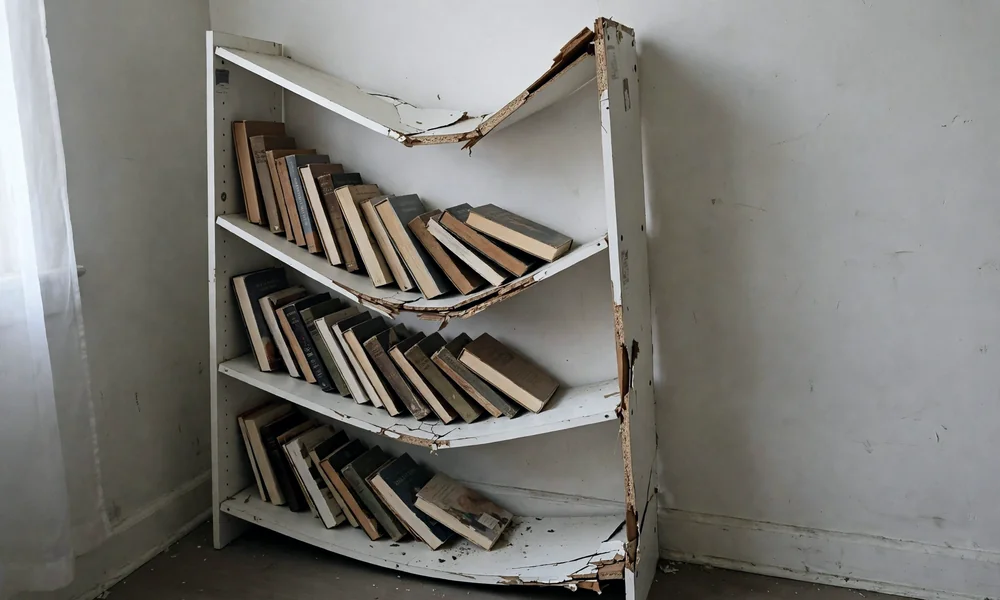
Strength is the first thing to check, and it matters more than any other feature. A bookshelf is not a display cabinet: a single shelf of ordinary hardbacks can weigh 15 to 20 kilograms, and a tall unit can carry well over 100 kilograms in total. A good bookshelf uses thick shelves, usually at least 18 millimetres of solid wood or good plywood, with sides that are just as substantial and a back panel that is fixed firmly rather than tacked on with staples. A bad bookshelf uses thin particleboard shelves that bow under a row of paperbacks within a few months, and sides so flimsy that the unit twists out of square when it is moved across the room.
Construction is the second thing, and it decides whether a bookshelf lasts a decade or a single house move. A good unit is joined with dowels, screws, or proper wood joints, and the fixings are hidden or neatly finished. The shelf supports should be metal pins or solid wooden pegs that sit firmly in their holes, not small plastic clips that crack and let a shelf drop one corner at a time. A bad unit relies on cam locks and thin dowels that work loose, and the first sign of trouble is usually a shelf that sits slightly uneven, followed by a side panel that starts to separate from the top.
Sizing is the third thing, and most people get it wrong in both directions. A shelf that is too shallow leaves books sticking out at the front, where they catch on sleeves and get knocked over. A shelf that is too deep pushes books to the back, where they are hard to reach and harder to see. Height between shelves matters too: paperbacks need about 20 centimetres, hardbacks about 25, and tall reference books closer to 35. A bookshelf with adjustable shelves lets you set each gap to the books on it, and that single feature can double how much a unit holds without looking crowded.
Finish and stability are the fourth thing, and they decide how a bookshelf ages in a real home. A good finish is smooth, hard-wearing, and easy to dust, with edges that are sealed so they do not chip when a heavy book is slid along them. A bad finish is a thin printed foil that peels at the corners and shows every scratch, and a base that rocks because the frame is not square. Stability is also a safety matter: any bookshelf taller than about 120 centimetres should be fixed to the wall with the strap or bracket supplied, and the fixing should be checked once a year.
The Best Side: Bookshelves That Earn Their Place
Solid wood bookshelves are the best choice for most homes, because they combine strength, repairability, and a finish that improves with age. Oak, ash, and walnut shelves carry heavy loads without sagging, and a scratch can be sanded out and re-oiled rather than lived with forever. The best ones have thick shelves, a solid back, and a frame that feels heavy when you try to move it, which is a good sign: weight usually means real material rather than hollow board. A solid wood shelf also suits almost any room, from a formal living room to a relaxed reading corner, without ever looking out of place. A well-made solid shelf also takes a repair gracefully, which a foil-covered board never does.

Tall narrow bookshelves are the best choice for rooms where floor space is scarce, because they use the wall instead of the floor. A unit 40 to 60 centimetres wide and 180 to 200 centimetres tall can hold 80 to 120 books while taking up less than a third of a square metre of floor, which is the same storage as a wide low bookcase that eats twice the space. The best ones have a narrow footprint, a solid back, and a wall fixing, so they feel like part of the room rather than a piece of furniture squeezed into it.
Low wide bookcases are the best choice for living rooms and open-plan spaces, because they store books without dominating the wall. A unit 100 to 150 centimetres wide and 80 to 100 centimetres tall holds a good collection at a height where every book is easy to reach, and the top becomes a useful surface for a lamp, a plant, or a row of framed photographs. The best ones are heavy and stable, with shelves that stay level even when fully loaded, and they work well under a window or along a wall that already holds a television. Our guide to dressers that actually hold everything in 2026 covers the same thinking for storage that has to work every day: solid construction, sensible sizing, and drawers or shelves that do not fight you.
The Worst Side: Bookshelves That Let You Down
Thin flat-pack particleboard bookshelves are the worst buy for anyone with a real collection of books, because they are designed to look adequate in a photograph and fail under a normal load. The shelves are often only 12 to 15 millimetres thick, the sides are hollow or thin, and the back is a sheet of hardboard held on with staples. Within months, the middle of each shelf bows downward, books start to lean, and the whole unit develops a slight twist that makes the doors or the top sit unevenly.

Bookshelves that are too deep or too tall for their books are the worst waste of space, because they look full while holding very little. A shelf 40 centimetres deep with paperbacks pushed to the back leaves a dead strip at the front that collects dust and nothing else, while a shelf with 45 centimetres between levels wastes the top half of every gap. A bookshelf should be bought for the books you own, not for the photograph on the box, and if your tallest book does not fit, the shelf has already failed its main job.
Choosing by Room: Living Room, Bedroom, Office, and Hallway
For the living room, choose a bookshelf that can hold a mixed collection and still look calm. A low wide bookcase or a pair of tall narrow units flanking a fireplace or a television both work well, and the best arrangement mixes books with a little open space rather than packing every shelf edge to edge. For the bedroom, choose a tall narrow unit that fits a corner and holds the books you actually read in bed, with a shelf at arm height for the book you are reading now.
For the hallway, choose a shallow unit that does not block the path, with shelves deep enough for paperbacks and a top that can hold keys and post without cluttering the books below. Wherever the shelf stands, keep the heaviest books low, the books you reach for most at eye level, and the lightest books and ornaments at the top, so the unit stays stable and easy to use. The same eye for balance applies to the pictures and objects around it, and our comparison of the best and worst photo frames in 2026 shows how a good frame can lift a shelf while a cheap one drags the whole display down.
How to Test a Bookshelf Before You Buy
Test a bookshelf the way it will be used, not the way it is displayed. Press down firmly in the middle of a shelf and watch for flex, push the unit gently from the side and watch for wobble, and pull a shelf support out to see whether it is metal or flimsy plastic. Measure the books you own before you shop, and take the tallest one with you if you can, because a shelf that cannot hold your largest book is the wrong shelf. If the shop will not let you test it, buy from a seller with a proper returns policy and load it at home on the first day: if a shelf bows under your books, send it back. Keep the receipt until the shelf has carried a full load for a week.
The Verdict
The best bookshelves in 2026 are the ones that are built to carry books, not just to display them. They have thick shelves, solid joints, adjustable heights, and a back panel that keeps the whole unit square, The worst bookshelves are the ones that look fine empty and fail once they are loaded: thin shelves that bow, weak fixings that work loose, and sizes that waste the space they were meant to save.
Buy the smallest shelf that holds your collection properly, test it under a real load, anchor it to the wall, and spend a little more on the unit that will hold your books every day than on the one that merely fills a wall. It is the one that stays level, stays square, and still looks good after years of daily use. That is the test that matters, and it is the test the best bookshelves pass.


