The worst furniture buys for small spaces are usually the largest, heaviest items in the showroom. They promise comfort and storage, but a small flat has no space to spare. One oversized sofa or deep wardrobe can decide whether a room feels calm or constantly in the way.
Small-space living rewards furniture that earns its footprint. A good piece does more than one job, leaves clear paths, and lets light reach the far wall. The worst buys block windows, swallow floor space, and make opening a drawer feel like a negotiation.
This guide looks at the furniture that most often goes wrong in small spaces, why each piece causes trouble, and what to buy instead, so you can choose pieces that fit the room you actually have.
Key takeaways
- Measure the room, doorways, stairs and lift before buying anything large, and leave at least 75 centimetres of clear walking space.
- Oversized sectionals, deep wardrobes and bulky coffee tables are the most common small-space mistakes.
- Choose furniture with legs, light colours and more than one use, such as storage ottomans and fold-away tables.
- Dark, tall and solid pieces block light and make a small room feel smaller, even when the floor area is the same.
- Buy for the room you have now, not for a future home, and test the layout on paper before you spend anything.
Why Small Spaces Punish Big Furniture
A large room forgives a large sofa. A small room does not, because the same piece takes a far larger share of the floor and the light. When a sofa fills two walls, there is no place left for a side table or a clear route to the kitchen.
Scale is easy to misjudge in a shop. Showrooms have high ceilings and wide aisles, so a three-metre sectional looks reasonable there and enormous at home. Depth matters too: a sofa 110 centimetres deep leaves far less room in front of it than one 90 centimetres deep.
Light, Air and Movement Matter Most
Many people buy big furniture for more storage or seating, but the result is often a darker room that is harder to move through. Before buying, ask whether you can walk through without turning sideways and whether every door and drawer can open fully.
The Oversized Sectional Sofa
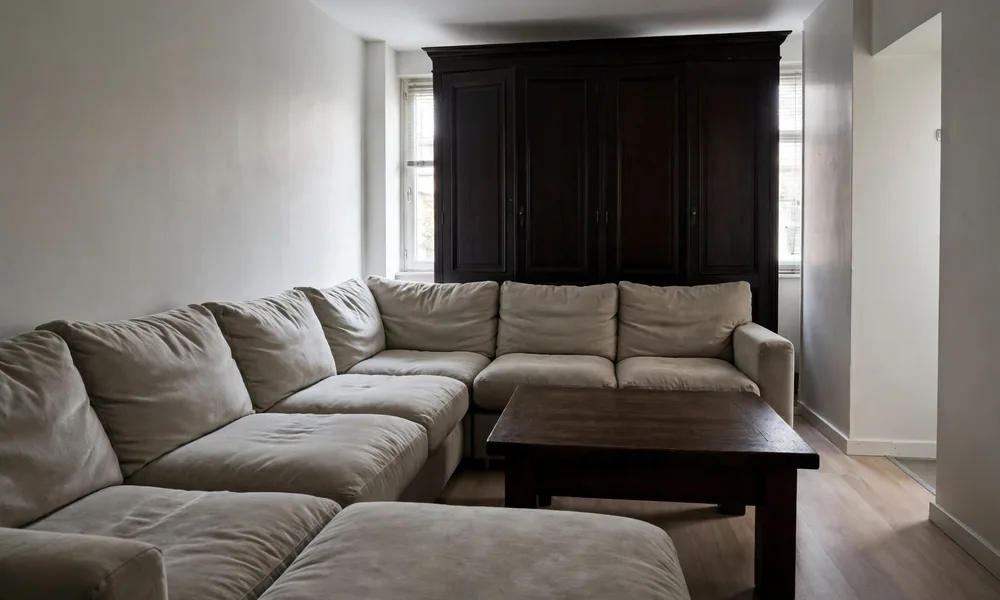
The oversized sectional is the classic small-space mistake. It promises seating for everyone, but in a compact living room it fills the longest wall and turns the corner, leaving no room for anything else. It also locks the layout in place, so rearranging the room becomes almost impossible.
A smarter choice is a compact two-seater or slim three-seater with narrow arms and visible legs, plus one accent chair that can be moved. Look for a seat depth of 90 to 95 centimetres and a low back. A chaise or separate ottoman gives stretch-out comfort without fixing the whole room around one shape.
The Deep, Dark Wardrobe
A tall, deep wardrobe can feel like the answer to a lack of storage, but in a small bedroom it often creates a bigger problem. A wardrobe 65 centimetres deep and two metres tall dominates the wall and blocks light from the window beside it.
Dark finishes make the effect worse, because they absorb light and draw the eye. A pale or mirrored finish reflects light and helps the room feel wider. Sliding doors save swing space but only open half the wardrobe at a time, so a shallower wardrobe with hinged doors is often more useful.
The Bulky Coffee Table
A large, solid coffee table looks inviting in a shop, with books and candles arranged on top. In a small living room, it becomes an obstacle between you and the sofa, the television and the door. Heavy stone or solid wood is hard to move when you need floor space, and it anchors the centre of the room.
A better option is a small round table, a nesting pair, or a lightweight ottoman that doubles as a table with a tray. Round shapes are easier to walk around, nesting tables can be pulled out only when needed, and an ottoman adds soft seating without sharp corners.
The King-Size Bed in a Small Bedroom
A king-size bed is a luxury in a large bedroom and a burden in a small one. When the bed fills the room from wall to wall, there is no space for bedside tables, no room to make the bed properly, and no clear path to the wardrobe. A heavy frame makes it worse, adding 20 centimetres in every direction.
Before buying a larger bed, leave at least 60 centimetres on each side for walking and making the bed, plus space for the wardrobe doors to open. If a king-size bed leaves less than that, a queen or a double will serve you better.
The Large Dining Table
A big dining table promises family meals, but in a small home it often sits empty most of the week while taking up the best part of the living area. A table for eight in a room that usually seats two is wasteful, and it leaves no room for chairs to be pulled out.
Fixed tables are the worst version of this mistake, because they cannot shrink when they are not needed. A drop-leaf or extendable table can be small on an ordinary evening and large when guests arrive. Choose a table for the everyday number of people in the home, not the largest number you might ever host.
Heavy Bookcases and Display Cabinets
Bookcases and display cabinets promise a place for everything, but a tall, deep bookcase against every wall turns a small room into a corridor lined with furniture. Open shelving is particularly unforgiving: every item is visible, every gap shows dust, and a crowded shelf reads as mess even when it is tidy.
Closed storage hides the clutter and lets the room breathe. A single cabinet with doors will usually serve a small room better than three open bookcases. Designers warn about the same problem in hotels, and the worst hotel design traps show how quickly a small space feels smaller when every surface is filled.
Oversized Recliners and Armchairs
A large recliner promises the most comfortable seat in the house, but in a small room it needs space in every direction: space in front for the footrest, space behind for the back to tilt, and space at the sides for the wide arms. A chair 90 centimetres wide when closed can need 160 centimetres when fully reclined.
Bulky armchairs have a similar effect on a smaller scale. A slim accent chair with a separate footstool gives most of the comfort with far less commitment, and the footstool can be moved aside when it is not needed.
Tech-Heavy Entertainment Units
Large entertainment units were designed for a time when a television, a DVD player, a games console and a sound system all needed a home. In a small modern living room, a wide, deep unit often holds little more than a streaming box and a router, while taking up a metre and a half of wall.
A wall-mounted television with a slim floating shelf or a small media console is usually enough, and it leaves the floor visible underneath. Choose a unit no wider than the television and no deeper than 40 centimetres. The same clutter problem applies to gadgets, and the worst smart home devices are a reminder that more technology in a small room often means more frustration.
Comparing the Worst Buys at a Glance
The table below sums up the worst furniture buys for small spaces, the main problem each causes, and the smarter alternative.
| Furniture buy | Main problem | Better alternative |
|---|---|---|
| Oversized sectional sofa | Fills two walls and locks the layout | Slim two-seater plus movable accent chair |
| Deep, dark wardrobe | Blocks light and dominates the bedroom | Shallower wardrobe in a pale finish |
| Bulky coffee table | Blocks walking routes and bruises shins | Small round table or nesting tables |
| King-size bed | Leaves no room to walk or make the bed | Queen bed with under-bed storage |
| Large fixed dining table | Sits empty while taking the best floor space | Extendable or drop-leaf table |
| Tall open bookcase | Adds visual clutter on every wall | One closed cabinet, some empty shelves |
| Oversized recliner | Needs far more space when fully open | Slim chair with a separate footstool |
| Wide entertainment unit | Deep unit serving a few small devices | Wall-mounted TV with a slim shelf |
How to Test Furniture Before You Buy It
The best defence against a bad buy is a tape measure and a little patience. Measure the room, note the doors, windows and sockets, and draw the layout on paper or in a free planning app, adding the furniture to scale.
Mark the footprint on the floor with masking tape before you order, and check the delivery route against the packaged dimensions, not just the assembled size.
Small-Space Furniture Checklist
Use this checklist every time you consider a large piece for a small room. If a piece fails more than one item, it is probably the wrong buy.
- Measure the room, the doorways, the stairs and the lift, and compare them with the packaged size of the furniture.
- Leave at least 75 centimetres of clear walking space on the main route through the room.
- Check that every door, drawer and cupboard can open fully without hitting another piece.
- Choose legs, pale finishes and open bases that let light and sightlines pass underneath.
- Pick furniture that does more than one job, such as a storage ottoman or a fold-away desk.
- Mark the footprint on the floor with tape and live with it for a day before you order.
Frequently Asked Questions
What is the single worst furniture buy for a small space?
The oversized sectional sofa is usually the worst buy, because it fills the longest wall, turns the corner and locks the whole layout in place. A slim two-seater with a movable chair gives comfortable seating without surrendering the room.
How much walking space should I leave in a small living room?
Leave at least 75 centimetres on the main route through the room, and 60 centimetres beside a bed. Less than that feels cramped and turns everyday movement into a shuffle.
Are dark furniture colours always bad in small rooms?
Dark colours are not always bad, but they absorb light and make a piece look larger, so they are risky on tall or wide items such as wardrobes. A dark accent chair or small dark table can work well.
Should I buy multi-purpose furniture for a small home?
Yes, in most cases. A storage ottoman, a fold-away desk, a sofa bed or an extendable dining table lets one piece do the work of two. Check that each function is genuinely comfortable, because a piece that does two jobs badly is worse than two good ones.
How do I make a small room feel calmer without buying new furniture?
Start by removing one large or unnecessary piece, clearing surfaces and letting light reach the seating area. Soft colours, fewer visible objects and a clear floor make a noticeable difference, and a quiet home often comes from what you take away as much as from what you add.
Can a small space still have a large television or a king-size bed?
It can, but only if the room genuinely has the space after you leave clear walkways and room for doors and drawers to open. Measure honestly, mark the footprint on the floor, and choose the smaller option if the large one leaves less than 60 centimetres of clear space.
The Bottom Line
The worst furniture buys for small spaces share one fault: they were chosen for the showroom, not for the room at home. Measure first, choose slim and multi-purpose pieces, leave clear walking space and some empty wall, and your small home will feel larger, calmer and easier to live in.