Why Garden Fountains Add Calm to Any Garden in 2026
A garden fountain changes the feel of a garden the moment the water starts moving. The soft sound of falling water covers traffic noise, the movement catches the light, and a still corner becomes a place you want to sit beside. Garden fountains are decorative water features, made to be looked at and listened to, and the best of them add calm to any garden, large or small. This guide explains why fountains work so well, which types suit which gardens, and how to choose, place and care for one.
Calm is the real reason people buy a fountain. The sound of moving water is steady and even, which helps the mind settle, and watching water fall is quietly absorbing in a way a static ornament never is. Birds come to drink at the edges, bees visit on hot days, and the air around a fountain feels cooler in summer. A fountain is different from the machinery that keeps a pond alive: a pond pump circulates pond water through a filter to keep it clear, while a garden fountain is a decorative water feature whose job is beauty and sound.
Key takeaways
- A garden fountain is a decorative water feature: its job is beauty, sound and calm, not filtration.
- Choose the size to match the space: a large fountain overwhelms a small patio, a tiny one vanishes in a big lawn.
- Solar fountains suit sunny spots with no mains power; mains fountains run steadily day and night.
- Place the fountain where you can see and hear it from your favourite seat, not hidden at the back.
- Top up the water regularly and clean the pump intake, because a dry pump burns out fast.
Why moving water calms a garden
Moving water affects a garden in three ways at once. First there is sound: a gentle trickle masks traffic and neighbours, replacing them with something the ear accepts without effort. Second there is movement: falling water catches sunlight through the day, so the fountain never looks the same twice. Third there is life: birds, bees and butterflies are drawn to open water, and a fountain with a shallow edge becomes a daily visiting point. Together they turn a garden from a view into a place, which is why fountains suit seating areas and patios better than a far corner.
There is also a practical side. A fountain cools the air around it slightly as water evaporates, which matters on a hot patio. It gives a garden a focal point, which makes even a modest garden feel designed. And unlike a pond, a fountain needs no fish, no filter and no deep water, so it fits gardens where a pond would be unsafe or impractical.
The main garden fountain types, compared
| Type | Best for | Strengths | Watch out for |
|---|---|---|---|
| Tiered stone fountain | Traditional gardens, lawns | Classic look, soothing cascade | Heavy, needs a level base |
| Wall fountain | Small gardens, patios | Takes no floor space | Needs a wall and power nearby |
| Solar fountain | Sunny spots, no mains power | No running cost, easy to move | Stops in shade and at night |
| Modern minimalist fountain | Contemporary gardens | Calm, sculptural, quiet | Shows limescale and leaves |
| Resin fountain | Budgets, first fountains | Light, cheap, easy to place | Can look plain up close |
Best Overall: A Tiered Stone Fountain
The classic tiered stone fountain is still the best all-round choice for most gardens. Water rises to the top tier, spills gently into the next, and falls again into a wide basin, making a soft, layered sound that carries without ever being loud. Stone ages gracefully: it weathers, mosses slightly at the edges, and looks more at home each year. Place it at the centre of a lawn or the end of a path, where it can be seen from the house, and plant low lavender around the base to soften the stone.

Best for Small Gardens: A Wall Fountain
Small gardens need a fountain that gives the sound and movement without taking the floor. A wall fountain does exactly that. It fixes to a fence or garden wall, with water spilling from a spout into a shallow basin below, and takes up no more room than a hanging basket. The sound is close and intimate, which suits a courtyard or a patio where you sit a metre or two away. Choose a basin deep enough that the water does not splash out in a breeze, and site it where you can reach it easily to top it up.
Best for Sunny Spots: A Solar Fountain
A solar fountain is the simplest fountain to own. A small panel powers a pump in the basin, and on a sunny day the water dances without a cable, a plug or a running cost. Solar fountains suit bird baths, small ponds and any sunny corner far from the house, and they are easy to move. The trade-off is the sun: on a cloudy day the spray weakens, and at night it stops, so a solar fountain is a daytime feature. Keep the panel in full sun and choose a model with a battery if you want the water to keep moving into the evening.
Best Modern Pick: A Minimalist Stone Fountain
For a contemporary garden, a minimalist fountain is the calmest choice. A thin sheet of water slides over a single slab of dark stone or steel into a narrow channel, making almost no splash and a very soft sound. There is nothing to look at except the water and the stone, which is the point: the fountain becomes a quiet sculpture rather than a decoration. It suits gardens with clean lines and gravel, and sits well beside a bench. The smooth surfaces show limescale and leaves, so wipe it down weekly and use rainwater for topping up.
Best Budget Pick: A Resin Fountain
A resin fountain is the sensible first fountain. It is moulded to look like stone or terracotta, weighs a fraction of the real thing, and costs far less, so you can try a fountain without committing to a heavy, expensive feature. Two people can carry one into place, and moving it later is easy. Up close the finish is less convincing than stone, and strong sun can fade the colour, so site it in partial shade and bring it under cover in a hard winter. For a first fountain, or a rented garden, resin is the right place to start.
Where to place a garden fountain
Placement decides whether a fountain is loved or ignored. Put it where you can see and hear it from the place you actually sit, whether that is a patio chair, a kitchen window or a bench under a tree. A fountain at the far end of the garden gives you nothing when you are sitting beside it. Keep it out of the fiercest wind, which blows the spray sideways and empties the basin, and out from under trees, which drop leaves into the water daily. A tilted fountain spills from one side and looks wrong, so set it on paving or a concrete pad.
Think about power before you buy. A mains fountain needs a socket or an outdoor cable, clipped safely and never trailing across a path. A solar fountain needs sun on its panel for most of the day. If the fountain sits near a pond, remember the two are different: a pond pump circulates pond water to keep it clear, while a garden fountain is a decorative water feature, and each needs its own care. A rain barrel nearby gives you soft water for topping up that leaves less limescale.

Keeping a fountain clean and running
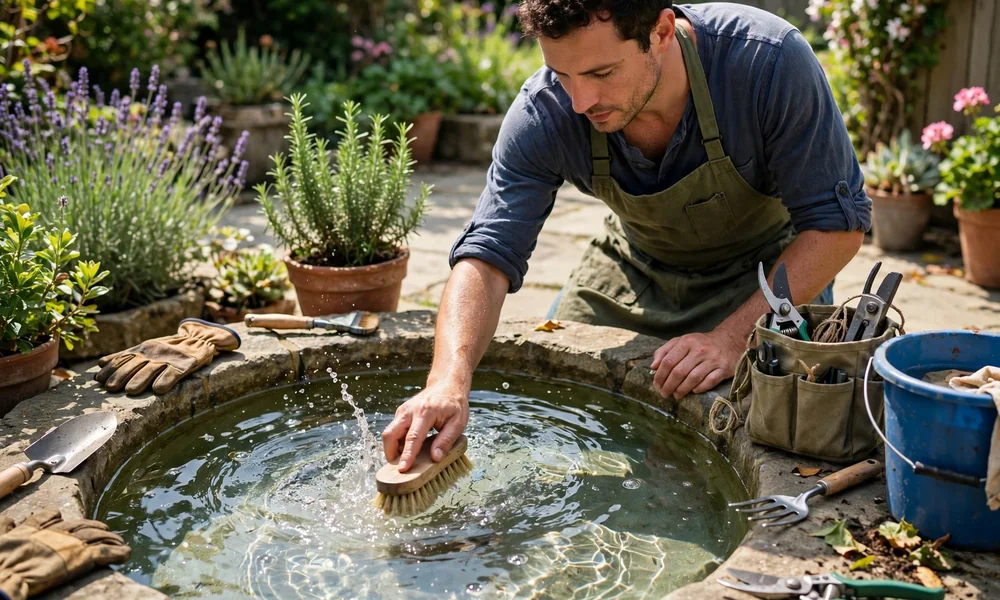
A fountain is easy to care for if you build the habit early. Top the water up every few days in summer, because evaporation and splash empty a shallow basin fast, and a pump that runs dry burns out in minutes. Once a week, lift out leaves and wipe the basin to stop algae taking hold. Every month or so, clean the pump: unplug it, rinse the intake sponge, and spin the impeller to check it moves freely. A clogged pump is the most common reason a fountain goes quiet.
In autumn, net the basin as leaves fall. Before the first hard frost, drain the fountain and store the pump indoors, because frozen water cracks stone and resin alike. Prevent algae rather than curing it: shade the basin, use rainwater where you can, and never use bleach or detergents, which harm birds that drink from the fountain. A bird bath is a shallow dish made for birds to drink and bathe in, while a fountain is a decorative feature birds happen to enjoy, and both deserve clean water.
Common garden fountain mistakes
The most common mistake is buying too big. A grand three-tier fountain on a small patio leaves no room to sit, and its splash soaks the chairs. Measure the space first and leave room for people. The second is putting the fountain where you never sit: a fountain you cannot hear from your chair is an ornament, not a feature. The third is forgetting the water: a fountain left to run dry kills its pump, so check the level every few days in summer. The fourth is placing it under a tree, where leaves clog the pump weekly. Finally, do not expect a fountain to filter a pond: a fountain moves water for beauty and sound, while filtration is a different job.
Checklist: choosing a garden fountain
- Measure the space and leave room to sit beside the fountain.
- Choose mains power for steady running, solar for sunny spots with no socket.
- Check the basin is deep enough that wind will not splash it empty.
- Site it on a level base, out of strong wind and falling leaves.
- Pick a pump you can reach, clean and replace easily.
- Plan where the topping-up water will come from before you buy.
Frequently asked questions
Do garden fountains use a lot of electricity?
No. Most mains fountains use a small pump of ten to forty watts, costing only a few pounds a month to run. Solar fountains cost nothing to run at all.
Will a fountain attract mosquitoes?
No, if the water keeps moving. Mosquitoes breed in still water, and a running fountain disturbs the surface too much for them. A fountain left off for days can become a breeding spot, so keep it running.
Can I leave a fountain running all winter?
Yes, if the water keeps moving and the basin cannot freeze solid. In a hard frost, drain it and store the pump indoors to stop the stone cracking.
How often should I clean a garden fountain?
Scoop leaves weekly, wipe the basin monthly, and clean the pump intake monthly. A five-minute clean keeps the water clear and the pump quiet.
Do fountains need a filter?
No. A fountain is a decorative feature, not a pond filter. The pump intake sponge catches debris, and regular cleaning does the rest.
What water should I use in a fountain?
Rainwater is best, because it leaves less limescale than tap water. If you use tap water, let it stand for a day first so the chlorine fades.
The bottom line
A garden fountain earns its place by changing how a garden feels. Choose one that fits the space, put it where you can see and hear it, keep the water topped up and the pump clean, and it will give you years of calm for very little effort. A garden fountain is a decorative water feature: it asks little, and gives back sound, movement and a quieter garden every day.