A small kitchen forgives nothing. Every centimetre of counter matters, every shelf is already spoken for, and a bulky appliance that looked fine in the shop can turn your morning routine into a daily shuffle. That is why the best electric kettles for small kitchens 2026 are the ones that fit your space, your routine and your habits.
The good news is that compact kettles have improved enormously. The best small models now boil a litre of water in around three minutes, pour without dripping, switch themselves off when the water boils, and tuck neatly under low cupboards or into a corner a full-size kettle would never fit. Many also add variable temperature settings and a keep-warm function.
This guide compares the compact kettles that deserve a place on a small counter, focusing on footprint, height, cord length and storage, and explains which features are worth paying for.
Key takeaways
- For most small kitchens, a 0.8 to 1 litre kettle is the sweet spot: enough for two or three mugs without hogging the counter.
- Measure your space before you buy, including the height under your wall cupboards and the depth of your worktop.
- Variable temperature control matters for green tea or pour-over coffee; a simple fast-boiling kettle suits most households.
- A 360-degree swivel base and short, tidy cord storage make a compact kettle far easier to live with every day.
- Stainless steel and glass bodies last longer and clean more easily than cheap plastic, especially with daily use.
Why Size Matters More Than Brand in a Small Kitchen
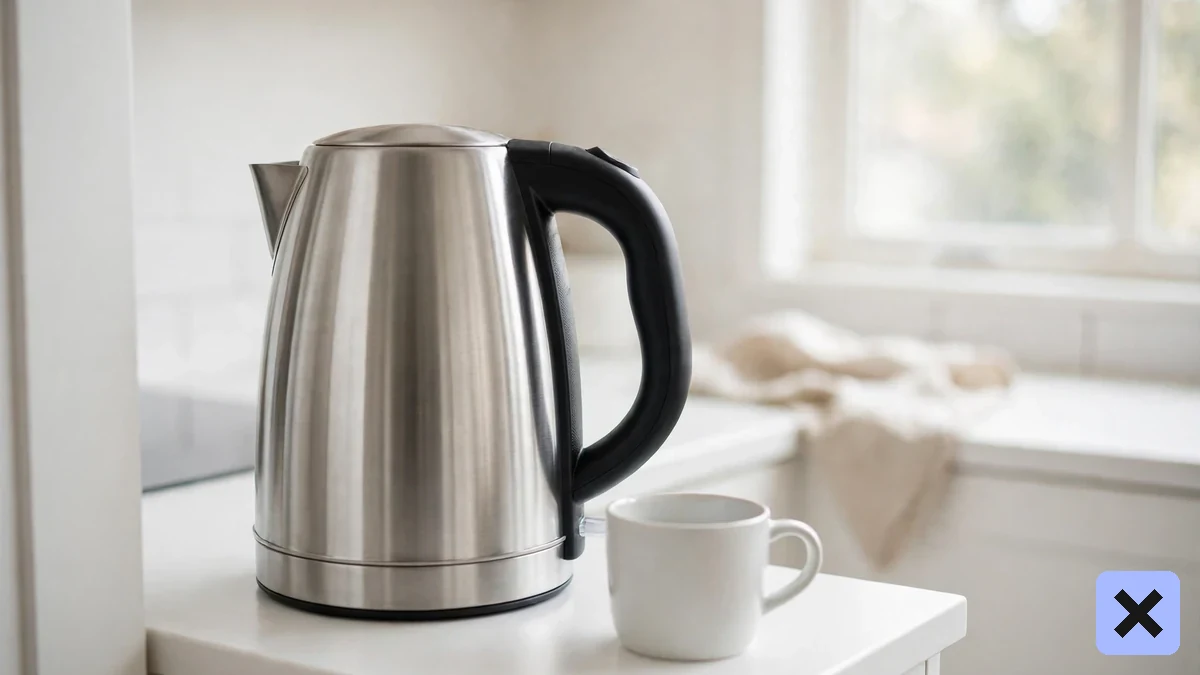
In a large kitchen, a kettle is a background appliance. In a small one, it is a daily negotiation. A standard 1.7 litre kettle can be 25 centimetres tall and 22 centimetres wide, which sounds modest until you try sliding it under a wall cupboard with only 40 centimetres of clearance.
Compact kettles solve these problems by design. Manufacturers shrink the body, lower the profile and shorten the base, so the kettle sits closer to the wall and leaves room for everything else. The trade-off is capacity, but for one or two people that barely matters: a 0.8 litre kettle still makes three standard mugs of tea, faster than a larger model.
What to Look For in the Best Electric Kettles for Small Kitchens 2026
Shopping is simpler when you know which specifications affect daily life. The five decisions below make the biggest difference.
Capacity That Fits Your Real Routine
Start by counting mugs, not litres. One standard mug holds about 250 millilitres, so a 0.5 litre kettle makes two mugs, a 0.8 litre kettle makes three, and a 1 litre kettle makes four. For a single person or a couple, 0.8 litres is usually ideal. Also check the minimum fill: the best small kettles boil a single 250 millilitre mug, while cheaper models need 500 millilitres.
Footprint, Height and Cord Storage
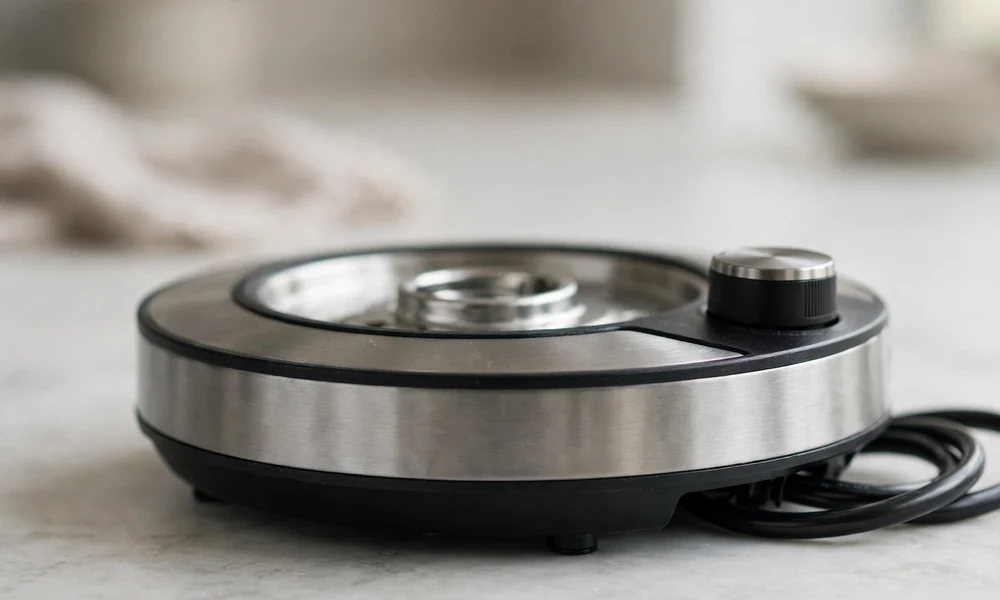
Footprint is the measurement most buyers forget: a wide round base can occupy far more counter than a slightly taller, narrower one. Measure the exact spot and leave two centimetres of clearance on each side. Look for a base with a cord winder underneath, so you can shorten the cable to the socket. The best tea kettles for small kitchens all share this trait.
Speed, Power and Temperature Control
Most electric kettles run between 1,500 and 3,000 watts, and higher wattage generally means faster boiling. A 3,000 watt kettle can boil a litre in about three minutes, while a 1,500 watt travel kettle may take five or six. Variable temperature control matters for enthusiasts: green tea tastes best at around 80 degrees, white tea at 70 to 75, and pour-over coffee at 92 to 96.
Materials and Build Quality
Stainless steel remains the most popular choice for compact kettles. It is durable, easy to wipe clean, and does not stain or retain flavours, while brushed steel hides fingerprints better than polished steel. Glass kettles look beautiful and let you watch the water boil, but they are heavier, more fragile and show limescale quickly in hard-water areas. Whatever you choose, check the lid, handle and spout: the lid should open with one hand, the handle should stay cool, and the spout should pour without dripping.
Safety Features Worth Paying For
Every kettle should have automatic switch-off and boil-dry protection, which cuts the power if the kettle is switched on empty. Any model without them should be avoided outright. Beyond those essentials, a cool-touch exterior is valuable when children reach for the kettle or the counter is very narrow. A locking lid prevents spills if the kettle is knocked, and a non-slip base stops it sliding. The best electric kettles for tea lovers tend to excel here, with gooseneck spouts and precise temperature controls.
The Best Electric Kettles for Small Kitchens 2026 at a Glance
The table below compares the compact kettles that performed best for small spaces; prices change often, so treat it as a comparison, not a fixed price list.
| Kettle style | Capacity | Best for | Standout feature |
|---|---|---|---|
| Compact stainless steel | 0.8 litres | Couples and solo drinkers | Fast boiling, narrow footprint |
| Mini gooseneck | 0.6 litres | Pour-over coffee fans | Precise slow pour, temperature control |
| Variable temperature | 1.0 litre | Tea lovers | Five temperature presets, keep warm |
| Glass compact | 1.0 litre | Style-led kitchens | Visible water level, LED lighting |
| Travel folding | 0.5 litres | Smallest flats and caravans | Collapsible body, dual voltage |
The Best Picks in Detail
Each kettle below earns its place for a different reason, so read the pick that matches your routine.
Best Overall: Compact Stainless Steel Kettle
The compact stainless steel kettle is the safest all-round choice for a small kitchen. At 0.8 litres it makes three mugs, boils in under three minutes at 2,200 watts or more, and its narrow body slides into corners wider models cannot reach. Brushed steel resists fingerprints, the concealed element makes descaling easy, and the 360-degree base suits everyone.
Best for Pour-Over Coffee: Mini Gooseneck Kettle
Pour-over coffee needs a slow, steady spiral pour, and a standard kettle spout cannot deliver it. A mini gooseneck kettle solves the problem with a long, thin spout that gives you complete control over the flow rate, and the compact 0.6 litre body suits a single serving or a two-cup brew. Many models add variable temperature control, so you can hold water at 94 degrees.

Best for Tea Lovers: Variable Temperature Kettle
If your day runs on green tea, white tea, oolong and herbal infusions, a variable temperature kettle is worth the extra money and the slightly larger body. Five presets from 70 to 100 degrees cover every common tea type, and the keep-warm function holds your chosen temperature while you finish a task. A 1 litre capacity still fits most small kitchens if you measure the height under your cupboards.
Best for Style: Compact Glass Kettle
A glass kettle turns a routine task into a small daily pleasure. Watching the water swirl and bubble is oddly satisfying, and the illuminated base looks striking on a dark worktop. The 1 litre capacity suits couples and small families, and the clear body makes the water level obvious at a glance. Glass demands more care: limescale shows quickly, so descale more often in hard-water areas.
Best for Tiny Spaces: Folding Travel Kettle
Some kitchens are so small that even a compact kettle is too much. A folding travel kettle collapses to half its height when empty, stores in a drawer or a cupboard, and still boils half a litre in about four minutes. It is a specialist choice, not a daily workhorse: capacity covers two mugs, and the body needs thorough drying between uses.
How to Fit a Kettle Into a Tiny Kitchen
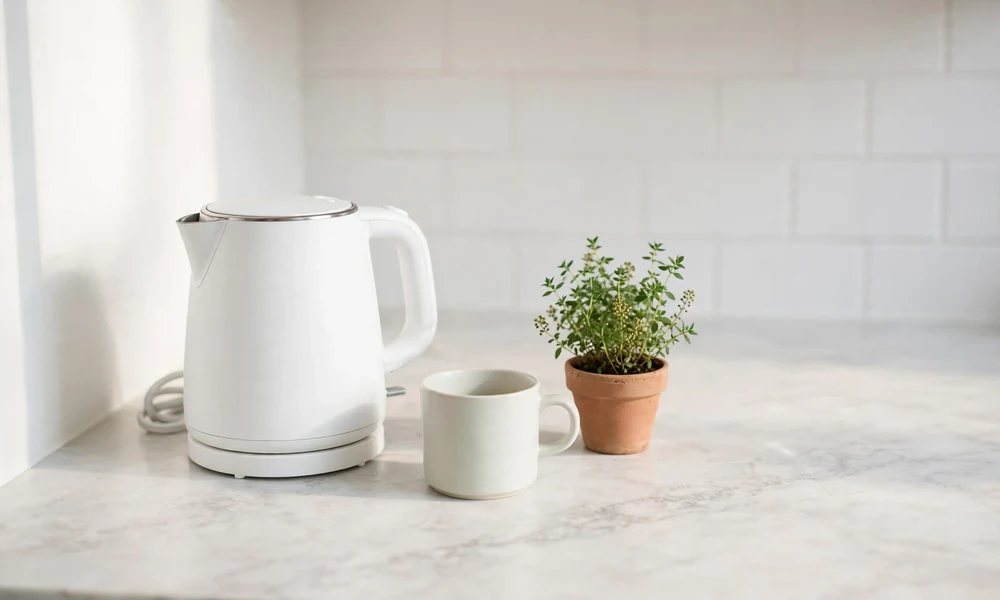
Choosing the right kettle is only half the job. Where you put it matters just as much. The back corner of a worktop is the natural home for a kettle: it is close to the socket, out of the main prep area, and the kettle can sit at a slight angle so the handle does not stick out into the room. Avoid the middle of the counter, where it blocks chopping.
Use vertical space as well. A small shelf above the kettle, a mug hook under a wall cupboard, or a narrow wall-mounted rail can transform a cramped counter. If you only boil water twice a day, consider storing the kettle in a cupboard and bringing it out for breakfast and the evening cup of tea. The kettle vs coffee maker for the morning debate often comes down to this same question of space, because a coffee machine demands a permanent home while a kettle can be tucked away.
Care and Descaling for a Longer-Lasting Kettle
A compact kettle works hard, and limescale is its biggest enemy. In hard-water areas, a white crust can build up on the element within a few weeks, slowing boiling, adding a chalky taste and shortening the kettle’s life. Descaling every four to six weeks prevents that and takes less than ten minutes. Fill the kettle with equal parts water and white vinegar, then boil and leave it to stand for 20 minutes before rinsing thoroughly.
Good habits save energy too: boil only the water you need, keep the lid closed, and descale regularly. Wipe the exterior weekly, clean the filter under running water, and always empty leftover water rather than reboiling it. A well-maintained compact kettle can last five years or more.
Checklist Before You Buy
Run through this checklist before you spend any money; it prevents the most common buying mistakes.
- Measure the height under your wall cupboards and the depth of your chosen spot.
- Count your daily mugs and choose a capacity of 0.8 litres for one or two people, or 1 litre for three or four.
- Check the minimum fill level so you can boil a single mug without wasting water.
- Look for a 360-degree swivel base, cord storage underneath, and automatic switch-off with boil-dry protection.
- Decide whether you need variable temperature control, or whether a simple fast boil is enough.
- Read recent reviews for noise and dripping, and confirm the warranty covers at least two years.
Frequently Asked Questions
What size electric kettle is best for a small kitchen?
A 0.8 to 1 litre kettle suits most small kitchens. It makes three to four mugs, boils quickly, and fits under low cupboards and into tight corners. Solo drinkers can go as small as 0.5 litres.
Are compact kettles slower than full-size kettles?
Not necessarily. A compact kettle holds less water, so even at the same wattage it often boils faster than a large kettle filled to the top. A 2,200 watt compact kettle boils 0.8 litres in under three minutes.
Is a glass or stainless steel kettle better for a small kitchen?
Stainless steel is the more practical choice: it is lighter, tougher, easier to clean and hides limescale better. Glass looks better and shows the water level, but it is heavier and needs descaling more often.
Do I need variable temperature control?
Only if you regularly drink green tea, white tea or pour-over coffee, where temperature changes the flavour noticeably. For black tea and instant coffee, a simple kettle is all you need.
How often should I descale a small kettle?
Every four to six weeks in hard-water areas, and every two to three months in soft-water areas. Descale sooner if boiling slows or you see white deposits inside.
Can I store an electric kettle in a cupboard?
Yes, provided the kettle is completely cool and dry, the cord is wound neatly, and the cupboard is not damp. Storing it away frees valuable counter space.
The Bottom Line
The best electric kettles for small kitchens 2026 prove that a smaller footprint does not mean smaller performance. A well-chosen compact kettle boils fast, pours cleanly, stores neatly and lasts for years. Measure your space, match the capacity to your daily mugs, and choose the features you will actually use.