
Best Ergonomic Footrests for Long Desk Days in 2026
The best ergonomic footrests for long desk days in 2026 do one simple job brilliantly: they keep your feet supported, your knees at a comfortable angle, and your blood moving through eight hours of sitting. Most desk workers never think about their feet until the aching starts, usually around three in the afternoon, when the legs feel heavy, the lower back starts to complain, and the chair that felt fine at nine suddenly feels wrong. The culprit is rarely the chair alone. When your feet dangle, rest flat on a hard floor at the wrong height, or tuck under the chair for relief, your whole posture unravels from the ground up. A good footrest fixes the foundation, and it costs a fraction of a new chair.
This guide compares the strongest ergonomic footrests of 2026 and explains how to choose the right one for your height, your desk, and the way you sit. Every pick was judged on adjustability, stability, surface comfort, and how it holds up through a full day.
Key Takeaways
- Your knees should sit at 90 to 100 degrees with your feet fully supported; if your feet dangle, you need a footrest.
- Height adjustment matters more than any other feature, because a footrest that sits even 5 cm too high or too low forces your knees into an awkward angle.
- Rocking footrests suit fidgeters and long sitters, because the gentle motion keeps blood moving and stops legs from going stiff.
- A textured surface helps cold or numb feet, but a flat, grippy platform is better if you wear shoes.
- The footrest works best alongside a chair set to the right height, as our guide to choosing an ergonomic office chair explains.
Why Your Legs Ache by Three in the Afternoon
When you sit with your feet unsupported, the weight of your legs pulls down on your thighs, pressing them against the front edge of the seat. That pressure narrows the blood vessels behind the knees and slows circulation to the lower legs. Over a morning the effect is small. By mid-afternoon, after four or five hours in the same position, the legs feel heavy, the feet feel cold, and the lower back starts to ache as your body shifts and slouches to find relief.
The average desk worker now spends seven to nine hours a day seated, more than 2,000 hours a year in a single chair, and over half of office workers report leg discomfort, swelling, or numbness by the end of the working day. The risk rises for people under 165 cm tall, whose feet often do not reach the floor. A footrest closes that gap: it gives shorter workers a floor that meets their feet, and taller workers a way to shift their leg angle through the day.
There is a second, quieter benefit. When your feet have somewhere solid to rest, your pelvis stops rocking forward and back to compensate, and your lower back holds its natural curve for longer. People who add a footrest often say their back feels better before their legs do.
What Makes a Good Ergonomic Footrest
Five things separate a footrest that helps from one that gathers dust under the desk.
Height and angle adjustment
This is the feature that matters most. A footrest should lift your feet so your knees sit at 90 to 100 degrees, with your thighs level. Look for at least 10 cm of height range and an adjustable tilt of 20 to 30 degrees. Fixed-height models are a gamble if the height does not match your body.
Stability
A footrest that slides away every time you press on it is worse than none at all. Check for a wide, weighted base and rubber grips underneath. On hard floors, rubber feet are essential.
Surface comfort
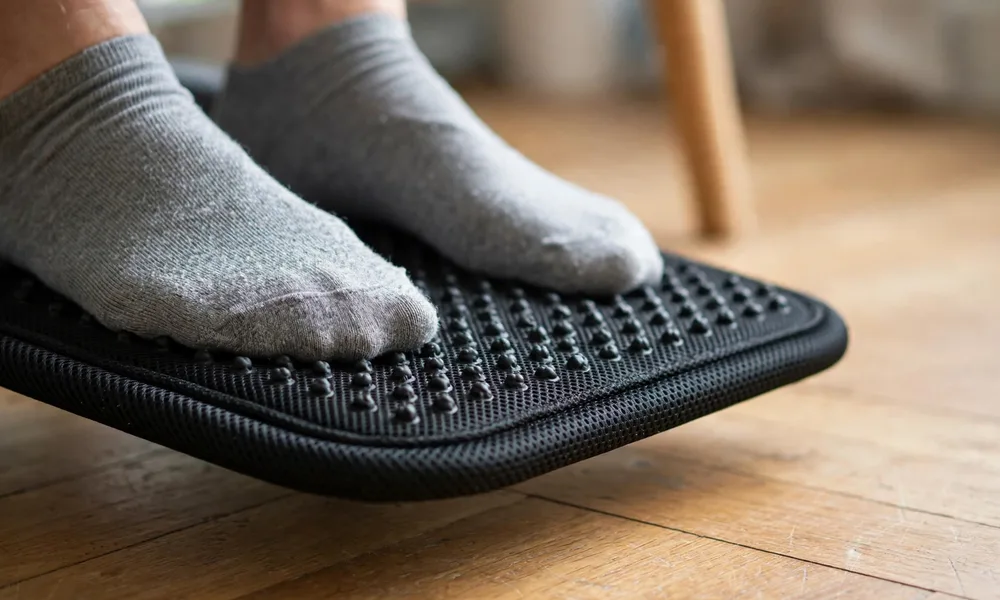
The surface decides whether you will use the rest all day or abandon it by lunchtime. Mesh breathes well in warm rooms and suits bare feet or socks; textured rubber grips shoes and stops slipping. Massage nubs suit short breaks rather than a full day.
Rocking or movement
Some footrests rock gently as you shift your weight. That small movement works the calf muscles, pumps blood back up the legs, and stops the stiffness of holding one position for hours. Rocking designs suit restless sitters and anyone whose legs go numb.
Size and fit
Measure the space under your desk before you buy. A platform around 40 to 45 cm wide fits most people and most desks. Check the depth too, so your heels do not hang off the back edge.
At a Glance: The Best Ergonomic Footrests of 2026
| Type | Best for | Adjustability | Price range |
|---|---|---|---|
| Adjustable platform | Most desk workers | Height and tilt | Low to mid |
| Rocking footrest | Long sitters and fidgeters | Tilt and rocking arc | Low to mid |
| Mesh footrest | Warm rooms, bare feet | Height and tilt | Low |
| Massage roller | Cold or numb feet | Roller pressure | Low |
| Heated footrest | Cold offices | Heat levels | Mid to high |
| Foot hammock | Small spaces | Strap length | Low |
The Best Ergonomic Footrests of 2026
The six types below cover every kind of desk worker, and the notes explain who each one suits best.
Adjustable platform: the best all-rounder
The adjustable platform is the safest first buy, and for most people it is the only footrest they will ever need. A solid, slightly textured platform on a frame that adjusts in height and tilt. It suits shoes and socks equally well, stays put under the desk, and holds your feet at the right height and angle. The best versions adjust with one hand and hold their setting for months, so test the locking mechanism if you can. Expect a low to mid price and years of use.
Rocking footrest: the best for long days
If your legs go stiff or numb by mid-afternoon, a rocking footrest is the design to try first. The platform pivots gently as you shift your weight, keeping the calf muscles working and the blood moving. It feels strange for a day, then most people stop noticing it. The trade-off is stability: rocking rests suit people who like movement, not people who want a rock-solid platform to brace against. They need a little more floor space, because the arc of the rock extends the footprint.

Mesh footrest: the best for warm rooms
Mesh footrests use a taut fabric surface stretched over a frame, and they are the coolest option in a warm room: air moves through the surface, so your feet stay dry, and the slight give feels softer than hard plastic. They suit bare feet and socks best; shoes can snag the weave over time. Cheap mesh sags after a year or two, so look for a tight weave.
Massage roller: the best for tired feet
A massage roller is a half-cylinder with raised nubs that you roll your feet across: less a footrest than a recovery tool that lives under your desk. Used for a few minutes at a time, it eases aching arches and wakes up cold feet. As your only support for eight hours, it is less comfortable, because the curved surface does not hold your feet at a steady angle. Use one alongside a flat platform: the platform for working, the roller for breaks.
Heated footrest: the best for cold offices
Cold feet are one of the most common desk complaints: when your legs are still for hours, circulation slows and the feet feel it first. A heated footrest warms the surface to a gentle, even temperature, usually with two or three settings, and the warmth keeps blood moving in a way thick socks cannot match. The cost is the highest on this list, and it needs a power socket, so it suits a fixed desk rather than a shared setup.
Foot hammock: the best for small spaces
A foot hammock is a fabric sling that hangs from the underside of your desk, and it is the most space-efficient option here. It costs little and suits people who like their feet raised and slightly swinging. The catch is the desk: it needs a solid edge to clip to, does not suit glass desks, and offers no tilt adjustment. For a tiny desk it is a clever answer; for a full-size setup, a platform is better.
How to Set Up Your Footrest Properly
Setting up a footrest takes five minutes, and it is worth doing properly rather than sliding it under the desk and hoping. Start by setting your chair height so your elbows sit at desk level, the same starting point our guide to the best desk chairs recommends. Then place the footrest so your feet sit flat on it with your knees at 90 to 100 degrees and your thighs roughly level. Your heels should rest on the platform, not hang off the back edge.
Give yourself a week to adjust: the first two or three days can feel odd as overworked muscles finally relax. If the ache moves rather than fades, adjust the height by one step and try again for two days. The footrest is part of a system, alongside your chair and desk height, and small things like a good wrist rest keeps typing comfortable, that keep your body aligned.

Footrest Checklist: Before You Buy
- Measure your seated knee height and check the footrest’s height range covers it, with room to spare.
- Confirm the platform is at least 40 cm wide, so your feet sit naturally apart rather than squeezed together.
- Check the tilt range is 20 to 30 degrees and that the tilt locks firmly under your weight.
- Test the base on your floor type: rubber grips for hard floors, a heavier frame for carpet.
- Match the surface to how you sit: mesh for bare feet and warm rooms, textured rubber for shoes.
- Check the weight rating is at least 20 kg and the warranty covers the frame for a year or more.
Frequently Asked Questions
Do I need a footrest if my feet already reach the floor?
Not always. If your feet rest flat on the floor with your knees at 90 to 100 degrees, your floor is already doing the job. A footrest still helps if you like to shift your leg angle through the day.
Are rocking footrests better than fixed ones?
For long sitters, usually yes, because the gentle motion keeps blood moving and stops stiffness. For people who want a solid platform to brace against, or who find movement distracting, a fixed adjustable platform is better.
Can a footrest help with lower back pain?
Often, yes. When your feet are supported, your pelvis stays steadier and your lower back holds its curve longer, reducing the slouching behind most desk backache.
What height should my footrest be?
Whatever height puts your knees at 90 to 100 degrees with your feet flat and your thighs roughly level. Adjustability matters far more than any single figure.
Are foot hammocks actually ergonomic?
They can be, for short sessions and small spaces, because they raise the feet and take pressure off the thighs. They are less good for a full working day, because they offer no tilt adjustment and the swinging motion can distract.
How long should a good footrest last?
A well-made platform or rocking footrest should last three to five years of daily use. Mesh surfaces wear first, usually after one to two years, and cheap locking mechanisms fail sooner. Replace one that slips, sags, or collapses: a failing footrest is worse than none at all.
The Bottom Line
The best ergonomic footrest for long desk days in 2026 is an adjustable platform with a solid base, a height range that fits your body, and a surface that suits the way you sit, with a rocking design as the best upgrade if your legs go stiff by mid-afternoon. It is a small purchase that fixes a problem most desk workers put up with for years, and it works from the first day you set it up properly. Measure your space, check the height range, and give yourself a week to adjust.


