
Horseshoes is one of the oldest backyard games in America, and it is still one of the best. Two stakes, four heavy shoes, a patch of lawn, and an afternoon is all it takes, and the game works for almost everyone, from children throwing light rubber shoes to serious players who practise their turn for years. A bad horseshoe set is too light to fly straight, too flimsy to survive a season, or so poorly balanced that every throw feels different, while a good set feels solid in the hand, lands with a satisfying clang, and lasts for years. The best horseshoe sets of 2026 are the ones that get the weight, the balance, and the stakes right, so the game is fair, fun, and worth playing again next weekend.
What Makes a Horseshoe Set Good
The first thing to judge is the weight of the shoes. A real horseshoe for pitching weighs about two and a half pounds, and that weight is what makes the shoe fly straight and hold its line in the air. A shoe that is too light gets pushed around by the wind and bounces off the stake instead of wrapping around it, while a shoe that is too heavy is tiring to throw and hard to control. The best sets keep every shoe close to the same weight, so each throw feels the same as the last, and a player can build a rhythm instead of adjusting to a different shoe every turn.
The second thing is the balance. A well-made horseshoe has its weight spread evenly, with the open ends slightly heavier than the curve, so it turns slowly and predictably in flight. Cheap shoes are often lopsided, with one side thicker than the other, and they wobble, spin, or dive without warning. Balance is easy to check: hold the shoe by the curve, let it hang, and see if it sits level. A shoe that hangs level is a shoe that will fly true, and a shoe that flies true is a shoe that scores.
The third thing is the stakes. A stake should be solid steel, long enough to stand firm in the ground, and thick enough not to bend when a shoe hits it. The best sets include stakes that are at least twenty-four inches long, with a pointed end that drives into the lawn and a top that leans very slightly toward the thrower. Stakes that are too short work loose after a few games, and stakes that are too thin bend on the first hard ringer. A good stake stays put, and a stake that stays put keeps the game honest.
The Main Types of Horseshoe Set
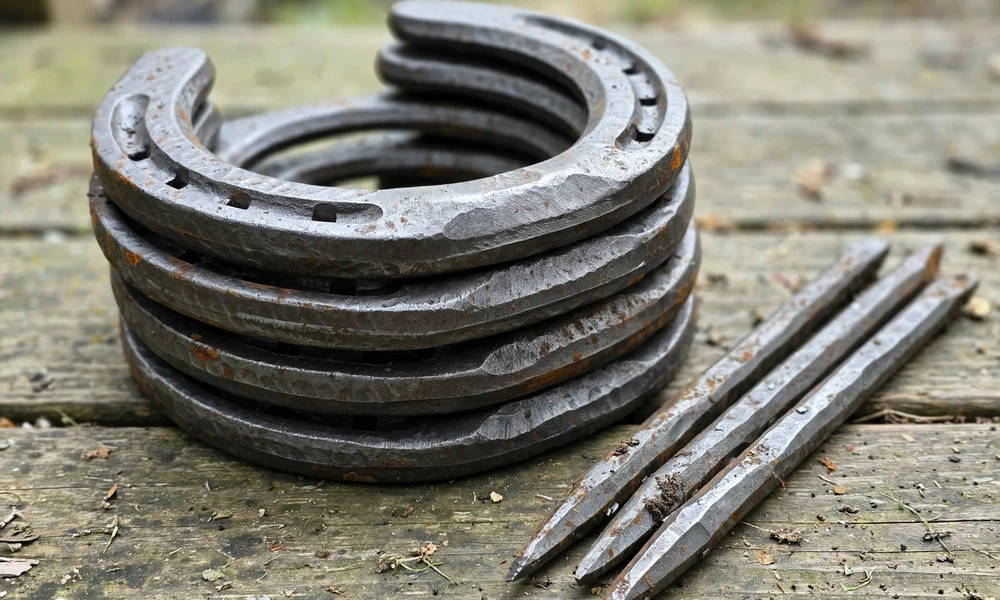
Forged steel sets are the classic choice and the best choice for most serious players. They are heavy, they ring properly when they hit the stake, and they feel like the game is supposed to feel. They suit adults who play regularly, they suit a permanent pit in the backyard, and they are the only sensible choice for anyone who wants to practise for league play. The trade-off is the weight: a full set with stakes can weigh more than ten pounds, so it is not the set to carry to a picnic, and the shoes can damage a lawn or a deck if they are thrown carelessly.
Cast iron sets are the budget classic. They are heavy enough to fly straight, they are cheaper than forged steel, and they have been the standard backyard set for decades. They suit a family that plays a few times a summer and does not want to spend much, and they suit a holiday cottage or a campsite where the set will be used hard and stored roughly. The downside is the finish: cast iron rusts quickly, the shoes can be brittle and chip if they hit concrete, and the balance is rarely as even as a forged set. For casual play, though, a cast iron set is hard to beat on value.
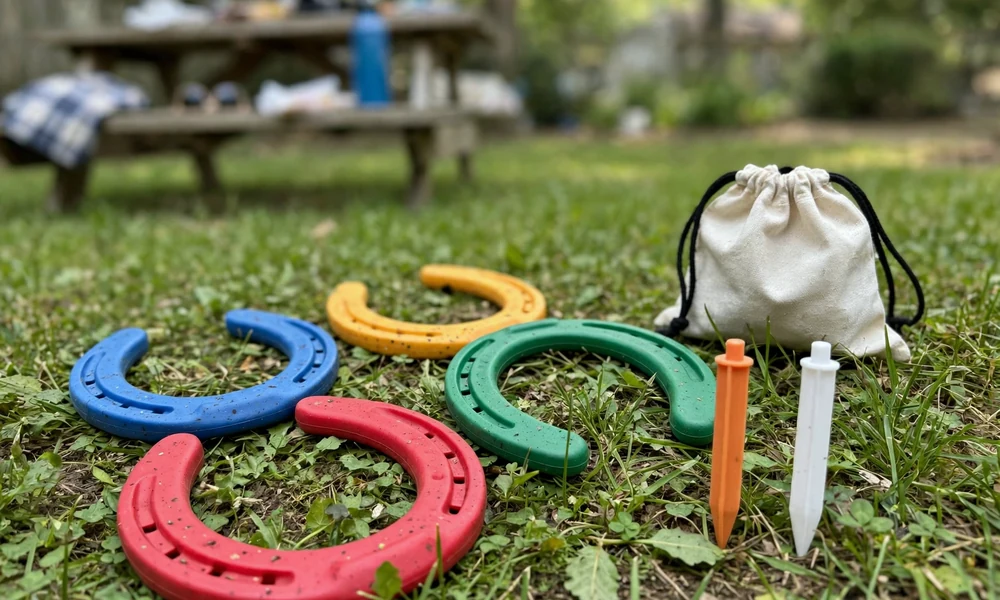
Rubber horseshoe sets are the friendly option. They are light, they are safe for children, and they will not dent a fence, a car, or a toe. They suit families with young children, they suit a small garden where a steel shoe would be a hazard, and they suit anyone who wants a game that can be packed into a bag and taken to the park. The trade-off is the feel: a rubber shoe does not ring, it does not fly like steel, and it will not satisfy a serious player. For a relaxed afternoon game, though, rubber is the right call, and the bright colours make it easy to tell the two teams apart.
How to Set Up a Horseshoe Pit
A good pit starts with the distance. For adults, the stakes are forty feet apart, measured from the centre of one stake to the centre of the other, and each stake stands in the middle of a pit that is about six feet long and three feet wide. For children and casual play, thirty feet is a fairer distance, and many backyard sets are sold with a thirty-foot layout in mind. The distance matters more than it seems: too close and every throw is a ringer, too far and nobody scores, and the game loses its tension either way.
The stakes should lean very slightly toward the thrower, about three inches over the height of the stake, and they should stand about fourteen inches above the ground. A stake that leans the wrong way makes ringers harder than they should be, and a stake that stands too tall is a hazard for a shoe that lands short. Drive the stake in firmly, check it with a level, and test it with a few hard throws before the game starts.

How to Play and Score
The basic game is simple. Two players or two teams stand at one stake and take turns throwing two shoes each at the far stake, then walk to the other end and throw back. A shoe that lands around the stake is a ringer and scores three points, a shoe that lands within six inches of the stake scores one point, and the closest shoe to the stake scores one point if nobody rings. The first player or team to reach twenty-one points wins, though many backyard games play to fifteen or to forty for a longer match. The rules sound simple, and they are, but the scoring keeps every throw interesting, because a single ringer can change the game.
The throw itself is worth learning properly. Most players grip the shoe by the curve, with the open ends pointing away, and throw with a smooth underarm swing, releasing the shoe so it turns once or twice in the air. A one-and-a-quarter turn is the most common, and it takes practice to get the release right, but the feel comes quickly. The key is a smooth swing rather than a hard throw: a shoe thrown too hard bounces off the stake, while a shoe thrown with a relaxed, even pace drops onto the stake and wraps around it.
What to Look For When You Buy
Start with the weight and the material, because they decide how the set plays. If the set is for serious play, choose forged steel at the full official weight, and check that all four shoes weigh the same. If the set is for children or for a small garden, choose rubber or a light alloy, and check that the shoes are dense enough to fly straight. If the set is for occasional family play, a cast iron set is the best value, and the money saved can go toward a decent pit.
Next, look at the stakes and the extras. A good set includes solid steel stakes, not thin rods, and it should include a way to carry the set, whether that is a bag, a case, or a simple strap. Some sets include a measuring stick or a small rule book, which is a nice touch for a beginner, and some include a scorekeeper, which is useful for a family game. A set that comes with a flimsy bag and thin stakes is a set that will need replacing sooner than it should, so the extras are worth checking before you buy.
Finally, think about the other games in the garden. A horseshoe set is at its best as part of a small collection of lawn games, and it pairs well with other classic throws. If the family already enjoys a long afternoon outside, a look at the best cornhole boards will show how a second throwing game can keep everyone playing, and a set that shares the lawn with cornhole needs a clear layout so the two games do not get in each other’s way. Planning the garden games together is half the fun, and it means the horseshoe pit is used rather than forgotten.
Care, Storage, and Making a Set Last
A steel horseshoe set will last for decades if it is looked after, and the care is simple. After a game, wipe the shoes dry, brush off the mud, and give them a light wipe with an oiled cloth before they are put away. Once a year, check the stakes for bends and straighten them gently, and check the shoes for chips or cracks, which are rare but worth catching early. A set that is oiled and stored dry will look as good in ten years as it does today.
Who Should Buy Which Set
For a serious player, the answer is a forged steel competition set, with solid stakes and a proper pit. It costs more, but it plays properly, and it will last a lifetime. For a family with young children, the answer is a rubber set, which is safe, light, and easy to carry, and which lets everyone play together. For a family that plays a few times a summer, a cast iron set is the best value, and it will give years of good games for a modest price. For a player who wants a set to take to the park or the beach, a lightweight set is the one to carry.
It also helps to think about the rest of the garden. A croquet lawn and a horseshoe pit can share a garden happily if they are laid out with a little thought, and the best croquet sets make a calm contrast to the clang of horseshoes, which is why many families keep both. A garden with two or three lawn games is a garden that gets used all summer, and the horseshoe set is often the one that gets the most play, because it is quick to set up and easy to learn.
When the set arrives, set up the pit properly, agree on the rules, and play a few practice games before keeping score. The first game is for learning the throw, the second is for finding the distance, and by the third the game starts to feel natural. Horseshoes rewards patience and practice, and a player who throws regularly will improve quickly. The best horseshoe sets of 2026 are the ones that make that practice a pleasure, and the game that follows is one of the simplest and most satisfying ways to spend an afternoon outside, which is why it has lasted so long. For a final comparison with another classic lawn game, the best bocce ball sets show how a rolling game can sit alongside a throwing game in the same garden.


