
How to Choose a Key Cabinet That Keeps Every Key in Its Place in 2026
A key cabinet solves a problem every household knows: keys in coat pockets, on counters, in bags, and nowhere at all when you are late. A good one gathers every set behind a door, each on its own labelled hook. A bad one is too small on day one, its hooks bend under car keys, or its lock is so fiddly everyone leaves the door open.
An open key holder is a board with hooks on the wall: fast, visible, ideal for the two or three sets a household grabs daily. Our guide to the best key holders covers those. A key cabinet is the closed version: keys behind a door, hidden from anyone at the front door. A safe is different again: a valuables vault built to resist fire and theft. Our guide to the best home safes explains fire ratings and bolting down. A key cabinet does not protect valuables from fire. It organises keys, hides them, and stops them wandering.
Key Takeaways
- A key cabinet is a lockable enclosed box, not an open hook board: it hides keys and adds a lock, at the cost of one extra step.
- Count every key before you shop, then buy the next size up: a cabinet full on day one is useless within a month.
- Match the lock to who uses it: keyed for one household, combination for a family or office, digital where codes change.
- Steel suits offices with many keys; wood suits hallways where the cabinet is furniture.
- Labels and a written key list matter more than the cabinet: an unlabelled cabinet is a locked box of mystery keys.
What a Key Cabinet Actually Does
A key cabinet does three jobs. First, storage: every key has a hook of its own, spaced so each set hangs straight and comes off without tangling. Second, concealment: the door closes and the keys disappear, which matters in a hallway with a glazed front door, where keys in plain view can be seen from outside. Third, control: the lock decides who can open it, which matters once tenants, cleaners, or employees need a key.
The Main Types of Key Cabinet
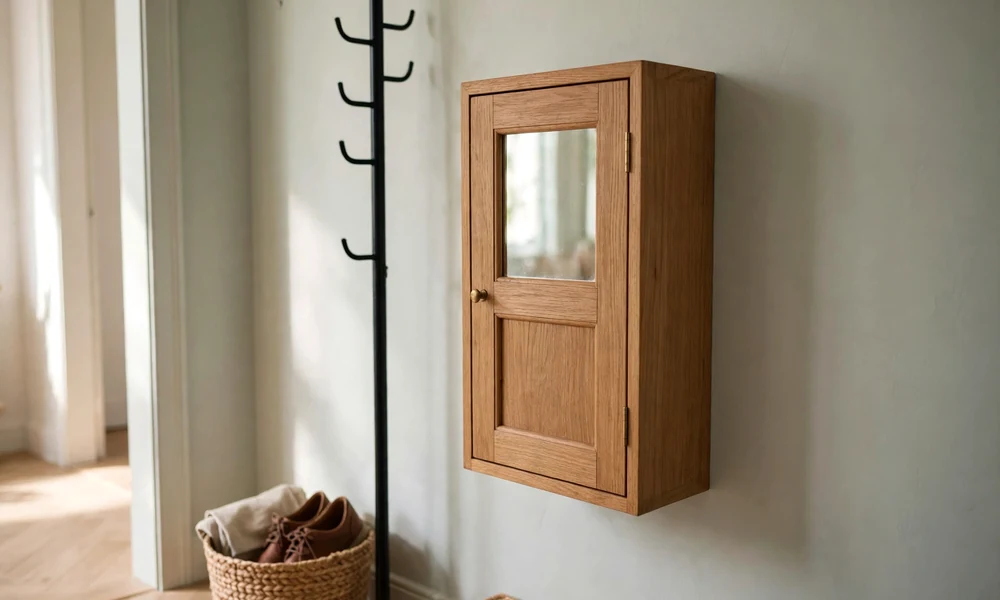
Small wooden cabinets are the hallway classic. They hold ten to thirty keys, look like a small piece of furniture, and many have a mirror on the front door. They suit a family home with a handful of sets: house, car, shed, garage, and spares. The weakness is security: a simple keyed lock and wood that will not stop anyone determined.
Steel cabinets are the workhorse. They hold twenty to two hundred keys, the body is folded steel, and the lock is a cylinder, a combination dial, or a digital keypad. Hooks are numbered, the back panel takes colour-coded tags, and larger sizes are deep enough for chunky sets with fobs. They suit landlords, small offices, and workshops.
Large office cabinets hold a hundred keys or more, often with removable hook panels and a key register inside the door. They belong in estate agents, car dealerships, and schools. For a home they are overkill.

Key Cabinets Compared
| Type | Best for | Capacity | Lock | Watch out for |
|---|---|---|---|---|
| Small wooden cabinet | Family hallway | 10 to 30 keys | Keyed | Light security, hooks close together |
| Steel cabinet | Landlords, small offices | 20 to 100 keys | Keyed, combination or digital | Plain looks, needs solid wall fixing |
| Large office cabinet | Fleet, lettings, schools | 100 to 200 keys | Combination or digital | Overkill at home, heavy to mount |
| Mirror-front cabinet | Small hallways | 10 to 20 keys | Keyed | Mirror shows every fingerprint |
| Glass-front cabinet | Workshops | 20 to 60 keys | Keyed | Keys visible, concealment lost |
Capacity: Count the Keys, Then Add Half Again
Capacity is where most purchases go wrong: people count the keys they use and forget the keys they own. Gather every key into one pile: house, car, bike locks, shed and garage, padlocks, the spare set at a relative’s, and the keys nobody can identify. Count the sets, not the individual keys, because one hook holds one set. Then add half again: a new car, a new tenant, a new padlock, and the hooks are full.
Spacing matters as much as number. Hooks under five centimetres apart crowd the keys together, so the sets tangle every morning. Hooks eight to ten centimetres apart let each set hang straight and come off cleanly. Check the depth too: a shallow cabinet will not close with a thick set inside.
Locks: Keyed, Combination, or Digital
A keyed lock is the simplest: one small key opens the cabinet, cheap and reliable. The weakness is obvious: the cabinet key becomes one more key to lose, and anyone who has it has every key in the house. Keep it somewhere sensible, never by the front door.
A combination lock suits a family or small office where several people need access. The code can be shared and changed when someone leaves, with no extra key to lose. The weakness: a code shared with five people is known by five people, so change it when staff or tenants change. A digital keypad is the most flexible version: codes change in a minute and several people can each have their own, though it needs a key override.
None of these locks makes a key cabinet a safe: a determined thief with a crowbar opens a wooden cabinet in seconds and a thin steel one in under a minute. The lock stops casual access and makes it obvious if someone has been inside. Valuable spares belong in a safe.
Materials: Wood, Steel, and What Lasts
Wooden cabinets are chosen for how they look. Solid wood with a proper finish ages well in a hallway, and the door can carry a mirror that makes the cabinet disappear into the room. Check the back panel is solid, not thin fibreboard: the hooks screw into it, and a thin panel will not hold a heavy set.
Steel cabinets are chosen for how they work. Powder-coated steel resists damp, the hooks are welded or riveted to a steel back panel, and the unit fixes to the wall with proper bolts. Check the coating is even, especially around the hook holes: a chip lets the steel rust in a damp hallway. Avoid thin steel that flexes: a flexing cabinet will not keep its door square, so it will not lock.
Mounting It So It Stays Put
Mounting is where most key cabinets fail, and it is almost never the cabinet’s fault. One small screw into plasterboard works for a week, then leans, cracks the plaster, and falls. A large steel cabinet full of keys weighs ten kilograms or more, so find a stud and fix into it with proper screws. With no stud, use wall anchors rated for the cabinet plus a full load of keys, at least four fixings across the back panel.
Height matters as much as strength: mount it at shoulder height, roughly 150 to 160 centimetres to the centre, so everyone can reach the hooks without stretching. Keep a spirit level handy: a cabinet a few degrees off looks wrong every time you walk past, and a crooked door will not close. Our guide to the best wall hooks covers the same fixing rules for heavy coats.

Labelling and the Key List
A cabinet full of unlabelled keys is a locked box of mystery, the most common way a key cabinet fails. Label every set as it goes in, with a tag that says what the key opens: front door, back door, shed padlock, garage side door. Colour-coded tags help: one colour for the house, one for the cars, one for spares. Numbered hooks help more: the hook number can match a line in a written key list.
The written list is the part most people skip, and the part that saves the day when a key goes missing. Keep a simple list, on paper, of every hook number and what it holds, somewhere other than inside the cabinet: a drawer, a safe, or with a trusted relative. Once a year, take out the keys nobody can identify.
Where to Put It
The best place is on the route between the front door and the rest of the house: the wall beside the door, on the same side as the handle, so the keys go in as the door closes behind you. Unlike an open holder, the cabinet can sit further from the door, because its door hides the keys from anyone at the threshold.
Mistakes That Ruin a Good Cabinet
The most common mistake is buying too small: hooks doubled up, keys piled on each other, and the door left open because it will not close. The second is buying for looks alone, then finding the lock fiddly or the hooks glued rather than screwed to the back. The third is never labelling anything, so the household goes back to keeping keys in coat pockets.
The fourth is putting the cabinet key in the obvious place: by the door, under the cabinet, or inside it. A key kept next to the cabinet is no security at all. The fifth is mounting it badly, with one screw in plasterboard, and finding it on the floor. All five are avoidable.
Checklist: Before You Buy a Key Cabinet
- Count every set of keys, then buy the next size up, hooks at least eight centimetres apart.
- Choose the lock for who uses it: keyed for one household, combination for a family or office, digital where codes change.
- Pick steel for many keys and damp rooms, wood for a hallway where the cabinet is part of the furniture.
- Check it is deep enough for your largest set, and that the door closes over it.
- Plan the fixing: a stud or four wall anchors, level at shoulder height, out of sight of the front door.
- Buy tags and a key list with the cabinet, and label every key the day it goes in.
Frequently Asked Questions
Are key cabinets more secure than open key holders?
They hide the keys from anyone who can see through the front door or a side window. But a cabinet is not theft-proof: a thin one will not stop a determined thief, so keep it out of sight.
How many keys should a cabinet hold?
Count the sets you own today, then add half again. A family home needs twenty to thirty hooks, a landlord or small office fifty to a hundred, and anything over a hundred belongs in a large office cabinet.
What is the best lock for a key cabinet?
Keyed suits one household where one person manages the keys. Combination suits a family or small office where several people need access. Digital suits a place where codes change often.
Can I mount a key cabinet without drilling?
Not safely beyond a tiny wooden cabinet with a few keys. A full steel cabinet is heavy, and adhesive strips will not hold it. Use a stud or wall anchors rated for the cabinet plus a full load of keys.
Where should the cabinet key live?
Somewhere you can reach it but a visitor cannot: a bedroom drawer, the back office, or with a trusted relative. Never by the front door, never under the cabinet, and never inside it.
What do I do with keys nobody can identify?
Put them on one hook, labelled unknown, with the date. If nobody claims them within a year, they open nothing you still own. Dispose of them.
The Bottom Line
The best key cabinet fits every key you own with room to spare, locks with one easy movement, mounts solidly out of sight of the front door, and stays labelled. Count the keys, buy the next size up, choose the lock for who uses it, and fix it level into a stud or with proper anchors. Get those four right and the cabinet disappears into the routine.


