
What Makes a Great Knife Roll in 2026
A great knife roll is the difference between arriving at a kitchen with sharp, safe blades and arriving with a chipped edge wrapped in a tea towel. A knife roll is a portable case, usually made of canvas or leather, that holds a chef’s knives in individual slots, rolls up tight, and carries them safely from one kitchen to another. The best knife rolls of 2026 protect the edge of every blade, keep the knives from rattling against each other, and open flat in seconds so the cook can see the whole kit at a glance.
Buying one is harder than it looks. A roll that is too small forces you to leave a knife behind, while a roll that is too big becomes a heavy bundle that never leaves the house. Cheap rolls use thin fabric that a sharp tip can pierce, weak stitching that splits at the slots, and straps that loosen on the move. This guide explains how to choose one that fits your knives, your work, and the way you travel.
Key Takeaways
- A knife roll is a portable chef’s knife case, not a knife set: it carries the blades you already own, keeping each one in its own slot so the edges never touch.
- Deep slots and a blade guard or flap matter more than looks, because a sharp tip that pokes through thin fabric is the fastest way to ruin a good knife and cut a hand.
- Ten to twelve slots suit most working cooks, while six to eight slots are enough for a home cook who carries a chef knife, a paring knife, and a few favourites.
- Waxed canvas is the best all-round material: tough, water-resistant, and easy to clean, while leather looks better and lasts longer but costs more and needs care.
- Try the roll loaded before you trust it: pack it, roll it, carry it around the house, and check that nothing shifts, nothing pokes through, and the straps stay fastened.
How We Judged the Best Knife Rolls
Every knife roll here was judged the way a working cook actually uses one: packed in the morning, carried to another kitchen, unrolled on a crowded worktop, and rolled up again at the end of a long shift. Protection came first, because a roll that lets blades touch each other has failed at its only job. We checked that each slot held its knife firmly and that nothing could slip out when the roll was carried upside down.
The Best Knife Rolls at a Glance
| Roll Type | Best For | Slots | Material | Carry Style |
|---|---|---|---|---|
| Waxed canvas roll | Everyday work, all weathers | 8 to 12 | Waxed canvas | Shoulder strap, handles |
| Leather roll | Long-term use, smart look | 8 to 10 | Full-grain leather | Handles, shoulder strap |
| Compact roll | Home cooks, short trips | 5 to 7 | Canvas or nylon | Handles |
| Knife backpack | Big kits, long commutes | 12 to 16 | Ballistic nylon | Backpack straps |
| Roll with tool pockets | Chefs with gadgets | 8 to 10 plus pockets | Canvas or leather | Shoulder strap |
| Budget canvas roll | Students, first roll | 8 to 10 | Plain canvas | Handles |
What a Knife Roll Actually Does
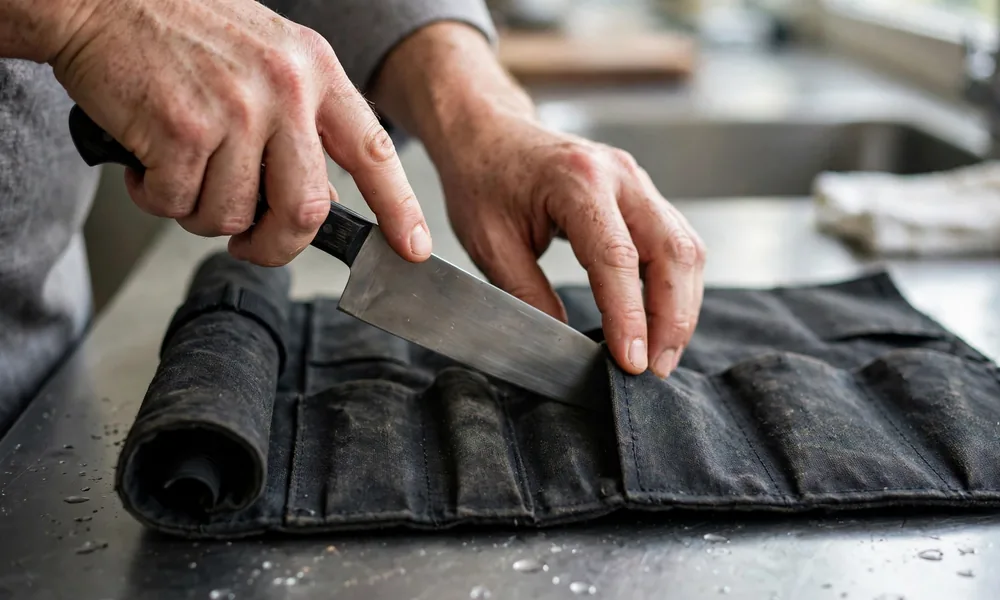
A knife roll does three jobs at once. It protects the cutting edge of each blade, it protects the person carrying it, and it keeps the whole kit organised so the right knife is always at hand. The slots are the heart of it. Each slot should be deep enough to hold most of the blade, snug enough that the knife does not slide out when the roll is tipped, and wide enough that the knife goes in and comes out without a struggle. Slots that are too tight are almost as bad as slots that are too loose: a cook who has to wrestle a knife out in the middle of service will eventually cut a finger or chip an edge.
Organisation is the third job. A cook who opens a roll should see every knife at once, in the order they use them, with the chef knife in the middle and the smaller blades to the sides. Some rolls add small pockets for a honing rod, a thermometer, a peeler, and a pair of tweezers, the tools a working chef reaches for almost as often as a knife. If you already own a good set of blades, our guide to the best knife sets of 2026 explains which blades earn a place in the roll and which can stay at home.
Canvas, Leather, and Nylon: Choosing the Material
Waxed canvas is the material most working cooks choose, and for good reason. It is tough, it resists water, and it gets better looking with use, picking up marks and creases that tell the story of a working life. A waxed canvas roll will keep rain off your blades on the walk to work, wipe clean after a spill, and survive years of daily use. Its weakness is weight, and the wax coating needs reapplying every year or so to keep its water resistance.
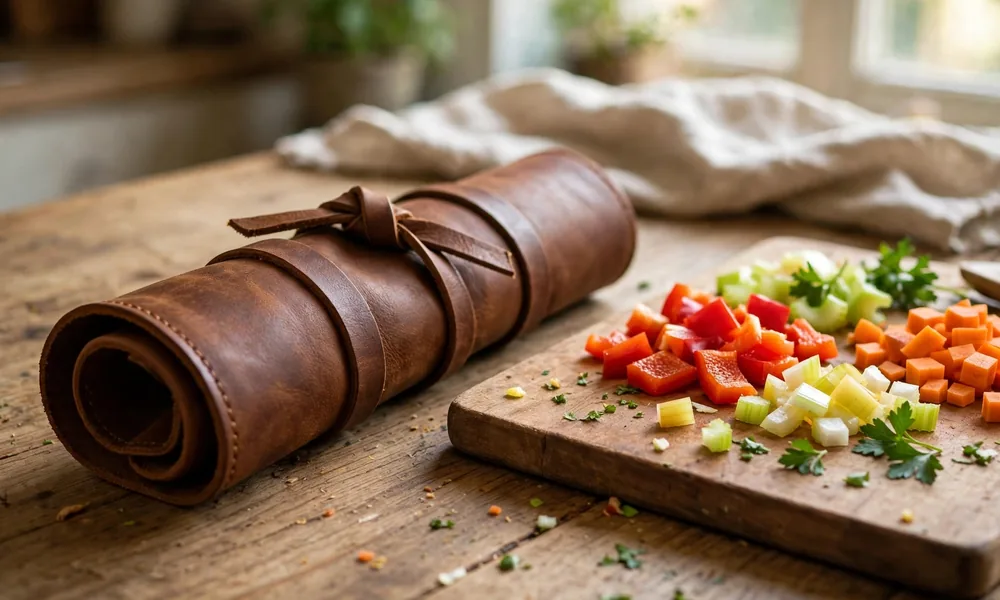
Leather is the premium choice. A full-grain leather roll is beautiful, it lasts for decades, and it moulds slightly to the knives it holds, so the fit improves with time. It is also the most expensive option and the most demanding: leather needs conditioning to stop it drying out, it stains if it is left wet, and it is heavier than canvas. For a chef who wants one roll for a whole career, leather is worth the money.
Nylon and other synthetic fabrics are the lightest and cheapest options, and they make sense for a first roll or a second roll kept for travel. The best synthetic rolls use thick ballistic nylon with reinforced stitching, and they are easy to wash when they get dirty. The worst use thin fabric that a sharp tip can pierce in weeks, and the slots stretch and sag so the knives slide about. If you buy synthetic, choose the thickest fabric you can find and check the stitching at the base of every slot.
How Many Slots Do You Really Need
The number of slots is the first decision, and most people get it wrong by buying too many. A roll with sixteen slots sounds generous, but a cook who owns eight knives will carry eight empty slots, extra fabric, and extra weight for no reason. Empty slots also let the loaded knives shift around, which is exactly what a roll is supposed to prevent. Count the knives you actually use in a working week, add one or two slots for the knives you hope to buy, and buy that size.
Straps, Handles, and Closures
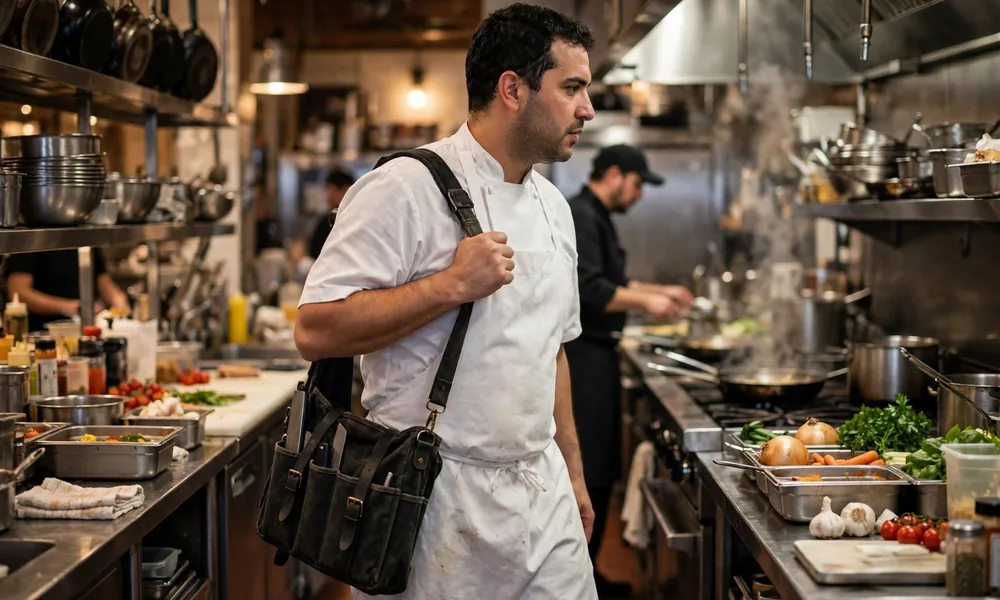
The closure is the part of a roll that fails most often, and it deserves more attention than it usually gets. Most rolls close with a pair of straps and buckles, which are simple, strong, and easy to replace if they break. Leather straps with brass buckles last longest, but they are slow to fasten when your hands are wet. Quick-release plastic buckles are faster and lighter, but they can crack if they are dropped on a hard floor. A padded, adjustable shoulder strap is worth having too, because it spreads the weight and leaves your hands free.
Keeping the Roll and the Blades in Good Shape
A knife roll needs very little care, but the little it needs matters. Empty it after every shift and shake out the crumbs and dust that collect in the bottom of the slots, because grit in a slot will scratch a blade every time it goes in and out. Wipe the inside weekly and let the roll dry fully open before you pack it away. Never put a wet knife into a roll: dry each blade before it goes into its slot, or the moisture will sit against the steel and cause rust.
The blades need care too. A roll protects an edge from knocks, but it does not keep it sharp. Hone your knives with a steel before each shift, and sharpen them properly a few times a year. Our guide to honing rods that keep an edge between sharpenings in 2026 explains how to use one without damaging the blade. Store the roll flat or hanging, never under a pile of other bags, because weight on top of a rolled bundle can bend a thin blade. If a slot tears, repair it quickly: a small tear grows every time a knife goes in and out.
Knife Roll Checklist
- Count the knives you use every week, then buy a roll with that many slots plus one or two spare.
- Check that your longest and widest blades fit their slots, with the tips covered by a flap or guard.
- Choose waxed canvas for everyday work, leather for a roll you want to keep for years, and thick nylon for a light first roll.
- Test the straps and buckles with wet hands, and make sure a shoulder strap is padded and adjustable.
- Pack the roll, roll it up, and carry it around the house to check that nothing shifts or pokes through.
- Dry every blade before it goes back in its slot, and air the roll open after each use.
Frequently Asked Questions
What is a knife roll?
A knife roll is a portable case that holds a chef’s knives in individual slots and rolls up for carrying. It is the case, not the knives: you buy the roll empty and fill it with the blades you already own, so they travel safely and stay organised.
How many knives should a knife roll hold?
Most working cooks need ten to twelve slots, which covers a chef knife, a bread knife, a boning knife, a paring knife, a utility knife, and a honing rod, with room to spare. Home cooks usually need only six to eight slots, and students should buy for the kit they expect to have in a year.
Is a leather knife roll better than a canvas one?
Leather looks better and lasts longer, and it moulds to your knives over time, but it costs more, weighs more, and needs conditioning. Waxed canvas is tougher in wet weather, lighter, and easier to clean, which is why most working cooks choose it for daily use.
Can I carry a knife roll on public transport?
Yes, in most places, as long as the knives are securely packed in the roll and you have a good reason to carry them, such as travelling to or from work as a chef or to a cooking class. Keep the roll closed and out of sight, and check the rules where you live, because they vary.
How do I clean a knife roll?
Empty it, shake out the slots, and wipe the inside with a damp cloth. Canvas rolls can be brushed clean and left to dry fully open. Leather rolls should be wiped with a damp cloth and conditioned now and then. Never machine wash a roll, and never pack it away damp.
Do I need a knife roll if I already have a knife block?
Only if you take your knives anywhere. A block is best for knives that stay in one kitchen, while a roll is for knives that travel. Many cooks have both. If you are choosing between the two, our guide to the best chef knives of 2026 explains which single blades are worth carrying in the first place.
The Bottom Line
The best knife roll in 2026 is the one that fits your knives, protects every edge, and is easy enough to carry that you actually take it with you. Count your blades, measure your longest knife, choose waxed canvas for daily work or leather for the long term, and test the roll loaded before you trust it on the road. Do that, and your knives will arrive sharp, safe, and ready to work, every single time.


