
The best laundry detergents in 2026 are the ones that get a full load properly clean on a normal cycle, without a double dose or a second run. Most of the difference comes down to three things: how much cleaning power is in the dose, whether the formula suits your water and machine, and whether you use the right amount.
This guide compares laundry detergents by what they do in the drum: stain removal, cold-water cleaning, cost per wash, and behaviour in hard water and high-efficiency machines. If sensitive skin is your main concern, our guide to the best laundry detergents for sensitive skin in 2026 covers fragrance-free formulas and label traps in detail.
Key Takeaways
- Cleaning power comes from enzymes and surfactants, not the size of the dose: a concentrated liquid measured correctly beats a full cap of a weak formula.
- Liquid suits cold washes and precise dosing, powder wins on cost per wash and whites, pods win on convenience, and sheets suit light loads and travel.
- Most people use too much detergent: a normal load needs about 30 millilitres of liquid, and excess leaves residue that dulls clothes.
- Hard water needs more detergent or a water softener, because minerals use up the cleaning agents before they reach the dirt.
- Detergent cleans, softener softens, and dryer sheets reduce static: three different jobs, and none replaces the others.
What a Laundry Detergent Actually Has to Do
A detergent has two jobs. The first is to lift dirt, sweat, body oils, and food off fabric and hold them in the wash water so they rinse away. Surfactants do most of this: one end of the molecule grabs grease and the other grabs water, so oily dirt gets carried off the fibres. The second job is to break down the stains surfactants alone cannot handle. That is where enzymes come in: protease for protein stains such as sweat and egg, amylase for starches, and lipase for fats and oils.
Everything else on the label is secondary. Fragrance cleans nothing, and optical brighteners only make whites look whiter with a fluorescent coating. Cold water is where the gap shows: at 30 degrees, a good enzyme detergent still breaks down sweat and food stains, while a weak formula leaves them half-done. Buy a detergent made for cold water and prove it on a stained tea towel first.
Detergent, Softener and Dryer Sheets Are Three Different Jobs
The laundry aisle blurs three products that do three different things, and mixing them up is the most common reason laundry comes out disappointing. Detergent is the only one of the three that cleans. It goes in at the start of the wash, lifts dirt off the fibres, and rinses away. Without it, nothing has removed the dirt.
Fabric softener does not clean anything. It is added in the rinse cycle, after the detergent has done its work, and coats the fibres so they feel softer and carry less static. That coating builds up, makes towels less absorbent, and blocks the wicking channels in gym clothes. Our guide to why fabric softeners are worth it, or not, in 2026 works out which loads benefit and which ones softener quietly ruins. The short version: softener suits bedding and casual cotton, never towels or activewear, and never replaces detergent.
Dryer sheets are the third job, and they work in the dryer rather than the wash. A sheet coats clothes with a thin layer of softening agent as it tumbles, which cuts static and adds scent. Like softener, the coating builds up and can leave a waxy film on the dryer sensor. Our guide to dryer sheets that leave laundry soft without the residue in 2026 explains how to pick lighter-coated sheets and use half a sheet for small loads. Remember one line: detergent cleans, softener softens, dryer sheets de-static.
The Main Formats Compared
Liquid is the most flexible format. It dissolves fully in cold water, rinses out cleanly, and lets you measure an exact dose. Its weaknesses are weight, plastic waste, and the temptation to pour too much, because a free pour is always more generous than a measured one.
Powder is the cheapest per wash and the strongest on whites and muddy clothes, because powder formulas handle minerals in hard water better than liquids. The trade-off is that powder needs warm water to dissolve fully. In a cold wash, undissolved powder can leave white marks on dark clothes, so dissolve it in a jug of warm water first.
Pods are the most convenient format and the least flexible. A pod is a fixed dose, which removes measuring entirely and suits shared laundry rooms. But a fixed dose is usually too much for a small or lightly soiled load, so pods cost more per wash. Keep them dry and out of reach of children.
Laundry sheets are the newest option: a pre-dosed strip that dissolves in the wash, with almost no packaging and almost no weight. They suit travel, small flats, and lightly soiled everyday loads, but their cleaning power is weaker on heavy stains.

The Best Laundry Detergents of 2026
The picks below are types, not single bottles, because the best formula depends on your water, your machine, and your stains.
Best Overall: A Concentrated Enzyme Liquid
For most households, a concentrated liquid with a full enzyme mix is the right first choice. It dissolves in cold water, lets you measure an exact dose, and handles the everyday mix of sweat, food, and body oils. Look for enzymes on the ingredient panel and a cold-wash claim on the front.
Best Budget: Powder
If you wash hot, have hard water, or want the lowest cost per wash, powder wins. It is the cheapest format by a clear margin, keeps whites bright, and handles muddy sports kit better than any other format. Avoid it only if you wash almost everything at 30 degrees and will not pre-dissolve.
Best for Cold Washes: A Liquid Made for 30 Degrees
Not every liquid works well cold. The ones that do say so on the front of the bottle and carry the enzyme mix to back it up. A cold-wash liquid saves energy on every load and is kinder to colours and elastic. Test it on a stained tea towel first.
Best Pods: A Three-Chamber Pod for Family Loads
Pods earn their place in busy family households, where measuring is a chore and loads are usually full. A three-chamber pod, with detergent, stain remover, and brightener in separate compartments, cleans better than a single-chamber pod on mixed family laundry. Use one pod per full load.
Best Sheets: Pre-Dosed Sheets for Light Loads and Travel
Sheets are the right pick for light loads, travel, and small flats where a bottle of liquid is more hassle than it is worth. They dissolve fully, leave almost no packaging, and cannot be overdosed. They are not the pick for heavy stains or greasy work clothes.
Best for Stains: An Enzyme Liquid Plus Pre-Treatment
No detergent removes a set stain on its own. The best stain result comes from a strong enzyme liquid combined with pre-treatment: rub a little liquid detergent into the stain, leave it for fifteen minutes, then wash as normal. For grease, add a drop of washing-up liquid. For dried blood, soak in cold water first, never hot, because heat sets protein stains permanently.

How Much Detergent to Use
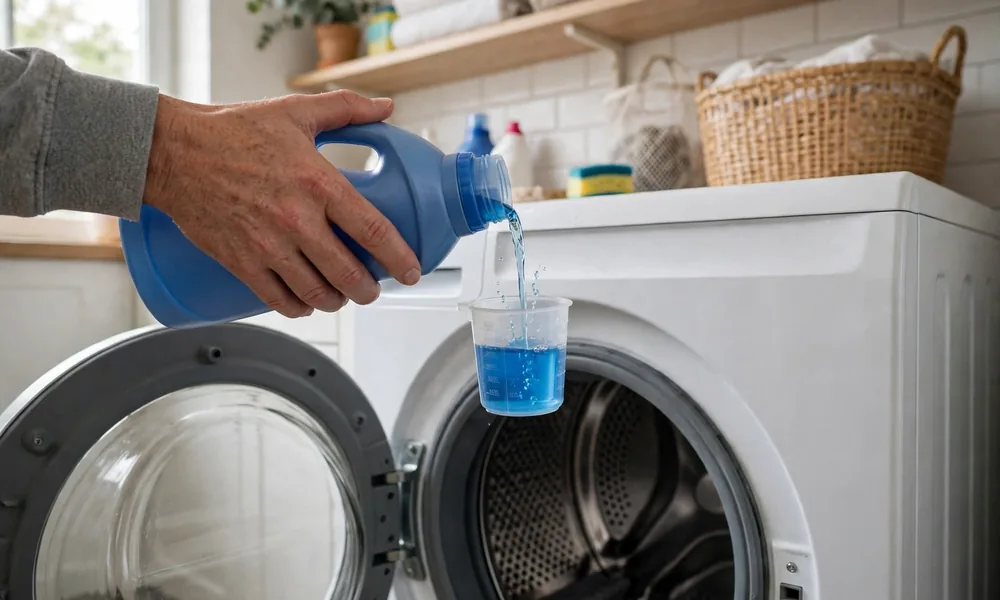
Overdosing is the most common laundry mistake, and the most expensive. For a standard 7-kilogram machine, a lightly soiled load needs about 20 to 25 millilitres of liquid, a normal load needs 30 to 35, and only a heavily soiled load needs the full dose on the cap.
Hard water changes the maths: minerals use up the cleaning agents before they reach the dirt, so you need a little more detergent, or a dose of washing soda in the drum. Front loaders need less detergent than top loaders. The measuring cap is the cheapest upgrade in the laundry room: pouring freehand adds roughly a third more detergent than measuring.
Cost per Wash and Waste
Cost per wash is the honest way to compare detergents, because bottle prices hide very different dose sizes. Divide the price by the number of loads the pack actually delivers at your dose. Powder is cheapest, usually a third less per wash than liquid. Concentrated liquid comes next, then standard liquid, then sheets, with pods the most expensive because the fixed dose is generous.
Laundry Detergents Compared
| Pick | Format | Best for | Cost per wash | Weakness |
|---|---|---|---|---|
| Best overall | Concentrated enzyme liquid | Most households | Medium | Easy to over-pour |
| Best budget | Powder | Whites, hard water, hot washes | Low | Needs dissolving in cold water |
| Best for cold washes | Cold-wash liquid | Everyday loads at 30 degrees | Medium | Weaker on heavy stains |
| Best pods | Three-chamber pods | Family loads, shared laundry | High | Fixed dose, no half loads |
| Best sheets | Pre-dosed sheets | Light loads, travel, small flats | High | Weak on heavy stains |
| Best for stains | Enzyme liquid plus pre-treatment | Sweat, food, grass stains | Medium | Needs fifteen minutes of pre-treatment |
Laundry Detergent Buying Checklist
- Match the format to your washing: liquid for cold washes, powder for hot washes and hard water, pods for full family loads, sheets for light loads.
- Check for enzymes on the ingredient panel, because enzymes remove sweat, food, and grease stains at low temperatures.
- Measure the dose for your load size, water hardness, and machine type, and use less than the cap suggests for lightly soiled loads.
- Test a new detergent on a stained tea towel at 30 degrees before buying the large bottle.
- Pre-treat stains with a little liquid detergent fifteen minutes before washing, instead of adding more detergent to the drum.
- Remember the three jobs: detergent cleans, softener softens, dryer sheets de-static, and none replaces the others.
Frequently Asked Questions
How much laundry detergent should I use per load?
For a standard 7-kilogram machine, use about 20 to 25 millilitres of liquid for a lightly soiled load, 30 to 35 for a normal load, and the full cap dose only for heavily soiled loads. Hard water needs a little more and soft water needs less.
Is liquid, powder, or pods better?
It depends on how you wash. Liquid is best for cold washes and precise dosing, powder is cheapest per wash and strongest on whites, pods are most convenient for full family loads, and sheets suit light loads and travel.
Can I use less detergent than the bottle says?
Yes, and most people should. Bottle doses are generous, and a normal load of everyday clothes cleans well on about two-thirds of the stated dose.
Why do my clothes still smell after washing?
Usually overdosing, a half-empty drum, or a dirty machine. Excess detergent leaves residue that traps smells, and a machine that never gets a hot maintenance wash grows mould in the seal and drawer. Cut the dose, wash full loads, and run an empty hot wash with a cup of white vinegar once a month.
Do I need fabric softener as well as detergent?
No. Detergent cleans and softener only coats fibres to make them feel softer, and the coating builds up on towels and gym clothes. Use softener only on bedding and casual cotton if you like the feel, and skip it on towels and activewear.
Are eco-friendly detergents as good as normal ones?
For everyday loads, yes, provided they carry enzymes and are dosed correctly. Plant-based surfactants clean lightly soiled clothes well at 30 degrees, but they are weaker on heavy stains, grease, and mud than a full enzyme formula.
The Bottom Line
The best laundry detergents in 2026 are not the most expensive bottles on the shelf. They are the ones that match your water, your machine, and your stains: a concentrated enzyme liquid for most households, powder for hard water and whites, pods for full family loads, and sheets for light loads and travel. Measure the dose, wash cold for everyday clothes, and pre-treat the stains that matter.


