
A selfie light is a small, battery-powered LED light that clips onto your phone or slips into your pocket, and it exists for one stubborn problem: the front camera on your phone is far better than the light in most rooms. Take a selfie in a dim restaurant or on a night walk, and the photo comes out grainy, yellow, or half in shadow, however good the phone is. A selfie light fixes the light, not the camera, by putting a soft, even glow right where the lens sits. It is the cheapest upgrade most people can make to their phone photos. This guide explains what a selfie light is, how the main types differ, and how to pick one for night photos.
Key Takeaways
- A selfie light is a small LED light made for phone photography: it clips to the phone or stands beside it, and it lights your face for still photos, not video calls.
- Clip-on lights are the best choice for most people: they travel with the phone, sit exactly where the front camera is, and need no stand or extra hands.
- Colour temperature matters more than raw brightness: a light that shifts from warm 3,000K to daylight 5,600K matches any room.
- Brightness should be judged at arm’s length, not on the box: a light that is too bright washes out skin, and a dimmer with small steps gives you control.
- Battery life decides whether the light is useful on a night out: look for at least an hour at medium brightness and USB-C charging.
What a Selfie Light Actually Is
A selfie light is any small light designed to light your face for a phone’s front camera, rather than to light a room. It sits centimetres from the lens, at eye level, and throws soft, even light forward onto your face. It is usually a slim panel or a small round disc of LEDs, powered by a rechargeable battery, with adjustable brightness and colour temperature, and small enough to live in a jacket pocket permanently. A room light sits in the wrong place, above you or to one side, while a selfie light sits where the camera sits, which is why even a small one beats a bright ceiling light.
The distinction matters because a video call happens at a desk, in one place, with time to set up, while a selfie happens anywhere: a dark bar, a night street, a concert, a beach at sunset. The light has to travel with the phone, switch on in seconds, and work without a stand or a plug socket. Our guide to the webcam lights that make you look sharp on calls covers the clip-on bars and desk panels made for laptop calls; a selfie light is the pocket-sized cousin made for photos on the move.

The Main Types of Selfie Light Compared
Most selfie lights fall into three groups: a clip-on light mounts directly on the phone, a pocket panel is held or propped nearby, and a selfie ring is the circular option with a phone mount in the middle.
| Selfie light type | Best for | Mounting | Power | Typical price |
|---|---|---|---|---|
| Clip-on light | Everyday selfies, travel | Clips to phone edge | Rechargeable battery | £10 to £30 |
| Pocket panel light | Portraits, group shots | Handheld or mini stand | Rechargeable battery | £15 to £45 |
| Selfie ring with phone mount | Short video, content | Tripod or handheld grip | Battery or USB | £20 to £60 |
Clip-On Lights: Best for Everyday Selfies
A clip-on light is a small disc or bar of LEDs that grips the top edge of your phone, right above the front camera. It is the most practical selfie light for most people, because it travels with the phone and is always in exactly the right place: behind the lens, at eye level, pointing at your face. The best ones are thin enough that the phone still fits in a pocket with the light attached, and they have a diffuser over the LEDs so the light is soft rather than a row of hard dots. Look for three colour temperatures and at least ten brightness levels, and check the clip grips firmly without marking the phone case. The trade-off is softness: a small disc gives a slightly harder light than a panel, and it lights one face well rather than a whole group.
Pocket Panel Lights: Best for Portraits and Groups
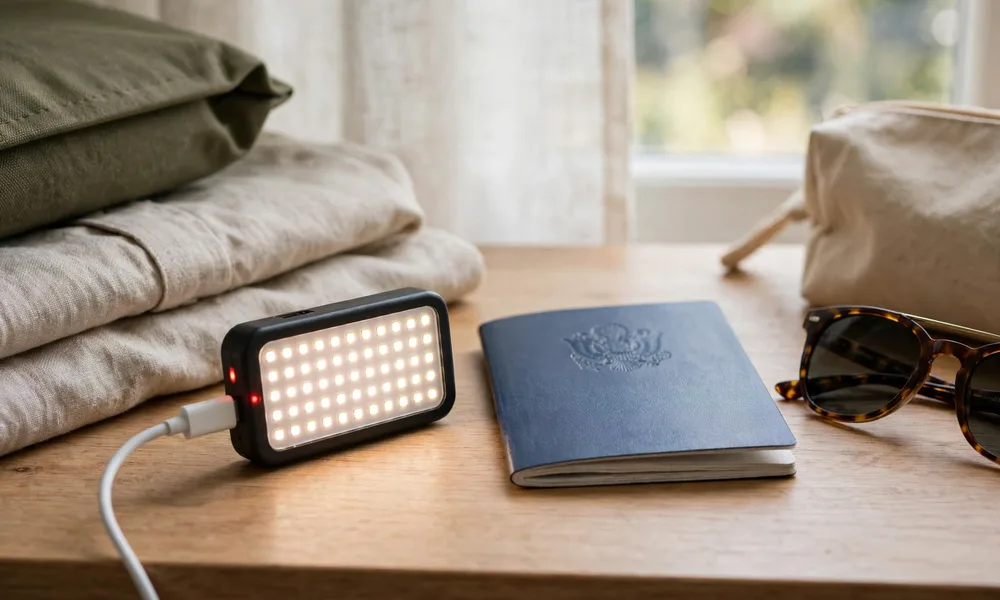
A pocket panel light is a flat rectangle of LEDs about the size of a credit card, and it is the best choice when the photo matters more than the pocket. The larger surface gives softer, more even light than a clip-on disc, flatters skin tones, and lights two or three faces at once. Panels suit portraits and group selfies, where someone can hold the light at arm’s length or prop it on a wall while the phone does the shooting. Many panels come with a tiny stand or a magnetic back. The trade-off is that a panel needs a hand or a stand, and it cannot clip to the phone and be forgotten. If you take group selfies at night, the panel is worth the extra pocket space. Our guide to the best selfie sticks covers the poles that hold the phone steady while the light does its work.
Selfie Rings: A Different Tool for a Different Job
A selfie ring is a circle of LEDs with a hole in the middle for a phone. Rings give very even light with a distinctive round catchlight in the eyes, and a large ring gives the softest light of any selfie light. For creators who record short video, a ring on a small tripod is the benchmark. For ordinary photos, a ring is often more light than you need: it needs a stand or a grip and does not fit in a pocket. If you want the full comparison of ring sizes, stands and colour settings, our guide to the top ring lights for video calls and content covers rings in depth. For a night out with friends, a clip-on or a pocket panel will serve you better than a ring you left at home.
Brightness, Colour Temperature and Skin Tones
Brightness is the number most buyers get wrong, because manufacturers quote it in different ways. Lumens describe total light output, while lux describes how much light reaches your face at a given distance, and lux is the number that matters. A light that gives a few hundred lux at 50 centimetres is plenty for a selfie, while a big lumen number with no diffuser will still look harsh. The practical test is simple: hold the light at arm’s length, take a photo at half brightness, and look at your skin. If the highlights on your forehead are blown white, step the brightness down or move the light further away.
Colour temperature, measured in kelvin, is the most misunderstood setting on a selfie light. Warm light, around 3,000K, is yellow and cosy; daylight, around 5,600K, is white and crisp; neutral, around 4,000 to 4,500K, sits in between. None is right in every place, so an adjustable light is worth paying more for, and neutral is the safest choice when in doubt. Also check the CRI: above 90 means skin tones look natural rather than grey or green.

Battery Life and Charging
A selfie light is only useful if it is charged when the photo happens, and battery life is where cheap lights fail first. Look for at least an hour at medium brightness, and at least twenty minutes at full brightness. USB-C is the charging port to look for, because it works with the same cable as most modern phones, and a light that charges in about an hour is ready again before dinner ends. Check whether the light can run while it charges, so a power bank in your pocket keeps it going all night, and look for a small battery indicator: a light with no indicator gives no warning before it goes dark.
How to Use a Selfie Light Well
Good setup beats an expensive light. Hold the phone at eye level or slightly above, never below the chin, because light from below carves shadows upward and makes everyone look tired. Keep the light at arm’s length: too close and the face blows out white; too far and the light is wasted. Start at half brightness and step up slowly, checking the preview rather than guessing. For group selfies, hand the light to the person furthest from the phone, so it reaches every face evenly instead of blasting the nearest one. Turn off the phone’s flash when the selfie light is on: the two lights fight each other, and the photo looks worse with both.
Your Selfie Light Buying Checklist
- Choose a clip-on light for everyday selfies and travel, or a pocket panel for portraits and group shots.
- Check for three colour temperatures, from warm 3,000K to daylight 5,600K, and a CRI above 90.
- Test brightness at arm’s length: look for small dimmer steps and a diffuser over the LEDs.
- Confirm at least an hour of battery at medium brightness, USB-C charging, and a battery indicator.
- Check the clip grips firmly with padded jaws, and that the light still fits in your pocket attached.
- Test for flicker at every brightness level before an important night out, and wipe the lens before shooting.
Frequently Asked Questions
Do I need a selfie light if my phone already has a flash?
Yes, for most night photos. A phone flash is a hard, single burst of light that washes out faces and leaves the background black. A selfie light is a soft, continuous light you can adjust before you shoot, so you can set the brightness and colour to match the room.
What size selfie light is best?
For everyday use, a small clip-on disc about 6 to 8 centimetres across is best: it lights one face well and fits in a pocket. For group shots, step up to a pocket panel the size of a credit card or larger, because the bigger surface gives softer light across several faces.
How far away should a selfie light be?
About an arm’s length, roughly 50 centimetres, at eye level or slightly above. Closer than that and the light blows out skin; further away and the light is too weak to matter. Start at half brightness at that distance, then adjust while watching the preview.
Is a selfie light better than a ring light for photos?
For photos on the move, yes: a selfie light fits in a pocket and clips to the phone, while a ring light needs a stand or a grip. For short video and content recorded in one place, a ring light gives softer, more even light and is the better tool.
What colour temperature should I use on a selfie light?
Match the room: warm, around 3,000K, for candlelit restaurants and bars; daylight, around 5,600K, for streets and outdoor evenings; neutral, around 4,000 to 4,500K, when in doubt. An adjustable light is worth paying more for, because no single setting suits every place.
Can I use a selfie light with a phone case on?
Usually yes, if the clip opens wide enough: most clip-on lights grip cases up to a few millimetres thick. Choose a padded clip so the jaws do not mark the case; very thick wallet cases may need a panel light held separately instead.
The Bottom Line
The best selfie light in 2026 is the one that fits your pocket, your phone, and your evenings. For most people that is a small clip-on light with three colour temperatures, a diffuser, and at least an hour of battery: it turns grainy night selfies into clear, natural photos. If you take group photos, add a pocket panel for softer light across several faces, and skip the ring unless you record in one place. Keep it charged: the best light is the one that is with you when the photo happens.


