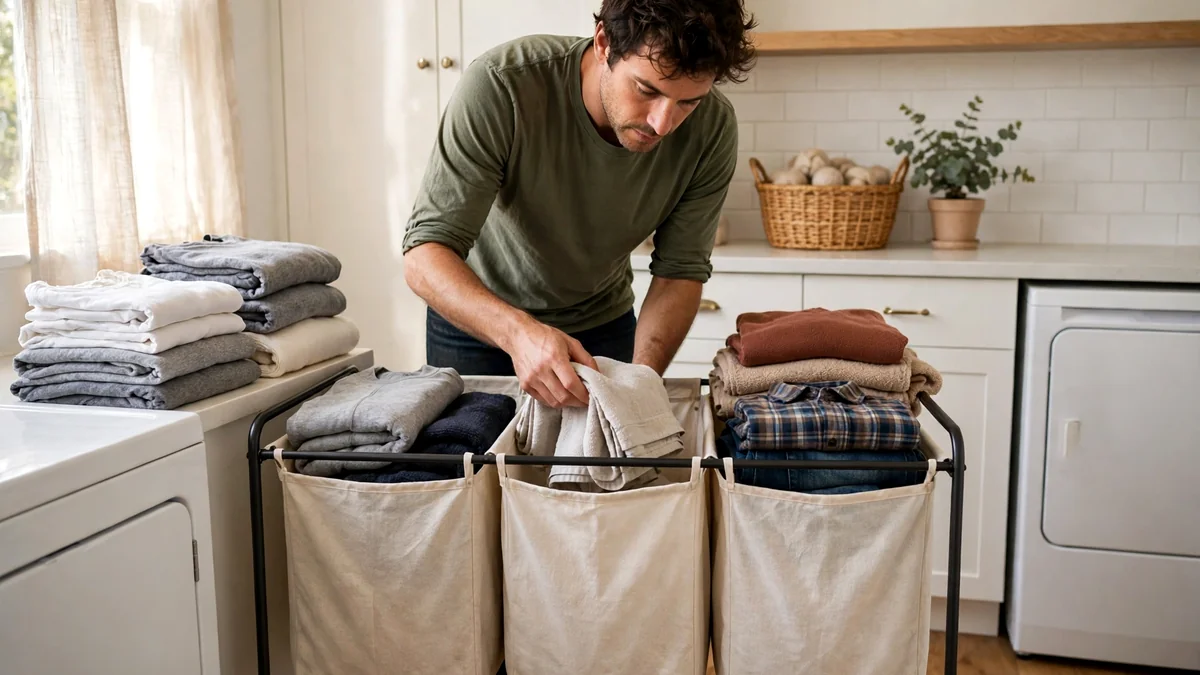
Laundry sorters are the standing frames with two, three or four separate bags that sort the washing at the moment it comes off, and the best ones in 2026 turn wash day into a five-minute job. Lights go in one bag, darks in the next, delicates in the third, and when a bag is full you lift it out and carry it to the machine — the sorting is already done. No re-sorting a pile on the laundry floor, no pink shirt in the whites, no digging through mixed washing at ten at night.
A sorter is not a basket and not a hamper. A laundry basket carries one mixed load from A to B; a sorter stays in one place and organises the washing over days. A hamper holds a week of mixed washing in one lidded compartment, while a sorter trades the lid for open bags and separation. Our guide to laundry hampers for small spaces covers the single-compartment alternative, where a divided sorter hamper appears as one type. This guide covers every sorter type, how many bags a household needs, and which frames and bag systems last.
Key Takeaways
- Sort at the source, not at the machine: a bag for lights, darks and delicates removes the re-sorting step from every wash.
- Three bags suit most households; two bags suit couples and singles, and four bags suit families who wash delicates or workwear separately.
- Removable bags with stitched handles matter more than the frame: the bag is what you carry, wash and replace.
- A three-bag sorter needs roughly 75 to 90 centimetres of width, so measure the laundry corner before buying.
- Rolling castors are worth having in any home where the sorter moves between bedroom and machine.
What a Laundry Sorter Actually Does
A laundry sorter holds dirty washing already separated into the loads you will wash. Each bag is one future load, and when any bag fills up, that is the load you run. The job it replaces is the sorting pile: the heap on the bed or the laundry floor that has to be divided by hand before every wash, with the mistakes that follow when you are in a hurry.
If your household washes everything together on one cycle, a sorter is wasted on you — a hamper holds more in less space. If you wash lights and darks separately, the sorter pays for itself in the first month. Families with children benefit most: school uniforms, sports kit, delicates and the inevitable muddy pile each get their own bag, and nobody has to ask which pile is which.
The Sorter Types Worth Knowing
Sorters come in five basic shapes, and the shape decides how the sorter behaves in a real laundry corner. Pick the shape for the room you have, not the one that looks tidiest in a photograph.

Two-Bag Sorters
A two-bag sorter holds lights in one bag and darks in the other, and it suits one or two people. Its footprint is the smallest of the standing sorters, usually around 55 centimetres wide, and it fits the gap between a machine and a wall that a three-bag sorter cannot. The weakness is the third load: delicates, towels or workwear have nowhere to go, so they end up in a basket on top or on the floor beside it.
Three-Bag Sorters
A three-bag sorter is the standard: lights, darks, and a third bag for delicates, towels or colours. It is usually 75 to 90 centimetres wide, which is the measurement to check before ordering. The three-bag frame is also the most stable shape, since the weight spreads across three compartments and the frame sits square. If you are unsure how many bags you need, start here.
Four-Bag Sorters
A four-bag sorter adds a compartment for workwear, baby clothes, sports kit or heavily soiled items, and it suits families of four or more. The footprint grows to around a metre wide, so it needs a dedicated laundry room or a wide utility corner. The advantage is that nothing overflows; the disadvantage is that four bags fill slowly in a small household, and a bag that sits half-full for a week starts to smell.
Rolling Sorters
A rolling sorter stands on four castor wheels, so it can be pushed from the bedroom to the laundry room and back. That matters where washing is generated upstairs and the machine lives downstairs. Look for castors that lock, because an unlocked sorter drifts across a hard floor every time someone brushes past it, and check the wheels are large enough to roll over a door threshold without tipping.
Tilt-Out and Cabinet Sorters
A tilt-out sorter hides its bags inside a cabinet, with a front that pulls down like a drawer. It looks the tidiest of all the types, because the washing is invisible. The trade-off is capacity and airflow: a cabinet holds less than an open frame of the same width, and damp clothes inside a closed cabinet go musty faster than in open mesh bags. Choose one with ventilation slots and a removable liner bag.
How to Size a Sorter for Your Household
Size a sorter by litres per bag, not by the total. One person generates roughly 30 to 40 litres of washing a week, a couple around 60 to 75, and a family of four around 100 to 120. A standard sorter bag holds 35 to 45 litres, so one bag is roughly one machine load. Measure the space before you buy: leave five centimetres of clearance on each side so the bags lift out without scraping the wall, and check you can lift a full bag straight up from under any shelf. The most common mistake is buying the four-bag sorter for a gap that fits three, then leaving the fourth bag empty and the frame sticking into the walkway.
Laundry Sorters at a Glance
| Sorter Type | Best For | Typical Width | Bag Size | Watch Out For |
|---|---|---|---|---|
| Two-bag | Singles and couples | 50–60 cm | 40 litres each | No home for delicates |
| Three-bag | Most households | 75–90 cm | 35–45 litres each | Needs a real gap |
| Four-bag | Families of four or more | 95–110 cm | 35 litres each | Bags fill slowly |
| Rolling | Multi-floor homes | 75–90 cm | 40 litres each | Castors must lock |
| Tilt-out cabinet | Bathrooms and bedrooms | 45–60 cm | 30–40 litres each | Less airflow |
Bags, Frames and Wheels: What Fails First
The bag fails first on most sorters, so judge the bag before the frame. A good sorter bag is heavy cotton canvas, thick polyester or mesh with reinforced seams, with handles stitched through the fabric rather than glued on. Lift a full bag by its handles if you can: a bag that stretches or tears at the handle seam will not survive a year of full loads. Removable bags are essential, because the bag is what goes to the machine and needs washing itself every month or two.
Mesh bags dry faster and let air through, which keeps damp clothes from going musty, but they show the contents and snag on zips. Solid fabric bags look tidier and hide the washing, but they trap moisture, so they suit dry laundry rooms and households that wash every two days. Either way, the bag should be machine-washable on its own.

Frames That Stay Put
The frame should be steel tube or solid wood, with joints that bolt or click firmly rather than press together. Press-fit plastic joints loosen with use, and a frame that wobbles when one bag is full and the others are empty will tip the first time a child leans on it. Check the feet: wide flat feet or a low crossbar keep the frame steady, and rubber caps stop it sliding and protect the floor.
Labels and Lids
Labels are what make a sorter work in a shared household. A bag labelled lights, darks and delicates gets used correctly by everyone, including children and guests; an unlabelled sorter becomes three bags of mixed washing within a week. Lids are a mixed blessing: they hide the pile and keep smells in, but they also hide how full a bag is, so bags overflow unnoticed. Open tops suit households that wash often; lids suit sorters that live in a bedroom.
Where to Put It
Put the sorter where the dirty washing is generated, not where the machine lives. Most washing is generated in bedrooms and bathrooms, so a sorter in the bedroom hallway or the bathroom corner gets used, while one banished to the laundry room gets bypassed in favour of the bedroom floor. Keep it off damp floors and out of direct steam, or the bags will grow mildew and the frame will rust.
Sorter Buying Checklist
- Count your real loads first: lights, darks, delicates, and anything else you wash separately, then buy that many bags.
- Measure the gap: width, depth and lift-out clearance, with five centimetres spare on each side.
- Lift a full bag by its handles and check the seams, the stitching and the weight before you commit.
- Check the bags are removable and machine-washable on their own.
- Push the frame diagonally and check it does not rock, and check the feet are wide and capped.
- Label every bag on day one, and agree with the household what goes in each.

Frequently Asked Questions
How many bags does a laundry sorter need?
Three bags suit most households: lights, darks and a third for delicates, towels or colours. Two bags suit singles and couples who wash everything in two loads, and four bags suit families with a separate workwear, sports or baby load. Count the loads you actually run and buy that number.
Are laundry sorters better than hampers?
They do different jobs. A sorter separates washing into loads as it is generated, so wash day needs no re-sorting. A hamper holds a week of mixed washing in one compartment and needs sorting at the machine. If you wash lights and darks separately, the sorter saves time every wash; if you wash everything together, the hamper holds more in less space.
Do sorter bags smell?
They can, if damp clothes sit in them for a week. Mesh bags and open tops help, because air circulates, and washing the bags themselves every month keeps them fresh. Never leave wet towels in a closed cabinet sorter overnight, and empty a bag as soon as it is full rather than letting it sit.
Can a laundry sorter replace a laundry basket?
Not quite. The sorter organises washing over days in one place, while a basket carries a load from one place to another. Most households use both: the sorter holds the separated loads, and the basket, or the removable sorter bag itself, carries a full load to the machine and the clean load back.
What size sorter do I need for a family of four?
A three-bag sorter with 45-litre bags, or a four-bag sorter with 35-litre bags, suits a family of four generating 100 to 120 litres a week. The three-bag version is simpler and fits more rooms; the four-bag version suits families with a separate sports, workwear or baby load.
Are rolling laundry sorters worth it?
Yes, where the washing is generated on a different floor from the machine: wheeling a full sorter beats carrying armfuls down the stairs. Just make sure the castors lock and the wheels are big enough to cross a door threshold without tipping.
Bottom Line
A laundry sorter earns its space by removing one job from every wash: the sorting. Buy the number of bags your household actually washes, measure the gap before you order, and judge the bags and the frame by how they behave full, not empty. Get those three things right, and wash day becomes lifting a bag instead of sorting a pile. Pair it with the right laundry detergents for sensitive skin for the loads it separates, and the routine takes care of itself.