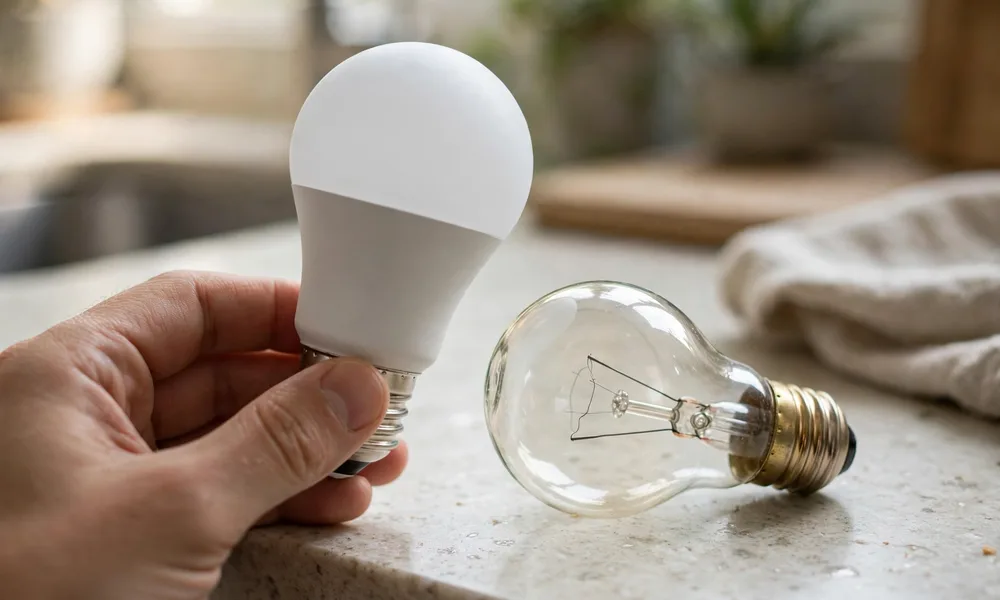
LED bulbs are the easiest upgrade in your home, and it is not close. No tools, no electrician, no redecorating, no learning curve. You unscrew the old bulb, screw in the new one, and the room looks better while the electricity bill quietly gets smaller. It takes about thirty seconds per bulb, and the rare home improvement that pays for itself many times over.
Most homes still have old-fashioned bulbs hiding in lamps, ceiling fittings and cupboards: hot, dim, yellowish things that burn out every year or so. Swapping them for LED bulbs fixes all of that at once. The light is steadier and truer, and the bulb stays cool and can last a decade or more. This guide explains what to look for and which mistakes waste money.
Key Takeaways
- Buy by lumens, not watts: an 800-lumen LED bulb replaces a 60-watt old bulb using about 9 watts.
- Colour temperature sets the mood — warm white around 2700K for living rooms and bedrooms, cooler white around 4000K for kitchens and workspaces.
- A high CRI (90 or above) makes colours, skin and food look natural instead of washed out or grey.
- Check the fitting and shape first: the wrong base or a bulb too wide for the shade is the most common wasted purchase.
- Dimmer switches need dimmable LED bulbs, and not every dimmable bulb suits every old dimmer.
Why the Swap Is So Easy
An LED bulb fits exactly where the old bulb fitted. The bases are the same — screw or bayonet — the shapes are the same, and the light switch works as it always did. There is nothing to rewire and nothing to learn. The only real decision is which bulb to buy: brightness, colour temperature, colour rendering and lifespan.
A typical old 60-watt bulb uses about six times as much electricity as its LED replacement for the same amount of light. The bigger win is lifespan: a good LED bulb is rated for 15,000 to 25,000 hours, roughly fifteen to twenty years at three hours a day. You stop buying bulbs, and you stop standing on a chair to change them.
Lumens, Not Watts
Watts measure how much electricity a bulb uses. Lumens measure how much light it gives out. With old bulbs the two moved together, so everyone shopped by watts. With LED bulbs that link is broken: a 9-watt LED can outshine a 60-watt old bulb. Shopping by watts now is how people end up with a bedroom lit like a cave.
The rough translations: about 450 lumens replaces a 40-watt bulb, 800 lumens replaces a 60-watt bulb, 1,100 lumens replaces a 75-watt bulb, and 1,600 lumens replaces a 100-watt bulb. Start from the room: a small bedroom is comfortable around 800 lumens per main fitting, a kitchen needs more. If a room feels gloomy after the swap, the bulb was almost certainly too dim.
Colour Temperature: The Mood of the Room
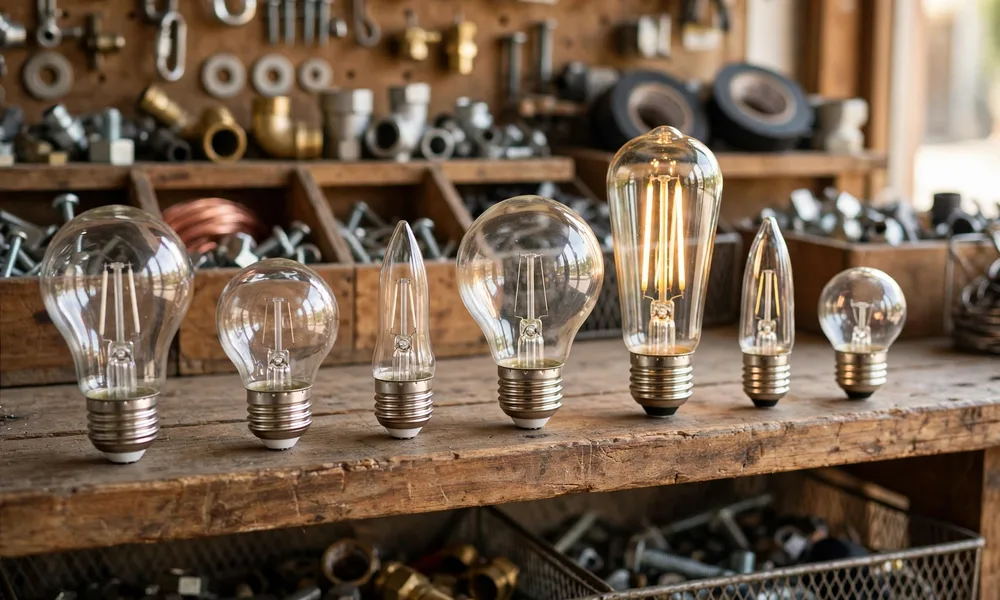
Colour temperature, measured in kelvin (K), describes whether the light looks warm and yellow or cool and blue-white, and it changes how a room feels more than brightness does. Warm white, around 2700K, feels like candlelight: relaxing and flattering, right for living rooms, bedrooms and dining rooms. Cool white, around 4000K, feels like daylight: clean and alert, right for kitchens, bathrooms and workspaces.
The mistake is mixing temperatures in one room: a warm ceiling light plus a cool-white lamp makes both look wrong. Pick one temperature per room and stick to it. Daylight bulbs at 5000K and above belong in a garage or workshop, not a living room, where they make everything look like a hospital corridor. If you are unsure, buy warm white for anywhere you relax and cool white for anywhere you work.
CRI: Why Some Bulbs Make Everything Look Grey
CRI, the colour rendering index, measures how truthfully a bulb shows colours compared with natural light. It runs to 100, and it matters more than most people realise. A bulb with a CRI of 80, the common standard, is fine for a hallway or a cupboard. In a living room or kitchen, though, a low-CRI bulb makes skin look sallow, food look dull and wood look flat.
A bulb with a CRI of 90 or above is a visible step up: tomatoes look red, faces look healthy, the room looks like itself. It costs a little more and is worth it anywhere you spend time. The box usually prints the CRI in small type; if a bulb does not list one at all, assume it is nothing special.
Dimmers: The One Place the Swap Can Go Wrong
Old bulbs dimmed smoothly because a dimmer simply starved them of power. LED bulbs are electronics and need to be built for dimming: a non-dimmable LED bulb on a dimmer will flicker, buzz, or glow faintly when it should be off. The fix is simple — buy bulbs marked dimmable, and check the dimmer itself.
Older dimmers were designed for heavy old bulbs and sometimes refuse to work with the tiny load of an LED: flickering at low settings, a limited range, or a bulb that never fully turns off. The cure is a modern LED-compatible dimmer, a small job for an electrician. Test one bulb on the dimmer before buying ten.
Smart Bulbs vs Ordinary LED Bulbs
Smart bulbs are LED bulbs with a radio inside: control them from a phone or voice assistant, change their colour, set schedules and dim them without touching a switch. They are genuinely useful in a few places — a bedroom lamp you want to fade at night, a hallway light on a timer when you are away. Everywhere else they are an answer to a question nobody asked.
The honest rule is to start ordinary: put plain LED bulbs everywhere first, and only then add smart bulbs where you actually reach for a switch at an awkward moment. Smart bulbs cost several times more, need an app and a connection, and go fiddly when the Wi-Fi drops. If you do go smart, check the bulb works with the assistant you already use, and never put a smart bulb on a dimmer switch.
| Bulb type | Best for | Strength | Weakness |
|---|---|---|---|
| Standard LED | Every room, every fitting | Cheap, cool, lasts 15+ years | Fixed brightness and colour |
| Dimmable LED | Rooms with dimmer switches | Smooth dimming, same savings | Needs a compatible dimmer |
| High-CRI LED | Living rooms, kitchens | Colours look true and natural | Costs a little more |
| Smart LED | Bedrooms, timers, mood lighting | App and voice control, colour changing | Pricey, needs Wi-Fi, can be fiddly |
| Old incandescent | Nowhere, really | Warm light, fully dimmable | Hot, short-lived, six times the power |
Fittings and Shapes: Measure Before You Buy
The most common wasted purchase is a bulb with the wrong base. In most homes the big screw base (E27) and bayonet cap (B22) cover the ceiling lights, while the small screw base (E14) fits chandeliers, bedside lamps and cooker hoods. The base is printed on the old bulb and on the fitting; match it exactly.
Shape matters too: a globe bulb looks right in a pendant and wrong in a narrow spotlight, and a wide bulb can stick out of a small shade. Take the old bulb with you before buying a multipack. Check enclosed fittings too: some LED bulbs are not rated for them, where heat builds up and shortens their life.

Lifespan, Savings and What to Avoid
A good LED bulb should last 15,000 hours or more; the best are rated to 25,000. That is the number to compare, not the warranty claim on the front of the box. Cheap no-name bulbs often quote a long life and deliver a short one. Buying from a known brand is the cheapest insurance: a bulb that lasts fifteen years beats three cheap ones that do not.
A few things to avoid: do not buy the cheapest multipack without checking the lumens, colour temperature and CRI — a bargain bulb that makes your living room look grey is no bargain. Do not put a non-dimmable bulb on a dimmer, or use a bulb in an enclosed fitting unless the box rates it for one. And do not throw dead LED bulbs in the general rubbish: they belong at the same recycling point as batteries. For the fittings themselves, it helps to know how the rest of the room’s lighting works — our guide to the best and worst desk lamps covers what to look for in a task light, and our guide to the best and worst table lamps does the same for the lamps beside your bed and sofa.
Where to Start in Your Home
Start with the room you use most: the living room first, where you will notice the better light every evening, then the kitchen. Bedrooms come next, with warm white bulbs that wind the day down. Hallways, cupboards and bathrooms can wait.
Buy one bulb first and try it for a few evenings: check brightness, colour and dimming. Once you have found one you like, buy the rest in one go. Keep a spare in a drawer, and write the fitting size on the box. If you want to dress the rooms up further once the bulbs are sorted, our guide to picking string lights that last all year covers the decorative side of home lighting.
Checklist: Buying LED Bulbs Without Regret
- Match the base exactly: E27, B22 or E14, as printed on the old bulb.
- Buy by lumens — 800 for a 60-watt replacement, 1,100 for 75-watt, 1,600 for 100-watt.
- Pick one colour temperature per room: 2700K warm for relaxing, 4000K cool for working.
- Choose CRI 90 or above for living rooms and kitchens.
- Buy dimmable bulbs for any fitting on a dimmer, and test one first.
- Check the bulb fits the shade and is rated for enclosed fittings if needed.
Frequently Asked Questions
Do LED bulbs really save money?
Yes — about a sixth of the electricity of the old bulb it replaces for the same light, and it lasts ten to twenty times longer. A whole house pays the swap back well within the first year or two.
Why does my new LED bulb flicker?
Almost always an old dimmer switch built for heavy old bulbs. Try the bulb on a normal switch first: if it is steady there, the dimmer is the problem. A non-dimmable bulb on any dimmer will also flicker.
Can I put an LED bulb in any fitting?
Almost. It must have the same base and fit inside the shade or cover. The one exception is fully enclosed fittings, where heat builds up: only use a bulb the box rates for enclosed fixtures.
What colour temperature should I choose?
Warm white around 2700K for living rooms and bedrooms; cool white around 4000K for kitchens and workspaces. Keep one temperature per room.
Are smart bulbs worth it?
For a few jobs — timers, bedtime fading, changing the mood — yes. For general lighting, no: plain LED bulbs give the same light and savings for a fraction of the price, with no app and no Wi-Fi.
How do I dispose of a dead LED bulb?
Take it to the same recycling point as batteries and small electronics. LED bulbs contain circuit boards and should not go in general rubbish.
The Bottom Line
LED bulbs are the easiest upgrade in your home because there is almost nothing to get wrong and everything to gain. Match the base, buy by lumens, pick warm light where you relax and cool light where you work, and spend a little extra on a high CRI and a known brand. Do that, and the swap takes an afternoon, the rooms look better the same evening, and the bulbs you fit now can still shine in fifteen years.