
Lumbar Pillows That Ease Back Pain on the Sofa in 2026
A lumbar pillow is the small cushion that fills the gap between your lower back and the seat, and for anyone whose back aches after an evening on the sofa, it can change how sitting feels. Most sofas are built for looks first: deep seats and soft back cushions that slope away from you, with nothing where the natural curve of your lower back needs support. You sink in, your lower back rounds, and after an hour the ache starts. A lumbar pillow pushes gently against that curve, holding your spine closer to its natural shape while you sit. Here is how to choose one for the sofa, the office chair and the car.
Key Takeaways
- A lumbar pillow should sit at belt height, filling the hollow of your lower back, not up near your shoulder blades.
- Memory foam and latex hold their shape under your weight; soft fibre and feather fills flatten and give no real support.
- A rectangular pillow around 30 by 50 centimetres suits most sofas, while a contoured shape suits desk chairs.
- Firmer is usually better for support, but the pillow should still compress a little when you lean back into it.
- If back pain is new, severe, or does not ease after a few weeks, talk to a clinician rather than relying on a cushion alone.
Why Your Lower Back Aches on the Sofa
Your lower back has a gentle inward curve. When you stand, that curve is held by your muscles and the shape of your spine. When you sit on a deep sofa, the seat is usually too deep for your legs, so you slide forward or slump back, and the curve flattens or reverses. The muscles along your spine then work overtime to hold you upright. That is why the ache often arrives slowly, an hour into a film or a long read, rather than the moment you sit down.
What a Lumbar Pillow Actually Does
A lumbar pillow does two things. First, it fills the space between your lower back and the backrest, so your spine is supported along its whole length instead of hanging unsupported. Second, it nudges your pelvis slightly forward, which helps restore the natural inward curve of the lower back. You should feel supported, not pushed: if the pillow shoves you forward, it is too thick or in the wrong place.
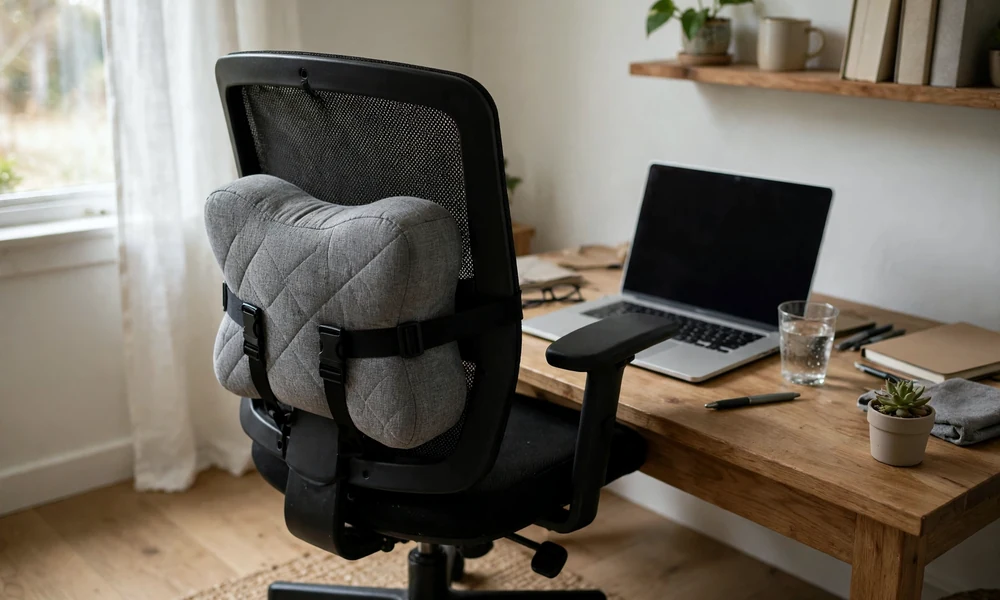
Position matters more than price. Place the pillow low, at about belt height, with its centre against the small of your back, and sit back fully so your shoulder blades rest on the backrest above it. If the pillow rides up, your shoulders will ache instead; if it sits too low, it presses into your hips. On a sofa, a pillow without straps needs a nudge back into place when you stand up. In an office chair, a strap around the backrest keeps it at the right height all day.

Lumbar Pillow Shapes Compared
Shape is the first choice, and it decides which seat the pillow suits. A rectangular pillow is the all-rounder: it covers a wide area and works on sofas, armchairs and beds. A half-moon shape gives a focused ridge of support and suits deep sofas where a flat pillow would disappear into the cushions. A contoured pillow, dipped in the middle, wraps around the lower back and stays in place on upright chairs. A wedge slopes from thin to thick and suits people who want gentle support.
| Shape | Best for | Support | Stays in place |
|---|---|---|---|
| Rectangular | Sofas and armchairs | Even, broad | Fair, needs adjusting |
| Half-moon | Deep sofas | Focused ridge | Good |
| Contoured | Office and desk chairs | Wraps the lower back | Very good with straps |
| Bolster roll | Reading and short sits | Firm, narrow | Fair, tends to roll |
| Wedge | Gentle support | Light, gradual | Good |
For a first lumbar pillow, the rectangular shape is the safest buy. If your sofa is deep and soft, go straight for the half-moon; for a desk chair, the contoured shape with straps is better. Our guide to the best vs worst throw pillows in 2026 covers the decorative side.
The Best Lumbar Pillows of 2026
Best Overall: Rectangular Memory Foam Pillow
A rectangular memory foam pillow, roughly 30 by 50 centimetres, is the best lumbar pillow for most people in 2026. Memory foam moulds to the curve of your lower back, then holds that shape while you sit, so the support stays even instead of flattening after twenty minutes. Look for a removable, washable cover and foam that springs back slowly when pressed.
Best for the Office: Contoured Pillow With Straps
For a desk chair, a contoured memory foam pillow with adjustable straps is the pick. The dip in the middle cradles the spine while the raised sides stop it sliding sideways, and the straps hold it at belt height through a full working day. Our guide to the best ergonomic chairs in 2026 explains seat height and depth, and a lumbar pillow works best on a chair that is already close to right.
Best for Deep Sofas: Half-Moon Bolster
Deep sofas swallow flat pillows. A half-moon bolster, with its curved ridge, reaches forward to meet your back even when the seat is deep, and its flat back sits neatly against the sofa cushions. It is firmer than a rectangular pillow, so it suits people who like a definite push against the lower back, and it doubles as a prop for reading.
Firmness: How Firm Should It Be?
Firmness is where most buyers go wrong, usually by choosing too soft. Press the pillow with both hands: it should push back firmly, compressing by about a third and then stopping. If it flattens to the seat, it is decoration, not support. If it barely compresses at all, it will feel like a brick after half an hour.
Body weight changes the answer. Lighter people need a softer pillow, because they do not press hard enough to compress a very firm one. Heavier people need a firmer pillow, because a soft one bottoms out under them. Give any new pillow a week: your back needs a few days to adjust to sitting straighter, and a pillow that feels strange on day one often feels right by day five.
Fillings Compared: What Holds Its Shape?
The filling decides whether the pillow keeps supporting you or slowly gives up. Memory foam is the best all-rounder: it moulds to your shape and holds firm for years. Latex is firmer and springier, but costs more. High-density fibre is cheap and washable, but it flattens over months. Feather and down feel luxurious, but they are the worst choice for support: they offer almost no resistance and collapse under your weight.
The cover matters too. A removable, machine-washable cover is worth paying for, because a lumbar pillow lives against your back every day. Cotton and linen covers breathe best, and a grippy texture helps the pillow stay in place on leather or smooth sofa fabric.
Size: Measure Before You Buy
Lumbar pillows are sold by width and height, and the numbers matter. The most useful size for a sofa is about 30 centimetres high and 50 centimetres wide: tall enough to cover the lumbar curve, wide enough to support you even if you shift sideways. Smaller pillows, around 25 by 40 centimetres, suit petite sitters and car seats. Larger ones, 35 by 60 centimetres, suit tall people and very deep sofas, but they can overwhelm a small armchair.
Measure your seat before ordering. Sit in your usual spot and measure the gap between your lower back and the backrest at belt height: that gap is the thickness your pillow needs to fill, usually between 8 and 15 centimetres. When in doubt, size down: a slightly small pillow in the right place beats a large one that pushes you forward.
Where to Use It: Sofa and Desk
On the sofa, the pillow belongs behind your lower back while you sit upright. Sit back fully, feet flat on the floor, and slide the pillow into the hollow at your waist. If your feet dangle, put a footrest under them: dangling feet pull the pelvis forward and undo the pillow’s work.
At a desk, the pillow works as part of the whole setup, not on its own. Set your chair height so your feet rest flat and your knees sit at roughly a right angle, then strap the pillow at belt height and sit back against it. No cushion replaces getting up: stand and stretch for a few minutes every hour.
Mistakes That Make a Good Pillow Feel Useless
The most common mistake is placing the pillow too high. Up near the shoulder blades it arches the upper back and does nothing for the lower back. The second is choosing a pillow that is too thick, which pushes you to the front of the seat. The third is buying a soft decorative cushion and expecting support from it. And the fourth is expecting the pillow to fix everything: it helps you sit straighter, but it cannot undo a sofa that is far too deep or a day spent without standing up.
Shopping Checklist
- Measure the gap between your lower back and the backrest at belt height before ordering.
- Choose memory foam or latex for support; skip feather and soft fibre fills.
- Press the pillow before buying: it should compress by about a third, then push back firmly.
- Pick a rectangular pillow for the sofa, a contoured one with straps for a desk chair.
- Check the cover is removable and machine washable, with a smooth hidden zip.
- Try it for a week, adjusting the height daily, before deciding it does not work.
Frequently Asked Questions
Where exactly should a lumbar pillow sit?
At belt height, centred on the small of your back, with your shoulder blades resting on the backrest above it. If it rides up toward your shoulders or slips down to your hips, move it back to belt height.
Are lumbar pillows good for back pain?
Many people find they ease the ache that comes from sitting, because the pillow supports the lower back’s natural curve and takes load off tired muscles. It is a comfort aid, not a treatment: if pain is new, severe, or does not improve in a few weeks, talk to a clinician.
What size lumbar pillow should I buy?
About 30 by 50 centimetres suits most adults on a sofa. Smaller sizes suit petite sitters and car seats, while taller people and very deep sofas usually need a taller pillow. Measure the gap your back leaves against the seat first.
Is memory foam or latex better for a lumbar pillow?
Memory foam moulds to your shape and suits most people, while latex is firmer, springier and cooler, and lasts longer. Both hold their shape far better than fibre or feather. Choose latex if you run warm or found foam too soft.
Can I use a lumbar pillow in the car?
Yes, with a compact contoured pillow and a strap around the seat. Fit it before driving, keep it slim so your distance from the pedals does not change, and make sure you can still see clearly over the wheel.
How do I stop my lumbar pillow sliding down?
Use a pillow with straps on upright chairs, choose a grippy cover on smooth sofas, and check its position each time you sit down.
The Bottom Line
The best lumbar pillow in 2026 is a medium-firm memory foam pillow, about 30 by 50 centimetres, placed at belt height on the seat where you sit most. Rectangular for the sofa, contoured with straps for the desk, compact for the car. Measure the gap first and give it a week at the right height. Our guide to the best pillows for side sleepers in 2026 covers the other half of the day, when the same lower back needs support in bed.


