
A padlock that lives outdoors has a harder life than any lock in the house. The padlocks that hold up in rain and rust in 2026 are built for it: a solid body, a shackle that resists cutting and corrosion, and a cylinder that turns after winter. The cheap padlock on the garden gate looks fine in the shop, until one February morning the key will not turn and the shackle has gone orange.
This guide explains what rain and rust do to a padlock, which materials survive them, and how to match the lock to the gate, shed, or storage unit. It covers keyed padlocks only: portable locks with a shackle you carry to the hasp, not combination padlocks, which open with a code, and not the fixed locks on a front door. For the wider picture, our comparison of the best and worst door locks of 2026 puts padlocks in their place alongside the rest of the hardware.
Key Takeaways
- Buy for the weather it will live in: an exposed gate needs a weatherproof body and a stainless shackle.
- Brass suits damp gardens; stainless suits coastal air; laminated steel is strong and cheap but needs its coating intact.
- A hardened steel shackle matters more than the body: a thin mild-steel one can be cut in seconds, and a rusted one can seize shut.
- Measure the hasp first: shackle diameter, clearance, and length all have to fit, or the lock will not close.
- Oil the keyway once or twice a year and hang the lock shackle-down so water drains out instead of sitting inside.
What Rain and Rust Actually Do to a Padlock
Rain does not kill a padlock in a day. It works slowly, from the inside out. Water gets in through the keyway, the gap where the shackle enters the body, and any crack in a plated finish. Once inside it sits: a padlock on a gate never fully dries, and over weeks and months the trapped water starts on the cheapest metal first, usually the springs and pins inside the cylinder.
Rust shows up in three ways. First, a stiff key: the pins inside the cylinder corrode and stop sliding, so the key needs a wiggle, then a shove, then one cold morning it snaps. Second, a seized shackle: the locking bolts rust in place, so the shackle will not lift even with the right key. Third, a weakened shackle: once the plating is breached, the steel underneath pits, and a pitted shackle is far easier to cut.
Frost makes it worse: water inside freezes overnight and pushes the pins out of alignment, so the key will not go in. Salt air is worse still: a padlock a mile from the sea corrodes several times faster than one inland.

The Three Parts That Decide Whether a Padlock Survives
Every padlock is three things: a body, a shackle, and a cylinder. Each fails in its own way, and a lock is only as weatherproof as its weakest part.
The body
The body’s job is to keep water and dirt out of the mechanism. Solid brass is the classic outdoor choice: it does not rust, it tarnishes slowly, and it machines cleanly. Stainless steel is tougher and better in coastal or industrial air, but it costs more. Laminated steel bodies are layers of steel pressed together; they are strong for their price, but water creeps between the layers, and once the coating chips, rust starts at the edges. For a gate or shed that faces the weather all year, brass or stainless is the sensible default.
The shackle
The shackle is the loop that takes the force, and it is the part a thief attacks first. A hardened steel shackle resists bolt cutters, where mild steel cuts like butter, so look for at least 8 millimetres for a shed or gate, and thicker for anything valuable. Intact plating keeps water off, but a single chip lets rust start underneath and spread where you cannot see it. Stainless shackles are worth it outdoors because they cannot rust through. A shrouded shackle leaves less of the loop exposed to a cutter: the best upgrade for a lock guarding tools or bikes.
The cylinder
The cylinder is the part the key turns, and it is the part weather kills first. A brass cylinder with brass pins resists corrosion far better than a zinc-alloy one, and a keyway cover keeps rain out. A keyway that faces upwards when hanging collects water no matter what the lock is made of, so hang it with the keyway facing down or sideways wherever the hasp allows. The deadbolts that keep your door locked tight in 2026 use the same principle on a bigger scale: the bolt and the frame matter, but the cylinder is what the weather and the thief both go for first.
Brass, Stainless Steel, or Laminated Steel?
There is no single best body material, only the best one for the spot.
| Body material | Rust resistance | Strength | Price | Best for |
|---|---|---|---|---|
| Solid brass | Very good; tarnishes only | Good | Mid-range | Garden gates, sheds, outdoor use |
| Stainless steel | Excellent, even in salt air | Very good | Higher | Coastal homes, exposed sites |
| Laminated steel | Fair; rusts once the coating chips | Very good | Budget | Sheltered spots, chains, short-term use |
| Aluminium | Excellent; cannot rust | Light duty only | Low to mid | Luggage, light gates, indoor storage |
For most gardens, solid brass is the sweet spot: it shrugs off ordinary rain for years. Go stainless when the lock will face sea air, road salt, or a spot that never dries. Laminated steel is fine for a chain in a dry garage or under a porch roof, but check its coating yearly and replace it at the first sign of rust at the edges.
Shackle Size, Clearance, and the Hasp
The best padlock in the shop is useless if it does not fit the hasp, so measure three things. Shackle diameter is the thickness of the loop: it has to pass through the hasp holes, and a millimetre too thick means it will not close. Clearance is the height of the loop: it must pass through the hasp and the chain link together. Shackle length is how far the loop reaches: too short and it will not span a thick gate post and its hasp; too long and it leaves a gap for a cutter.
The hasp matters as much as the lock. A hasp held on with short screws into soft wood can be prised off in seconds, whatever the padlock costs, because the thief attacks the screws, not the lock. Fit it with long screws or coach bolts through the door or post, and choose one with a cover that folds over the padlock body to hide the shackle. A heavy padlock on a flimsy hasp is decoration.
How to Keep a Padlock Working in the Rain
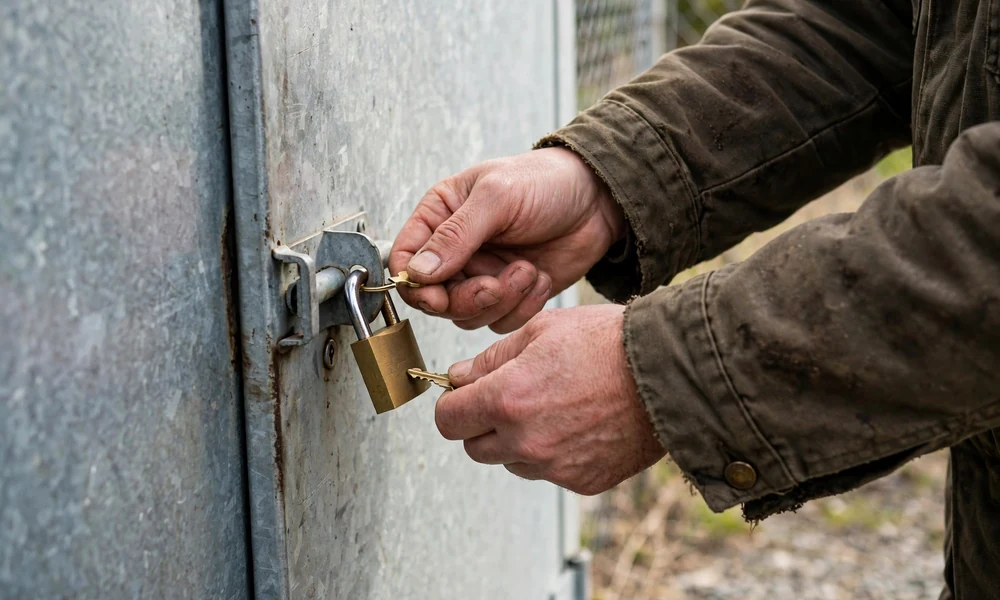
Twice a year, work a drop of light oil or a puff of graphite into the keyway, then work the key in and out and open and close the shackle. Graphite suits dusty places; light oil suits wet places. Never use heavy grease in the keyway: it goes stiff in the cold.
If a key starts to stick, do not force it. Spray a little penetrating oil into the keyway, wait ten minutes, and work the key gently: forcing a key in a corroded cylinder is how keys snap, and a snapped key in a rusted lock is a locksmith’s job. If the shackle will not lift, tap the body lightly while turning the key; the vibration often frees a rusted bolt inside. Keep a spare key somewhere dry indoors, not on the same ring.
What to Avoid
The worst padlocks fail in the same few ways, all visible before you buy. Avoid a shackle thinner than 6 millimetres outdoors: it can be cut with small bolt cutters in seconds. Avoid bright chrome plating on a cheap zinc body for an exposed gate: the plating chips, the zinc corrodes, and the lock swells and seizes. Avoid a lock with no keyway cover and a keyway that faces up when hung, and avoid buying by weight alone.
Match the lock to what is behind it: a shed full of power tools deserves a hardened shackle and a shrouded body, because the tools inside are what a burglar needs to break into the house itself. For the front door, a keypad or fingerprint option suits households that hate carrying keys; our guide to the best smart locks for front doors in 2026 covers those, but a smart lock belongs on a door, not on a gate in the rain.
Checklist Before You Buy
- Check the exposure: full rain, sheltered porch, or coastal salt air, and pick the body material to match.
- Measure the hasp: shackle diameter, clearance, and length must all fit before you leave the shop.
- Choose a hardened steel shackle at least 8 millimetres thick for a shed or gate, and a shrouded body for valuables.
- Pick a brass or stainless cylinder and a keyway cover, or a hanging position that keeps rain out.
- Match the hasp to the lock: long screws or bolts and a cover that hides the shackle.
- Buy two keys and keep the spare dry indoors, away from the key ring.

Frequently Asked Questions
How long should an outdoor padlock last?
A good brass or stainless padlock, oiled twice a year, should last ten years or more outdoors; a cheap plated lock can fail in two or three winters. Replace it when the key sticks regularly or the shackle pits, rather than waiting for it to seize.
Is brass or stainless steel better for a padlock?
Brass suits most gardens: it does not rust and lasts for years in ordinary rain. Stainless is better in salt air, by the coast, or anywhere the lock never fully dries; spend the extra only where the weather justifies it.
What size padlock do I need for a shed?
A body 40 to 50 millimetres wide with a hardened shackle at least 8 millimetres thick is the usual pick. Measure the hasp first: the shackle must pass through the hasp holes with room to spare, and the clearance must span the hasp and chain.
Can I use a padlock on a gate that gets rained on every day?
Yes, if it is built for it: a brass or stainless body, a hardened shackle, and a keyway cover, hung keyway-down and oiled twice a year. A cheap indoor padlock on a wet gate will seize; a weatherproof one will not.
Why does my padlock key stick in winter?
Usually water inside the cylinder has frozen, or corrosion is stopping the pins. Warm the key in your hand, work it gently, and use a little penetrating oil or de-icer in the keyway; do not force it, or it can snap. A keyway cover and twice-yearly oiling prevent most of it.
Should I choose a keyed padlock or a combination padlock?
A keyed padlock suits a lock that stays in one place and is used by one or two people: the key is simple and the mechanism is strong. A combination padlock suits a lock shared between several people, a gym locker, or anyone who loses keys: no key to lose and no keyway to rust shut; the trade-off is a code to remember and more moving parts to keep dry.
The Bottom Line
The padlocks that hold up in rain and rust in 2026 are not the dearest ones: they are the ones with the right materials for the spot, a hardened shackle thick enough to matter, a cylinder that keeps water out, and a hasp as strong as the lock itself. Measure the hasp, pick brass for the garden or stainless for the coast, and oil the keyway twice a year.


