A pen holder is the smallest piece of furniture on a desk, and it does more work than almost anything else there. It keeps the pens you actually use within reach, stops them rolling onto the floor, and turns a scattered handful of writing tools into a tidy, intentional corner of the workspace. The best pen holders of 2026 do that without taking up half the desk, without tipping over when you pull a pen out, and without looking like an afterthought. The worst ones are too light, too shallow or too small, and they end up as clutter themselves.
What a Pen Holder Actually Does
A pen holder has three jobs, and only three. It stores pens upright so you can see what you have and grab the right one without digging. It protects pen tips and nibs from being knocked about in a drawer, where they dry out, leak or snap. And it defines a home for writing tools, so they stop migrating across the desk, into drawers and down the back of the sofa. A holder that fails at any of these is not doing its job, however attractive it looks. The best pen holders of 2026 are judged on exactly those three things, and everything else is decoration.
Start with weight and stability. A pen holder is used dozens of times a day, and every use is a small tug. A light plastic cup tips over when you pull a pen out at an angle, and it slides across the desk when you bump it. A good holder is heavy for its size: solid wood, thick ceramic, weighted metal or leather wrapped around a solid core. Pick it up before you buy it, if you can. If it feels light in the hand, it will feel light on the desk, and it will spend its life being knocked over. A wide, flat base helps as well, because it lowers the centre of gravity and makes the holder harder to tip.
How to Choose: The Four Things That Matter Most
Next, look at depth and diameter. A holder that is too shallow lets pens fall out, and a holder that is too deep swallows short pens and pencils so you cannot reach them. For most desks, a depth of around ten to twelve centimetres works well: deep enough to hold a standard pen upright with a third of it showing, shallow enough that a short pencil is still easy to grip. Diameter matters just as much. A narrow cup holds eight to ten pens comfortably. A wide carousel holds thirty or more, but it needs a bigger footprint. Count your pens before you shop, and add a little room for the ones you will buy next year.
Compartments come third, and they are the difference between a cup and a system. A single open cup is fine if you own a handful of pens. If you own fountain pens, highlighters, markers, pencils and a pair of scissors, one compartment means everything leans together and the fountain pen nibs knock against the scissors. Two or three compartments keep writing tools apart by type, so the good pens stay safe and the everyday pens stay easy to reach. Rotating carousels add compartments without adding footprint, and they suit shared desks, because each person can spin the holder towards themselves.
Finally, think about what else the holder might do. Some pen holders include a phone slot, a small tray for paper clips, or a notch for charging cables. A few include a built-in clock or a small plant pot. These extras are worth having only if you will actually use them. A phone slot that holds your phone at a readable angle is genuinely useful. A clock that you never look at is just extra weight. If you want the wider desk picture, our guide to the best desk organizers of 2026 covers the full range of trays, caddies and drawer units, and it is worth reading before you decide whether a pen holder alone is enough.
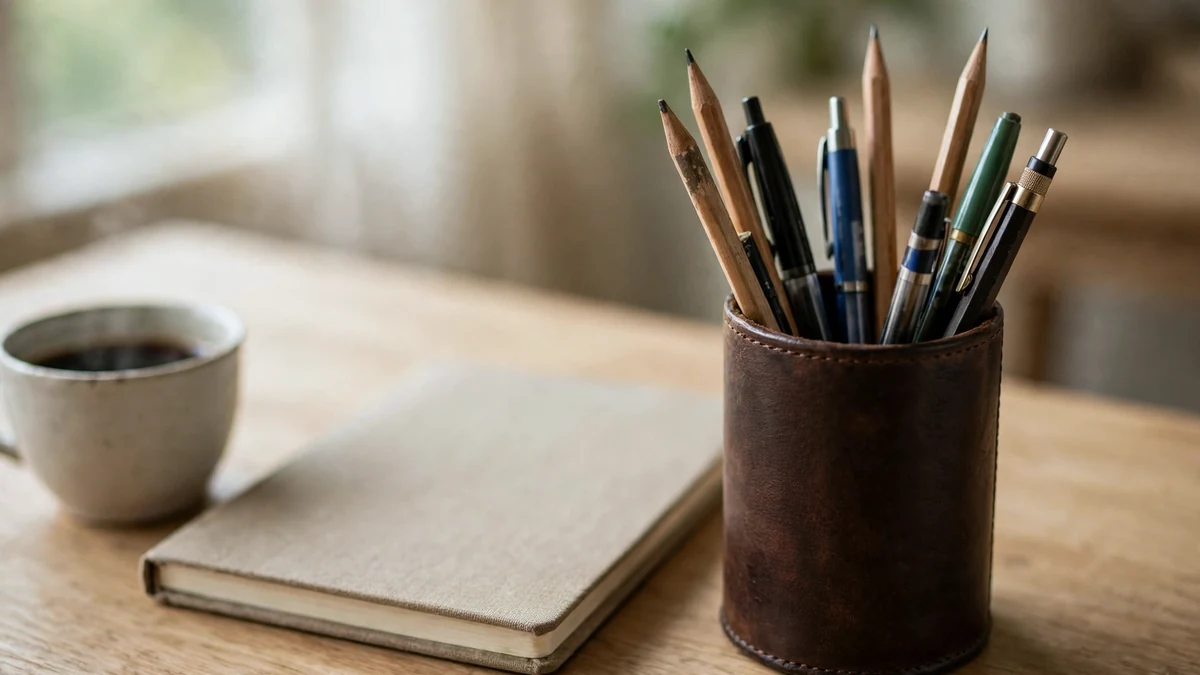
Leather Pen Cup, Best Overall. A single cylindrical cup in full-grain leather over a weighted core is the safest choice for most desks. It holds ten to twelve pens upright, it does not slide, and it looks at home in a home office or a study. The leather ages gracefully, darkening slightly where it is handled, and the stitched rim protects pen barrels from scratches. Choose a dark brown or black if the desk is busy, because it hides ink marks, and choose a natural tan if you want the holder to be a feature of the desk rather than a background piece.
Walnut Wood Pen Holder, Best for a Home Office. A solid walnut block with two or three drilled holes and a shallow tray is the quietest choice on this list. It is heavy, it does not move, and the wood grain makes every piece slightly different. The holes keep fountain pens upright and apart, which matters if you own pens with gold nibs, and the tray holds a pencil and a letter opener. Walnut darkens gently with age, and a yearly rub with a little wood oil keeps it looking new. It costs more than a plastic cup, but it will outlast several desks.
The Best Pen Holders of 2026
Rotating Mesh Carousel, Best for a Shared Desk. A round metal mesh carousel with four or five compartments spins on a smooth base, and it is the best choice when several people share one desk or when one person owns a lot of tools. The mesh lets you see what is inside each compartment, the compartments keep markers away from fountain pens, and the rotating base means nobody has to reach across the desk. It is light for its size, so keep it away from the desk edge, but on a flat surface it is stable enough for daily use.
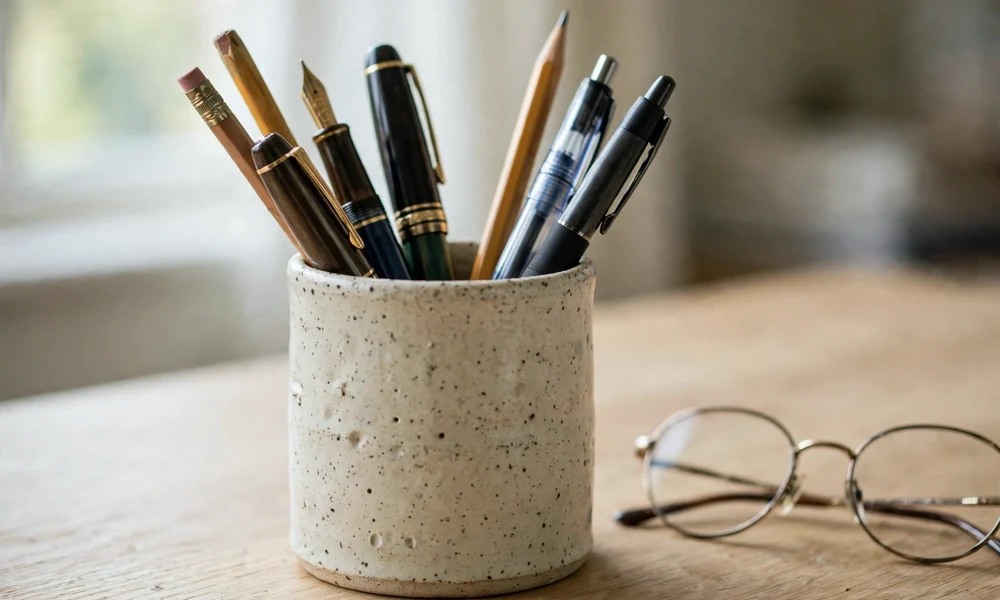
Ceramic Pen Pot, Best for Colour. A handmade ceramic pot in a speckled or glazed finish is the best choice if you want the holder to add colour to the desk. Ceramic is heavy and stable, it wipes clean with a damp cloth, and it holds heat well, which matters if the desk sits near a sunny window. Choose a pot with a slightly flared rim, because it makes pens easier to pull out, and avoid very tall, narrow pots, which tip more easily. A ceramic pot also makes a good gift, because it feels personal in a way a plastic cup never does.
Metal is the toughest choice. Stainless steel, powder-coated steel and brass all survive being knocked off a desk, and they wipe clean in seconds. Metal suits a busy office desk, a workshop or a shared family desk, where the holder will be used hard and cleaned rarely. A brushed or matte finish hides fingerprints better than a polished one, and a mesh design lets you see what is inside. The drawback is noise: metal holders clatter when a pen is dropped in, and they can scratch a wooden desk unless they have a felt or rubber base.
Ceramic is the most stable choice for its size, because it is heavy and has a low centre of gravity. A ceramic pot rarely tips, and it is the easiest material to clean, because ink wipes off glaze without staining. Ceramic comes in the widest range of colours and finishes, from speckled stoneware to glossy porcelain, so it is the best choice if the holder is meant to be a decorative object as well as a useful one. The drawback is fragility: a ceramic holder that falls off the desk will chip or break, so keep it away from the edge.
If you are choosing between materials, start with the desk rather than the holder. A wooden desk suits a wooden or leather holder, because the materials sit together comfortably. A white or glass desk suits metal or ceramic, because the contrast looks clean. A desk that is shared, moved often or used by children suits metal, because it survives the most punishment. And if the desk already has a strong style, the holder should support it rather than fight it. A small bookend can do the same job of anchoring a desk corner, and our guide to the best bookends of 2026 shows how a heavy pair of bookends can hold a row of books steady while the pen holder keeps the writing tools close.
Keep the holder away from the front edge of the desk, where an elbow or a sleeve can knock it off, and away from direct sunlight, which fades leather and heats metal. If the desk sits against a wall, the holder can sit against the wall as well, which gives it extra stability. If the desk floats in the middle of a room, a heavier holder is worth the extra cost, because there is no wall to catch it. A pen holder also pairs well with a desk calendar, because both sit in the same corner of the desk and both are reached for at the start of the day. Our guide to the best desk calendars of 2026 covers the paper calendars that sit beside a pen holder and get used every morning.
Avoid holders that are too small for what you own. A cup that holds eight pens is no use if you own twenty, because the extra twelve will still end up in a pile on the desk. Count your pens, pencils, markers and highlighters before you buy, and choose a holder with a little room to spare. Avoid the opposite mistake as well: a huge carousel with thirty slots is wasted on a desk that holds five pens, and it takes up space that could hold a notebook or a lamp.
How many pens should a pen holder hold? It depends on how you work, but most people use between eight and fifteen pens regularly, and a holder that holds twelve to fifteen comfortably is the sweet spot. A holder that is too big invites clutter, because every pen you own ends up in it, including the ones that no longer work. A holder that is too small forces the overflow onto the desk. Count the pens you actually reach for in a week, and choose a holder that fits those, with a little room for one or two more.
The best pen holder is the one that fits your pens, your desk and the way you work. Choose a holder that is heavy enough to stay put, deep enough to hold pens upright, and divided enough to keep different tools apart, and it will quietly make every workday a little smoother. Choose on looks alone, and you will be choosing again far sooner than you planned.

Materials Compared: Metal and Ceramic
Where to Put Your Pen Holder


