
Best Bookends 2026
A bookshelf without bookends is a slow landslide waiting to happen. One book leans, then the next, and by the end of the week the whole row is slumped against the side of the shelf like tired commuters. A good pair of bookends stops that drift before it starts, holding the row upright while adding a small piece of sculpture to the room.
The best bookends of 2026 do that quiet job well. They are heavy enough to hold real books, shaped to suit the shelf they sit on, and handsome enough that you would keep them even if you owned no books at all. These are the pairs worth buying, chosen for weight, grip, size, and staying power.
Key Takeaways
- Weight is the first test, because a bookend lighter than the books it holds will slide across the shelf instead of stopping them.
- Match the bookend to the shelf, since a tall pair on a low shelf looks crowded and a short pair cannot hold tall hardbacks upright.
- Metal and stone suit heavy books, while wood and resin suit lighter paperbacks and rooms where warmth matters more than force.
- Check the base before you buy, because a felted or rubberised base protects the shelf and stops the bookend creeping forward.
- Buy bookends as a pair, not as singles, since two matching ends frame a row of books and make even a half-empty shelf look deliberate.
Bookends 2026 at a Glance
| Best for | Bookend type | Material | Standout strength |
|---|---|---|---|
| Best overall | Classic L-shaped pair | Cast brass | Heavy, steady, and quietly elegant |
| Best for heavy books | Block pair | Natural stone | Serious weight that never budges |
| Best for reading nooks | Animal figures | Painted resin | Character without clutter |
| Best for modern rooms | Open frame pair | Powder-coated steel | Light look with a firm grip |
| Best for desks | Low L-shaped pair | Stained wood | Compact and kind to surfaces |
| Best as a gift | Decorative figures | Cast iron | Memorable and built to last |
What a Bookend Is Really For
A bookend does two jobs at once. First, it holds books upright, which matters more than it sounds: books stored leaning for months develop bent spines and warped covers, and a row that leans puts strain on every spine in it. Second, it marks the end of a collection, turning a loose pile of books into a shelf that looks finished.
Most people buy bookends the wrong way round. They fall for a shape, then discover the pair is too light for their hardbacks or too tall for their shelf. Think about the books first, and only then worry about how the bookends look. A pair that cannot hold your heaviest book is decoration, not furniture.
It helps to know the difference between a bookend and its close cousins. A bookshelf gives books their home, and our guide to the best bookshelves of 2026 covers the shelves themselves in detail, from small-room designs to full wall units. Bookends are the smaller, harder-working partner: they keep the books on those shelves standing straight, and they can move with you from shelf to shelf and room to room.
How Heavy Should a Bookend Be?
There is no single right weight, because it depends on what the bookend must hold. As a rough guide, each bookend should weigh at least as much as the two or three books leaning against it. A pair of paperbacks needs very little holding, while a row of large art books or old hardbacks needs real mass behind it.
Weight is not the whole story, though. The shape matters just as much. An L-shaped bookend uses the weight of the books themselves, because the first few books sit on its flat foot and press it down onto the shelf. A solid block relies on mass alone. Both work, but the L-shape is usually the better choice for a shelf that gets used every day, since it grows steadier as you add books.
Choosing by Material
Brass is the traditional choice, and it still earns its place. A solid brass bookend has a warm colour that suits leather-bound books and wooden shelves, and it ages gracefully, developing a soft patina rather than looking worn. It is heavy for its size, which is exactly what you want, and it suits both classic and modern rooms. The only real drawback is price: good brass costs more than painted metal, and very cheap brass-coloured bookends are often hollow.
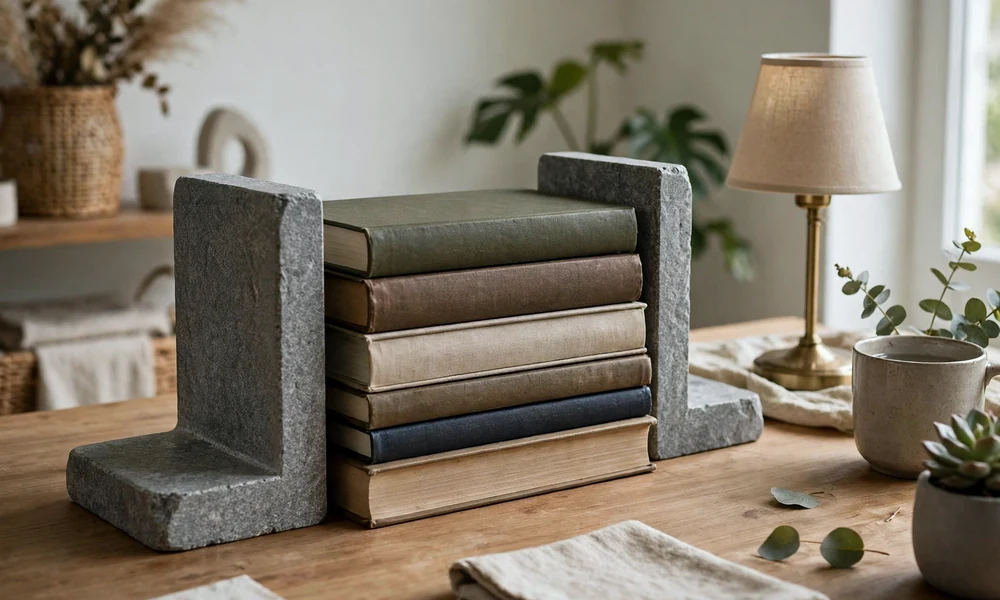
Stone and marble suit a different mood. A pair of marble or granite blocks looks calm and architectural, and their sheer weight makes them the best choice for the heaviest books on the shelf. They are also easy to live with, since they need no polishing and shrug off dust. The trade-off is that stone can scratch a delicate shelf, so look for a felted base, and it can chip if it is dropped on a hard floor.
Wood brings warmth that metal and stone cannot match. A pair of bookends in walnut, oak, or teak looks at home on a wooden shelf, and wooden bookends are often the kindest to the books themselves, with no sharp metal edge to mark a cover. Solid wood is the thing to look for: a hollow wooden box will be too light, while a solid block will hold a row of paperbacks without fuss.
Steel is the modern answer. A powder-coated steel bookend is slim, strong, and available in almost any colour, and the open-frame designs that have become popular in recent years take up almost no visual space at all. They are a good choice for a small room or a shelf that already feels busy. Cast iron sits at the other end of the scale: rough, heavy, and full of character, it suits industrial rooms and makes a generous gift.
Sizing Bookends to Your Shelf
Measure the shelf before you order. A bookend should be at least two-thirds as tall as the books it holds, otherwise the books can topple over it, and it should sit comfortably within the depth of the shelf, with a little room to spare at the front. A pair that overhangs the shelf edge looks wrong and is easy to knock off.
Think about the shelf depth as well as the height. A deep shelf gives you room for a bookend with a long foot, which is the most stable kind, while a narrow shelf suits a slim block or a frame design. If your shelf is only just deep enough for the books themselves, choose a bookend whose foot slides under the first book rather than one that needs space beside it.

Bookends for Every Room
In the living room, bookends are part of the furniture, so choose a pair that suits the room as much as the books. Brass lions, marble blocks, or a pair of sculpted figures all work here, and they can carry the shelf on their own even when the books are few. Keep the finish in step with the rest of the room: warm brass with wooden furniture, cool steel with pale walls, dark iron with leather chairs.
On a desk, bookends need to be compact and practical. A low pair in wood or steel will hold reference books and notebooks upright without eating into your working space, and a felted base will protect the desk surface. If your desk also holds a lamp and a pen pot, keep the bookends simple so the desk does not start to look like a shop display. Our guide to the best desk organizers of 2026 covers the rest of the desktop, from trays to pen holders, and a good pair of bookends sits naturally alongside them.
A reading nook is where bookends can have the most fun. A pair of foxes, owls, or dogs framing the books beside an armchair turns a corner of the room into a place of its own. The trick is to stop at one decorative pair: two characterful pairs on the same shelf start to compete, and the books get lost between them.
Styling a Shelf With Bookends
Start with the books, not the bookends. Group them by size or by colour, whichever you prefer, and leave a little space at one end for the bookend to do its work. A row of books all the same height looks tidy; a row that steps down from tall to short looks relaxed. Either can work, as long as the bookend at the end is tall enough to hold the tallest book beside it.
Use bookends to break up a long shelf. A shelf full of books from end to end can feel like a wall, while the same books in two or three groups, separated by a plant, a vase, or a framed photograph, feel like a display. The bookends mark the edges of each group and keep the whole arrangement from drifting.
Lighting helps too. A shelf near a window gets natural light for part of the day, which suits stone and wood, while a shelf in a darker corner benefits from a nearby lamp that catches the surface of brass or polished steel. If your reading corner needs light, our guide to the best desk lamps of 2026 will help you find a lamp that suits the space without crowding the books.

Care, Mistakes, and What to Avoid
Bookends need very little care, but a little goes a long way. Dust brass with a soft cloth and polish it only when the patina starts to look dull rather than warm. Wipe stone with a damp cloth and dry it straight away, and keep marble away from anything acidic. Oil wooden bookends once a year with a little furniture oil, and they will keep their colour for decades.
The most common mistake is buying bookends that are too light. It is an easy mistake to make online, where weight is hard to judge from a photograph, so always check the listed weight and the material before you order. If a pair looks substantial but weighs less than a paperback, it will not hold a row of hardbacks, however good it looks in the picture.
The second mistake is buying a pair that is too small. A bookend that reaches only halfway up the books beside it cannot stop them falling, and a pair that is too narrow for the shelf looks lost. Measure the tallest book the pair will hold and the depth of the shelf, and choose a pair that fits both numbers with room to spare.
Finally, do not overload a single pair. Bookends are designed to hold a row, not a library, and a pair asked to hold thirty heavy books will eventually give way, however well made it is. Split long runs into groups, use a second pair where you need one, and let the shelf do the heavy work while the bookends do the finishing.
The Short Version
The best bookends are the ones you stop noticing, because the books stay upright and the shelf looks finished without any fuss. Choose a pair heavy enough for your books, tall enough for your tallest hardback, and suited to the room it will live in, and it will serve you for years. Brass suits a classic room, stone suits heavy books, steel suits a modern shelf, and a decorative pair suits a reading nook or a gift. Get those four choices right, and the books will take care of themselves.


