
Top Portable Power Stations for Camping and Blackouts in 2026
Portable power stations have become the quiet backbone of modern camping trips and home blackout plans in 2026. A good one charges phones, runs a small fridge, keeps lights on and powers a laptop without the noise, fumes or fuel of a petrol generator. A bad one runs flat in an hour, shuts down under load or weighs so much that it never leaves the garage. The top portable power stations for camping and blackouts in 2026 are not the biggest boxes on the shelf. They are the ones whose capacity, output and weight match the job, whether that is a weekend under canvas or a night without mains power.
Key Takeaways
- Capacity is measured in watt-hours. A 300Wh station suits phones and lights, a 500 to 1,000Wh station suits a weekend of camping, and a 1,000 to 2,000Wh station suits a home blackout.
- Output in watts matters more than capacity. A large battery is useless if its inverter cannot run your fridge, kettle or laptop charger.
- Lithium iron phosphate batteries last far longer than older lithium-ion cells, handle heat better and are the best choice for most buyers in 2026.
- Campers should prioritise weight, solar charging and quiet fans. Home backup buyers should prioritise capacity, a pure sine wave inverter and enough outlets.
- Always add up the watts of everything you plan to run at once, then leave a margin of at least 20 percent.
What a Portable Power Station Actually Does
A portable power station is a rechargeable battery in a box, with an inverter that turns its stored direct current into the alternating current your household devices expect, plus USB ports for phones and laptops. It charges from a wall socket, a car socket or solar panels. Think of it as a very large power bank that can also run a lamp, a small fridge, a fan or a medical device such as a CPAP machine.
The first number is capacity, measured in watt-hours and usually shortened to Wh. A 300Wh station can charge a phone about twenty times, run a small LED lamp for a day or power a laptop for three or four charges. A 1,000Wh station can run a portable fridge for a day or more, keep a television going for an evening or carry a household through a short power cut with the essentials covered. A 2,000Wh station starts to feel like a small generator, minus the noise and the fuel. Bigger is not automatically better, because every extra watt-hour adds weight, size and cost.
The second number is output, measured in watts, and it is the one most buyers ignore. Output is the maximum power the station can deliver at once. A station rated at 300W cannot run a 1,000W kettle, however large its battery is. The third thing to check is the inverter. A pure sine wave inverter produces clean power that is safe for laptops, fridges and medical devices. In 2026 almost every station worth buying has one, and you should treat anything without one as a warning sign.

How Much Capacity Do You Really Need?
List what you will run, check the watts printed on each device, and estimate how many hours each one will run. A phone charger draws about 10W, a laptop charger 45 to 90W, an LED lamp 5 to 15W, a portable fridge 40 to 60W and a small fan 20 to 40W. Multiply watts by hours to get watt-hours, add the results, and add a margin. A station also loses about 10 to 15 percent of its energy in the inverter.
| Use case | Typical load | Capacity to buy | Weight to expect |
|---|---|---|---|
| Day trip and phones | Phones, lights, camera | 200 to 300Wh | 3 to 5kg |
| Weekend camping, two people | Phones, lights, small fridge | 500 to 1,000Wh | 7 to 12kg |
| Family camping, four people | Fridge, lights, laptops, fan | 1,000 to 1,500Wh | 12 to 18kg |
| Short home blackout | Fridge, lights, phones, router | 1,000 to 1,500Wh | 12 to 18kg |
| Long home blackout | Fridge, freezer, lights, laptop | 2,000Wh or more | 18 to 25kg |
The contrast between camping and blackout use is the heart of this guide. A camper carries the station, so every kilogram matters and solar charging matters more than raw capacity. A home user does not carry it far, so capacity and outlets matter more than weight. Match the station to the job, and the rest of the decision gets much easier.
The Best Portable Power Stations for Camping in 2026
Camping rewards stations that are light, tough and easy to recharge in the field. The best camping station in 2026 is usually a 500 to 1,000Wh model with lithium iron phosphate cells, a comfortable carry handle and a solar input that accepts a standard panel. It should recharge from empty in under two hours from a wall socket.
Best for a weekend for two: the 500Wh compact
A compact 500Wh station is the sweet spot for two people camping for a weekend. It weighs about 7kg, fits under a car seat or in a tent porch, and runs phones, lights and a small fridge with power to spare. Look for at least two USB-C ports, one rated at 60W or more so it can charge a laptop, and two AC outlets. The fan should be quiet enough to sleep beside.
Best for a family trip: the 1,000Wh all-rounder
Four people, a portable fridge, lights, a fan and a couple of laptops need about 1,000Wh. A station of this size weighs 12 to 15kg, which is heavy to carry far but fine to lift from a car boot to a pitch. It should have a continuous output of at least 1,000W, so it can run a fridge and a laptop at the same time without tripping, and a surge rating high enough to start the fridge compressor. Four AC outlets, three USB ports and a 12V car socket cover a family, and a 200W solar panel keeps it going in good weather.
The Best Portable Power Stations for Blackouts in 2026
A blackout changes the priorities completely. Weight stops mattering, because the station sits in a hallway or kitchen, and capacity, output and the number of outlets take over. The best home backup station in 2026 is a 1,000 to 2,000Wh model with a continuous output of at least 1,500W, so it can run a fridge, a freezer, lights, a router and a laptop at the same time. It should have a pure sine wave inverter and a display that shows input and output watts in real time.
Start with the fridge, because it is the most expensive thing a blackout can spoil. A modern fridge-freezer draws 100 to 200W while its compressor runs, but it needs two to three times that for a second when the compressor starts. A station with a 1,500W continuous output and a 3,000W surge rating handles that easily. A 1,000Wh station keeps a fridge running for roughly eight to twelve hours, and a 2,000Wh station doubles that.
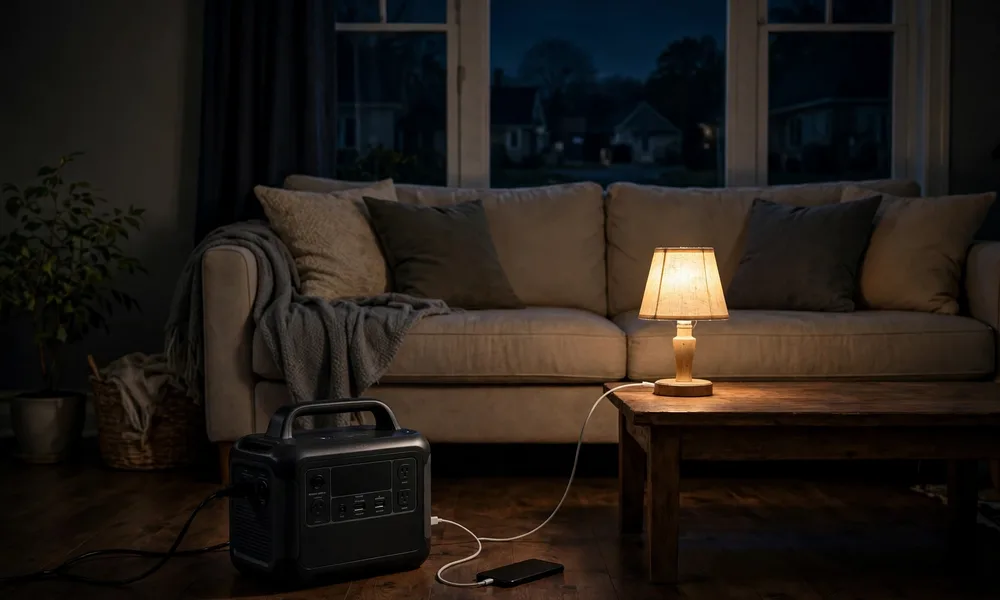
Lights, phones and the router are cheap in power terms: a router draws 5 to 15W, an LED lamp 5 to 15W and a phone charger 10W. What a station cannot do is run a kettle, a hair dryer, an electric heater or an air conditioner. Those draw 1,000 to 2,000W each and will drain even a large station in under an hour. Boil water on gas instead, and keep the station for the things that genuinely need electricity.
Battery Chemistry: Why Lithium Iron Phosphate Wins in 2026
Older stations used lithium-ion cells, which typically last 500 to 800 full charge cycles. Newer stations use lithium iron phosphate, or LFP, which typically lasts 3,000 to 4,000 cycles, handles heat better and is far less likely to overheat if damaged. LFP cells are slightly heavier for the same capacity, but the trade is worth it for almost every buyer in 2026.
Solar Charging: How to Keep Going Off Grid
Solar charging turns a portable power station from a big battery into a small power system. A 100W panel in good sun adds roughly 400Wh over a five-hour day, enough to run a small fridge for a night, and a 200W panel doubles that. In winter or under cloud, expect a third of those figures. Buy a panel that matches the station’s solar input voltage range. For a closer look, our guide to the best and worst solar generators compares the options side by side.

Mistakes That Ruin a Good Power Station
The most common mistake is buying on capacity alone: a 2,000Wh station with a 300W inverter cannot run a fridge. The second is forgetting surge power, as fridges need two to three times their running watts for a second when they start. The third is leaving a station flat in storage, which can damage a lithium battery permanently, so store it half charged. The fourth is ignoring weight and outlets: a 25kg station is not portable, and two AC outlets are not enough for a family. If your car battery is the weak point, our comparison of the best and worst jump starters covers the other half of the problem.
Before You Buy: The Six-Point Checklist
- Add up the watts of everything you will run at once, then add a 20 percent margin, and buy an output that covers the total.
- Choose lithium iron phosphate cells for a longer life, better heat tolerance and safer storage at home.
- Check the weight by lifting the station, and check that it fits in your car boot or tent porch.
- Count the outlets: at least two AC sockets, two USB-C ports and one 12V car socket for most households.
- Confirm the solar input voltage and wattage, and buy a panel that matches it if you plan to camp off grid.
- Test the station at home before you rely on it, by running your fridge and lights from it for an hour.
Frequently Asked Questions
How long will a 1,000Wh power station run a fridge?
About eight to twelve hours for a modern fridge-freezer. A small portable camping fridge uses less power and can run for a day or more from the same station.
Can a portable power station run a kettle or a heater?
Only a very large station can, and only briefly. A 1,000W kettle drains a 1,000Wh station in under an hour. Use gas for heating water and keep the station for lights, phones and the fridge.
Is solar charging worth it?
Yes, if you camp for more than two days or want backup during a long outage. A 200W panel can add about 800Wh on a sunny day, enough to keep a small fridge running in summer. For a single overnight trip, a wall charge before you leave is enough.
How long do portable power stations last?
A lithium iron phosphate station typically lasts 3,000 to 4,000 full charge cycles, or ten years of weekend use. A lithium-ion station typically lasts 500 to 800 cycles.
Can I take a portable power station on a plane?
Usually not. Airlines limit lithium batteries to 100Wh, with approval up to 160Wh, and most power stations are far larger. Travel with a station by car, train or boat instead.
Do I need a pure sine wave inverter?
Yes, for almost every buyer. A pure sine wave inverter produces clean power safe for laptops, fridges and medical devices. A modified sine wave inverter can damage some electronics, and the saving is rarely worth the risk.
The Bottom Line
The top portable power stations for camping and blackouts in 2026 are the ones that match the job. Campers should buy a light 500 to 1,000Wh lithium iron phosphate station with solar charging and a quiet fan. Home users should buy a 1,000 to 2,000Wh station with a strong inverter and plenty of outlets. Add up your watts, leave a margin, and test the station before you need it.


